|
Getting your Trinity Audio player ready...
|

A Tribute to the Spirit of Bharat Mata
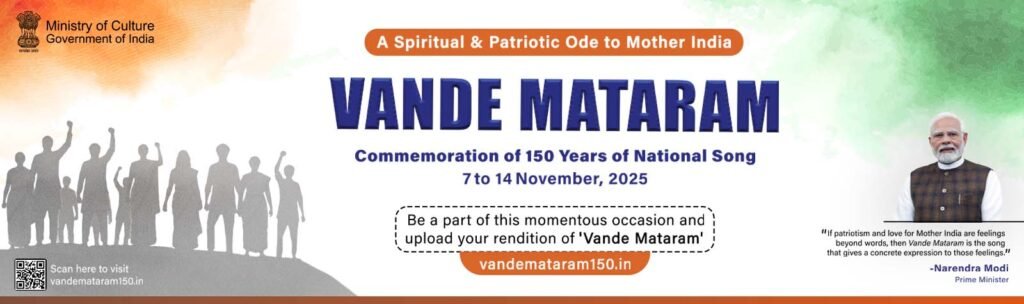
In 2025, India celebrates 150 years of Vande Mataram — one of the most powerful symbols of the country’s freedom movement and a timeless ode to the motherland. Written in 1875 by the great patriot, poet, and philosopher Bankim Chandra Chattopadhyay, Vande Mataram is not merely a song — it is the heartbeat of India’s national identity.
The Birth of a Song, The Birth of a Revolution
The year was 1875. India was still under British colonial rule. Amid the growing discontent and suppressed voices, Bankim Chandra Chattopadhyay penned Vande Mataram in his novel “Anandamath”. The song was a call to awaken — a prayer that equated the land of India to a divine mother, urging her children to rise and protect her honor.
The words “Vande Mataram” — “I bow to thee, Mother” — stirred the souls of countless Indians. It was the first time the nation was imagined as a spiritual mother — one worthy of devotion, protection, and sacrifice.

Vande Mataram – Original Sanskrit/Bengali Written
वन्दे मातरम्
सुजलां सुफलां मलयजशीतलाम्
शस्यश्यामलां मातरम्॥
वन्दे मातरम्॥
शुभ्रज्योत्स्ना पुलकित यामिनीम्
फुल्लकुसुमित द्रुमदलशोभिनीम्
सुहासिनीं सुमधुर भाषिणीम्
सुखदां वरदां मातरम्॥
वन्दे मातरम्॥
सप्तकोटि कण्ठ कलकल निनाद कराले
द्विसप्तकोटि भुजैर्धृतखरकरवाले,
अबला केनो मा एतो बले
बहुबलधारिणीं नमामि तारिणीम्
रिपुदलवारिणीं मातरम्॥
वन्दे मातरम्॥
तुमि विद्या तुमि धर्म
तुमि हृदि तुमि मर्म
त्वं हि प्राणा शरीरे,
बाहुते तुमि मा शक्ति,
हृदये तुमि मा भक्तिः,
तोमारे प्रतिमा गतिः
त्वं हि दुर्गा दशप्रहरणधारिणी,
कमला कमलदलविहारिणी,
वाणी विद्यादायिनी,
नामामि त्वां नमामि कमलाम्
अमलाम् अतुलाम्
सुजलां सुफलां मातरम्॥
वन्दे मातरम्॥
श्यामलां सरलां सुस्मितां भूषिताम्
धरणीम् भरणीम् मातरम्॥
वन्दे मातरम्॥
The Anthem of India’s Freedom Struggle
By the early 20th century, Vande Mataram had become the anthem of India’s independence movement. It was sung at the sessions of the Indian National Congress since 1896, first rendered by the legendary Rabindranath Tagore.
Freedom fighters like Lala Lajpat Rai, Bipin Chandra Pal, Bal Gangadhar Tilak, Subhas Chandra Bose, and countless others drew strength from its words. When British authorities tried to ban its public singing, the act itself became a form of protest — a bold declaration of defiance.
From street rallies to prison cells, the chant of Vande Mataram echoed across the subcontinent, uniting people across languages, faiths, and regions under one cry for freedom.
The Music, The Magic, The Meaning
Composed in a mix of Sanskrit and Bengali, the song’s verses are filled with vivid imagery — lush fields, flowing rivers, gentle breezes, and shining harvests — all symbolic of India’s natural beauty and divine grace.
When sung, its melody evokes deep emotion — reverence, pride, and courage. It reminds every Indian that our land is not just geography; it is sacred, alive, and eternal.
“Sujalam suphalam malayaja sheetalam,
Shasyashyamalam, Mataram!”
— O Mother, you are rich with streams, fruitful and cool with the southern breeze, verdant with fields of grain!
1947 and Beyond: From Anthem to Immortality
After independence, Vande Mataram was honored as the National Song of India (distinct from the National Anthem Jana Gana Mana). Its first two stanzas were officially recognized by the government, balancing the nation’s plural spirit while preserving its historical legacy.
Even today, Vande Mataram remains a symbol of unity and devotion. It is sung at national events, schools, and cultural programs, reminding every generation of the sacrifices that built the nation.
150 Years Later: Why Vande Mataram Still Matters
In an era of rapid change, Vande Mataram continues to remind us of something timeless — love for the motherland beyond politics, religion, or region. It calls upon us not only to bow before our nation but to serve and uplift her through action, integrity, and compassion.
As we celebrate 150 years of Vande Mataram in 2025, let us remember that the song is not confined to the pages of history — it lives in the heart of every Indian who dares to dream of a stronger, more united, and more self-reliant Bharat.
Conclusion
Vande Mataram is not just a song — it is India’s eternal salutation to her own spirit.
It transcends centuries, reminding us that true patriotism is not loud, but deeply felt.
And as we bow once again to our beloved motherland, we whisper the words that have carried our nation for 150 years —
Vande Mataram. Jai Hind!