|
Getting your Trinity Audio player ready...
|
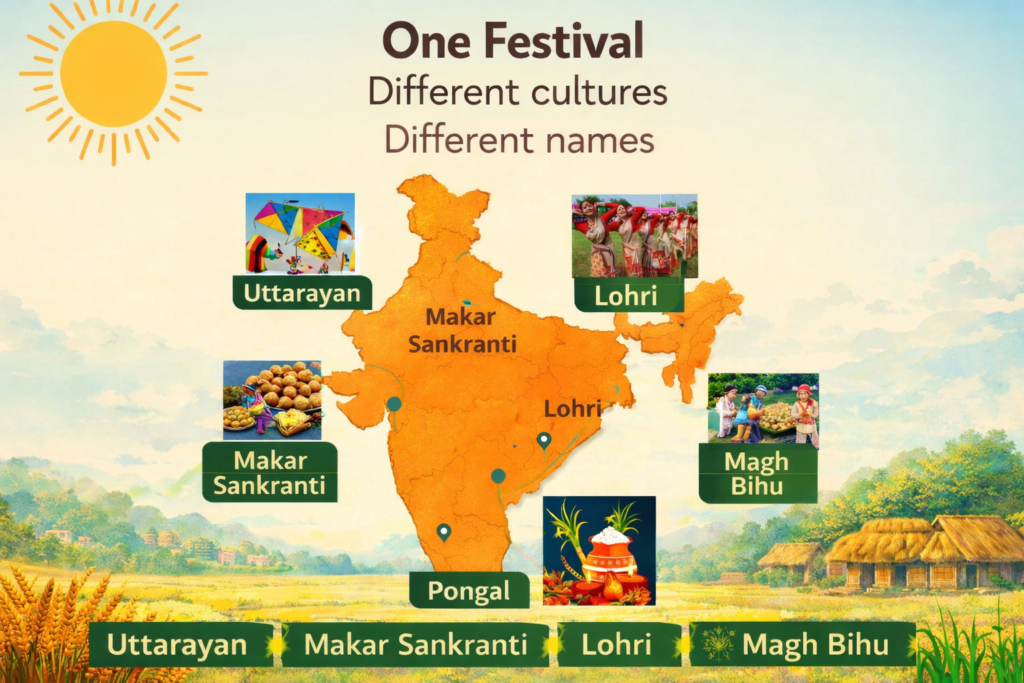
India celebrates unity in diversity like no other nation, and 14 January proves this beautifully. On this single day, people across the country come together to celebrate in different ways. However, they all share the same emotion—gratitude, hope, and joy.
- In North India, people celebrate Makar Sankranti.
- In Tamil Nadu, families welcome Pongal.
- In Punjab, communities gather for Lohri.
Meanwhile, Gujarat fills the skies with kites during Uttarayan, and
Assam observes Magh Bihu.
Although these festivals look different on the surface, they all carry the same message: celebrate harvest, honor nature, and welcome a new beginning.
In fact, if you have already read our detailed blogs on Why We Celebrate Makar Sankranti, Why We Celebrate Pongal, and Why We Celebrate Lohri, you will notice a powerful connection among them. This blog ties them all together.
Why 14 January Holds Such Importance
Most Indian festivals follow the lunar calendar. However, these festivals follow the solar calendar. On 14 January, the Sun begins its northward journey, known as Uttarayan.
As a result, days become longer, temperatures slowly rise, and life feels lighter. For ancient farming communities, this shift meant survival, hope, and renewal.
Therefore, people began celebrating this day as a symbol of transformation—from cold to warmth, from darkness to light, and from struggle to abundance.
Makar Sankranti: A Festival of Spiritual Transition
In North and Central India, people celebrate Makar Sankranti as a festival of positivity.
They believe that the Sun’s movement into Capricorn brings auspiciousness. Therefore, people take holy dips, donate food, and prepare sweets made from sesame and jaggery.
Moreover, this festival teaches emotional sweetness. People greet each other with warmth and forget past bitterness.
If you want to understand its deeper meaning, spiritual significance, and traditions, you can explore our full blog on Why We Celebrate Makar Sankranti.
Pongal: A Festival of Gratitude and Abundance
Meanwhile, in Tamil Nadu, Pongal celebrates nature, farmers, and animals.
People thank the Sun, the Earth, and cattle for helping crops grow. They cook freshly harvested rice with milk and jaggery. When the pot overflows, everyone cheers—because it symbolizes prosperity.
In contrast to fast-paced modern life, Pongal encourages people to slow down, reflect, and appreciate what they already have.
To explore its rituals and lessons in detail, you can read our blog on Why We Celebrate Pongal.
Lohri: A Festival of Fire, Warmth, and Community
At the same time, Punjab celebrates Lohri with bonfires, music, and dance.
People gather around fire, sing folk songs, and throw traditional foods into the flames as a gesture of gratitude. The fire represents the Sun’s warmth and life-giving power.
Furthermore, Lohri celebrates courage, kindness, and new beginnings. Families celebrate newborns and newlyweds with extra joy.
If you want to dive deeper into Lohri’s meaning and traditions, you can read our blog on Why We Celebrate Lohri.
Uttarayan: A Festival of Freedom and Dreams
In Gujarat, the sky becomes a canvas of color on 14 January.
People fly kites from rooftops, competing playfully while celebrating the joy of movement and freedom.
Symbolically, kites represent ambition. Just as a kite rises higher, people believe their dreams should rise too.
This festival teaches that joy does not always come from material wealth—it often comes from simple pleasures.
Magh Bihu: A Festival of Feasting and Rest
Meanwhile, Assam celebrates Magh Bihu, a festival that marks the end of the harvesting season.
After months of hard work, farmers finally rest, feast, and rejoice. Communities build temporary huts, cook together, and share meals.
Unlike festivals that focus on rituals, Magh Bihu focuses on satisfaction.
It teaches that rest is not laziness—it is necessary.
Different Names, Same Message
Although these festivals look different, they all celebrate:
Gratitude
Harvest
Change
Nature
Togetherness
In other words, India does not celebrate one festival on 14 January. It celebrates one emotion in many forms.
Why Harvest Festivals Matter So Much
In ancient times, people depended entirely on agriculture. A good harvest meant survival. A bad one meant disaster.
Therefore, people created festivals to:
Thank nature
Pray for future abundance
Strengthen community bonds
Share food
Celebrate survival
Even today, these values remain relevant.
Food: The Common Thread
Every festival on this day revolves around food.
Pongal dishes
Til sweets
Rewari and gajak
Rice-based meals
Traditional snacks
Food symbolizes warmth, nourishment, and generosity.
More importantly, people share food—not just eat it.
Thus, food becomes a language of love.
Spiritual Wisdom Behind These Festivals
Beyond celebration, these festivals teach life lessons.
They encourage people to:
Let go of negativity
Embrace change
Respect nature
Practice humility
Share joy
In today’s stressful world, these lessons feel more necessary than ever.
A Day That Unites India
On this day, India does not divide.
Different languages, clothes, foods, and customs come together like colors of one rainbow.
This is not coincidence—it is culture.
These festivals teach unity without uniformity.
Why These Festivals Still Matter Today
Today, many people live in cities. They forget how food grows. They forget seasons.
However, these festivals reconnect them with nature.
They remind people that food is not just a product—it is a process.
They teach sustainability without preaching.
Lessons for the Modern World
From these festivals, we learn:
Gratitude creates peace
Community creates strength
Nature deserves respect
Sharing multiplies happiness
Simplicity brings fulfillment
These lessons never expire.
Conclusion
14 January is not just a date.
It is a reminder.
A reminder that happiness does not come from having more—but from appreciating what we already have.
Different festivals.
- One joy.
- One message.
- One heart.
India does not just celebrate harvest on this day.
It celebrates life itself.