|
Getting your Trinity Audio player ready...
|
Mary Kom is not just a name in Indian sports; she is an emotion. Rising from humble beginnings in Manipur to becoming a six-time world boxing champion and an Olympic medalist, her journey has inspired millions. For years, she was seen as a symbol of discipline, resilience, and sacrifice.
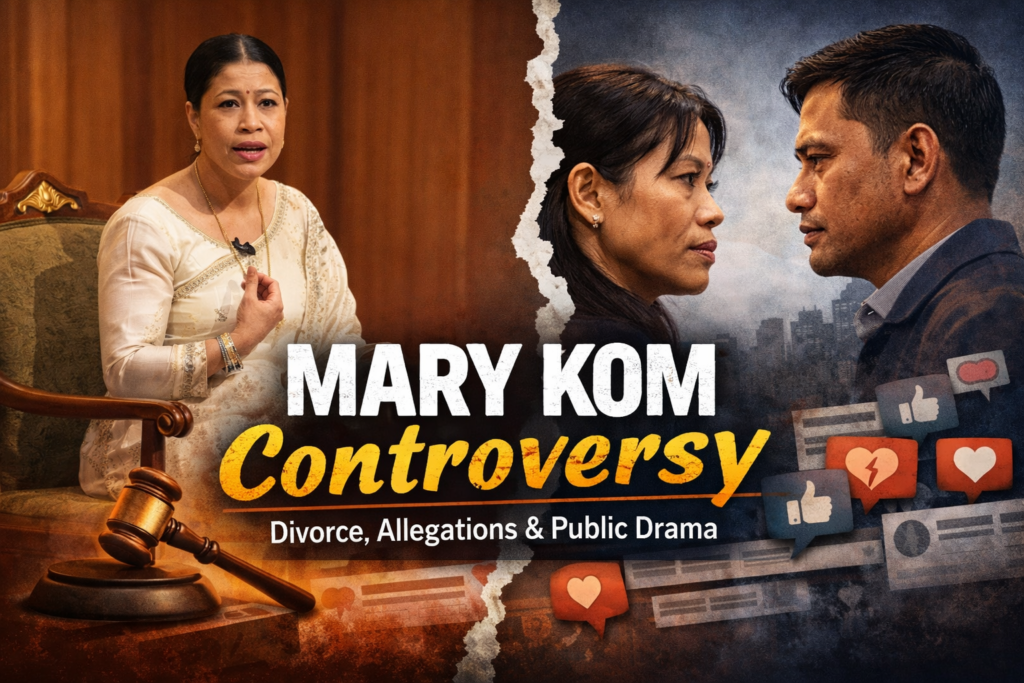
But in recent times, Mary Kom has been in the headlines not for her sporting achievements — but for her divorce controversy and the public exchange of allegations between her and her former husband, Onler. What was once a private matter has now turned into a topic of national debate.
This sudden shift from sporting glory to personal scrutiny has raised uncomfortable questions about privacy, truth, public judgment, and how society treats its heroes when they show vulnerability.
A Marriage That Once Looked Strong
Mary Kom married Onler in 2005. Their relationship was often portrayed as supportive and stable. They built a family together and raised four children. For years, Onler stayed away from the spotlight while Mary Kom focused on her boxing career.
However, like many long-term relationships, things reportedly began to fall apart behind closed doors. The couple separated and later finalized their divorce under customary law in 2023. Initially, both sides stayed silent, and the matter remained private.
That silence didn’t last long.
When Mary Kom Spoke Publicly
The controversy erupted when Mary Kom decided to speak openly about her separation. She made serious claims about financial betrayal, emotional distress, and the loss of assets she had earned through years of hard work.
According to her version of events:
- She was financially exploited.
- Important properties and money were mishandled.
- She suffered mentally due to rumors and character attacks.
For many fans, this was shocking. Mary Kom had always been seen as mentally strong and unbreakable. Hearing her speak about emotional pain made people realize that champions, too, are human.
The Counterclaims
Soon after Mary Kom’s statements, her ex-husband publicly denied her allegations. He claimed that the financial accusations were false and challenged her to prove them. He also made counter-allegations, suggesting personal and moral issues on her side.
This back-and-forth turned into a media spectacle.
Instead of legal proceedings settling things quietly, social media became the courtroom.
- Every statement was dissected.
- Every expression was judged.
- Every word was twisted.
And that’s when things became messy.
The Social Media Trial
In today’s digital world, public opinion spreads faster than facts.
Short video clips, edited quotes, emotional reels, and trending hashtags turned this personal dispute into viral content. People began picking sides without knowing the full truth.
Some supported Mary Kom blindly because of her legendary status.
Some attacked her harshly, claiming that heroes should be morally perfect.
Others questioned why such private matters were being discussed publicly.
The debate wasn’t about facts anymore.
It became about beliefs, loyalty, and perception.
Impact on Her Legacy
No matter what the final truth is, one thing is certain — this controversy has affected how people see Mary Kom.
Her medals, titles, and achievements haven’t vanished. But public memory is fragile. Scandals often overshadow success, especially in the age of instant outrage.
This raises an important question:
Should a person’s personal struggles define their professional legacy?
Mary Kom fought her way into history with blood, sweat, and sacrifice. But now, her personal life is being judged with more intensity than her sporting records.
My Opinion on This Controversy
I’ll be direct.
This situation is tragic — not scandalous.
Two people who shared decades together are now airing deeply personal wounds in public. And instead of empathy, the internet is serving judgment.
Here’s what I believe:
- We do not know the full truth.
Both sides are telling their stories. Without legal proof, everything remains allegations. - Public trials are dangerous.
Once something is online, it never disappears. This will follow both of them forever — especially their children. - Being a hero doesn’t make someone emotionally invincible.
Mary Kom is a champion, but she is also human. Pain doesn’t discriminate. - Character assassination helps no one.
Social media is too quick to cancel, shame, and mock.
This controversy should remind us that fame magnifies pain. Private suffering becomes public entertainment — and that’s deeply disturbing.
What I Think About This Controversy
In my view, this entire situation is deeply unfortunate. Mary Kom has spent her life representing India on the global stage, bringing pride to the nation. But today, instead of celebrating her achievements, we are debating her personal life.
I believe personal relationships should remain personal. No one outside a marriage truly knows what happens inside it. Judging either side without full facts is unfair.
This controversy also shows how quickly people forget achievements and focus on drama. The same society that once applauded Mary Kom is now questioning her character.
Whether she is right or wrong is not for social media to decide.
Some things deserve dignity. Some things deserve silence.
Bigger Than Just One Person
This isn’t just about Mary Kom.
It reflects how society treats public figures:
- We love them when they win.
- We destroy them when they fall.
- We consume their pain as content.
That’s not justice. That’s cruelty disguised as curiosity.
Final Thoughts
Mary Kom’s boxing career is legendary. That will never change.
But this controversy is a reminder that even the strongest people can break. And when they do, they deserve compassion — not a digital court.
Instead of asking,
“Who is right?”
We should ask,
“Why are we enjoying someone’s pain?”