|
Getting your Trinity Audio player ready...
|
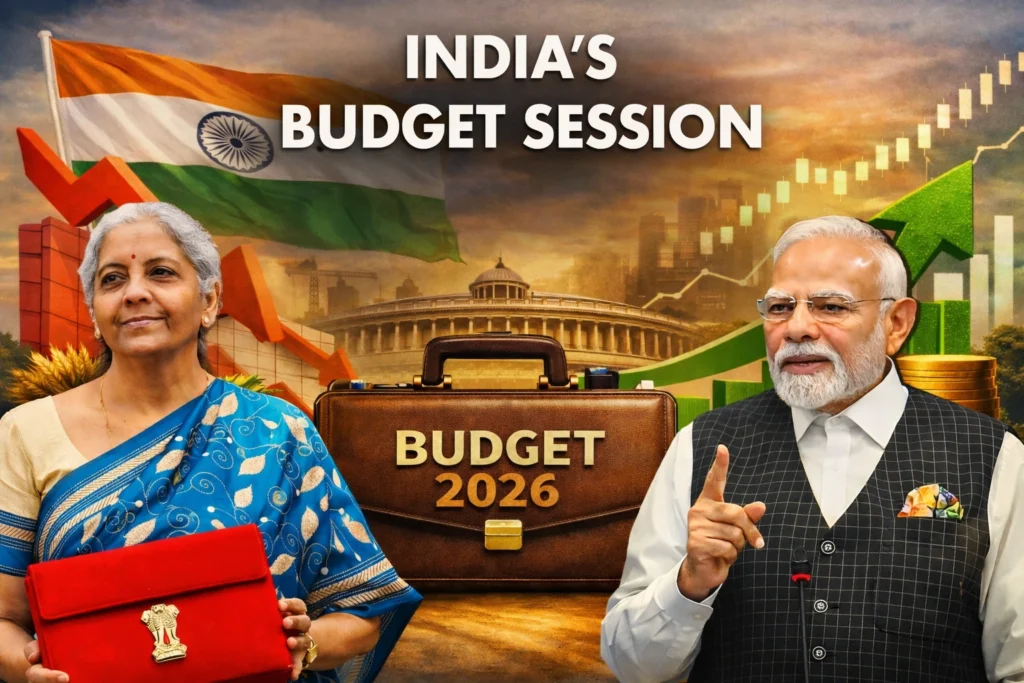
The Budget Session of Parliament 2026 witnessed a defining second day as economic planning intersected with political developments and national sentiment. With the Union Budget 2026–27 just days away, Day 2 set the tone for fiscal debates, policy direction, and parliamentary dynamics.
Proceedings unfolded against the backdrop of three major developments:
- The tabling of the Economic Survey 2025–26 by Finance Minister Nirmala Sitharaman
- Prime Minister Narendra Modi’s address to the media, outlining expectations from the session
- A somber atmosphere following the death of Maharashtra Deputy Chief Minister Ajit Pawar, which deeply impacted Parliament
Economic Survey 2025–26 Tabled in Lok Sabha
One of the most anticipated moments of the day was the presentation of the Economic Survey 2025–26 in the Lok Sabha. As per parliamentary tradition, the survey was tabled ahead of the Union Budget to provide a comprehensive assessment of India’s economic performance over the past year.
Prepared under the guidance of the Chief Economic Adviser, the Economic Survey serves as a diagnostic document, analysing:
- Overall economic growth and macroeconomic stability
- Inflation trends and fiscal management
- Employment outlook and consumption patterns
- External trade and investment climate
- Structural reforms and long-term growth challenges
While the survey does not announce policy decisions, it strongly influences budget priorities, reform signals, and investor expectations. Policymakers, economists, industry leaders, and financial markets closely study its findings to anticipate budgetary direction.
The tabling took place after Question Hour, marking the official start of detailed economic discussions that will intensify in the coming days.
PM Modi’s Message: Growth, Discipline and Meaningful Debate
Before parliamentary proceedings gained momentum, Prime Minister Narendra Modi addressed the media outside Parliament. His remarks emphasised the importance of constructive debate and national interest during the Budget Session.
The Prime Minister called upon all Members of Parliament to contribute meaningfully to discussions focused on:
- Empowering citizens
- Accelerating India’s development journey
- Strengthening India’s global economic position
He highlighted India’s growing role in international trade and cooperation, signalling confidence in the country’s economic fundamentals and future potential. His message reinforced the government’s intent to balance growth, governance, and global engagement through upcoming budget decisions.
Parliament Mourns the Death of Ajit Pawar
Day 2 of the session also carried a heavy emotional weight following the tragic death of Ajit Pawar, Maharashtra’s Deputy Chief Minister, in a plane crash. The news cast a shadow over proceedings and led to moments of silence and tribute in Parliament.
Lok Sabha Speaker Om Birla formally informed the House, acknowledging Pawar’s contribution to public life and governance. Leaders across party lines expressed condolences, reflecting the bipartisan respect he commanded.
As a senior political figure with deep roots in Maharashtra’s administration and fiscal management, Ajit Pawar’s sudden demise was seen as a significant loss to Indian politics. Parliamentary proceedings were briefly adjourned as a mark of respect.
Political Undercurrents Ahead of the Union Budget
Beyond formal proceedings, political signals suggest intense debates ahead as the Budget Session progresses. Opposition parties have indicated that issues such as:
- Rural employment schemes
- Welfare spending
- Fiscal transparency
- Allocation priorities
will be raised forcefully during discussions on the Union Budget.
With the general elections on the horizon, this Budget Session is being closely watched not just for numbers, but for policy intent, political messaging, and economic credibility.
What Day 2 Signals for the Days Ahead
The second day of the Budget Session 2026 made one thing clear:
This is not just a routine parliamentary sitting — it is a high-stakes policy moment.
- The Economic Survey has laid the analytical groundwork
- The Prime Minister’s address set expectations for discipline and development
- The political climate, shaped by loss and opposition strategy, adds emotional and strategic depth to debates
All attention now shifts to February 1, when Finance Minister Nirmala Sitharaman will present the Union Budget 2026–27 — a budget expected to balance economic growth, fiscal responsibility, and public expectations.