|
Getting your Trinity Audio player ready...
|
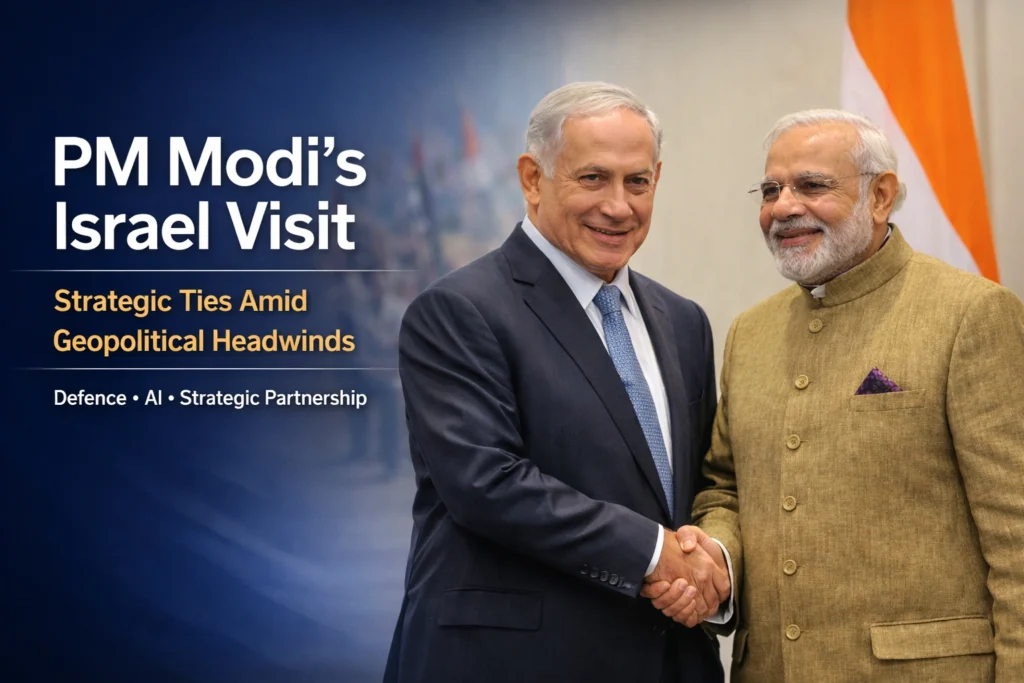
India’s diplomatic outreach in West Asia has entered a decisive phase as Prime Minister Narendra Modi embarks on a two-day visit to Israel. The trip comes at a time when the region faces heightened geopolitical tensions, shifting alliances, and rising security concerns. Therefore, this visit is not merely ceremonial. It represents a calculated move to strengthen India–Israel strategic ties while balancing complex regional sensitivities.
- A Visit Framed by Strategic Timing
- Strengthening India–Israel Strategic Partnership
- Focus on Technology, AI, and Innovation
- Navigating Geopolitical Headwinds in West Asia
- Defence and Security Dialogues Take Center Stage
- Economic and Trade Opportunities Expand
- Diplomatic Signaling and Global Implications
- Domestic Political and Strategic Impact
- The Road Ahead: Opportunities and Challenges
A Visit Framed by Strategic Timing
The timing of PM Modi’s Israel visit is significant. West Asia currently stands at a crossroads, with ongoing conflicts, fragile ceasefires, and evolving power dynamics shaping the regional order. Against this backdrop, India aims to reinforce its diplomatic presence without disturbing its balanced relations with Arab nations.
Moreover, India’s growing global stature compels it to engage with key partners like Israel on defence cooperation, technology collaboration, and intelligence sharing. As a result, this visit sends a clear message: New Delhi seeks deeper strategic engagement while maintaining diplomatic neutrality in volatile geopolitical environments.
Strengthening India–Israel Strategic Partnership
India and Israel share a robust strategic partnership built on defence, agriculture, cybersecurity, and innovation. Over the years, bilateral relations have transformed from quiet cooperation to an openly celebrated alliance. Consequently, PM Modi’s visit underscores the maturity and confidence in this partnership.
Defence cooperation remains the cornerstone of India–Israel relations. Israel has consistently been one of India’s top defence suppliers, providing advanced surveillance systems, drones, missile technology, and border security solutions. Therefore, discussions during the visit are expected to focus on expanding defence collaboration, joint production, and technology transfer initiatives aligned with India’s self-reliance push.
Additionally, intelligence cooperation between the two nations plays a crucial role in counterterrorism efforts. Given the evolving global security threats, closer intelligence coordination enhances both countries’ capacity to respond swiftly and effectively.
Focus on Technology, AI, and Innovation
Beyond defence, the visit highlights growing cooperation in emerging technologies. Israel is widely known as a global innovation hub, particularly in artificial intelligence, cybersecurity, agritech, and water management. India, on the other hand, offers scale, talent, and market potential.
Consequently, the synergy between India’s digital expansion and Israel’s deep-tech expertise opens new opportunities. Talks are expected to emphasize AI-driven governance, smart agriculture solutions, and collaborative startup ecosystems. Such initiatives can significantly boost India’s digital economy while creating high-value partnerships in cutting-edge sectors.
Furthermore, cooperation in water conservation and desert farming technologies holds immense relevance for India’s climate-resilient agriculture strategy. Israel’s expertise in drip irrigation and precision farming continues to influence India’s agricultural modernization efforts.
Navigating Geopolitical Headwinds in West Asia
While the visit focuses on strategic cooperation, it unfolds amid sensitive geopolitical conditions. West Asia remains deeply polarized, with ongoing conflicts and fragile diplomatic alignments shaping foreign policy decisions. Therefore, India must walk a diplomatic tightrope.
India maintains strong ties with Israel while simultaneously nurturing longstanding partnerships with Gulf countries and Iran. This balanced approach defines India’s West Asia policy. However, any high-profile engagement with Israel during tense regional conditions inevitably draws global attention.
Hence, PM Modi’s visit reflects India’s evolving diplomatic doctrine—engage deeply with strategic partners while preserving multi-vector relationships across the region. This pragmatic approach allows India to safeguard energy security, diaspora interests, and geopolitical leverage simultaneously.
Defence and Security Dialogues Take Center Stage
Security cooperation will likely dominate the bilateral agenda. Both nations face persistent security challenges, including cross-border terrorism, cyber threats, and emerging warfare technologies. Therefore, strengthening defence interoperability becomes a mutual priority.
Joint military exercises, advanced missile defence systems, and drone warfare capabilities are expected to feature prominently in discussions. Additionally, collaboration on border surveillance and homeland security solutions aligns with India’s long-term internal security strategy.
Furthermore, the visit could push forward co-development initiatives under India’s “Make in India” defence manufacturing vision. Such collaborations would not only enhance domestic production but also reduce reliance on external imports over time.
Economic and Trade Opportunities Expand
Although defence and technology dominate headlines, economic cooperation also plays a vital role. Bilateral trade between India and Israel has witnessed steady growth, especially in diamonds, pharmaceuticals, chemicals, and IT services. However, both nations aim to diversify trade baskets and explore new sectors.
Renewable energy, semiconductor manufacturing, and digital infrastructure present promising avenues. With India pushing for semiconductor ecosystem development, Israeli expertise in chip design and fabrication technologies could become highly valuable.
Moreover, collaboration in fintech, digital payments, and cybersecurity startups can accelerate bilateral economic integration. Such initiatives align perfectly with India’s ambition to emerge as a global technology powerhouse.
Diplomatic Signaling and Global Implications
PM Modi’s Israel visit carries broader diplomatic signaling beyond bilateral ties. It demonstrates India’s willingness to engage assertively with key global partners despite geopolitical complexities. At the same time, it reassures allies that India’s foreign policy remains independent and interest-driven.
Globally, this visit reinforces India’s image as a pragmatic middle power capable of balancing competing alliances. While Western nations deepen ties with Israel, India’s engagement maintains strategic autonomy without aligning fully with any single bloc.
This balanced positioning enhances India’s credibility as a responsible global actor capable of dialogue across conflict lines. Consequently, India’s diplomatic leverage in multilateral forums and peace-building initiatives strengthens further.
Domestic Political and Strategic Impact
From a domestic perspective, the visit also reflects India’s long-term national security priorities. Strengthening ties with technologically advanced partners like Israel directly contributes to military modernization and intelligence capabilities.
Moreover, collaboration in AI, cybersecurity, and surveillance technologies supports India’s internal security architecture. As digital threats grow more sophisticated, partnerships with innovation-driven nations become indispensable.
Politically, the visit reinforces the government’s narrative of proactive diplomacy, strategic clarity, and national interest-driven foreign policy. It showcases a leadership style that prioritizes decisive engagement over cautious distance.
The Road Ahead: Opportunities and Challenges
Despite the strong strategic convergence, challenges remain. Regional instability, global power competition, and shifting diplomatic equations will continue to test India’s balancing strategy. Therefore, sustained engagement and nuanced diplomacy will be essential going forward.
Nevertheless, the visit opens multiple pathways for deeper cooperation. Joint research initiatives, defence co-production, and technology partnerships can reshape the trajectory of India–Israel relations in the coming decade.
Additionally, people-to-people exchanges, academic collaborations, and innovation partnerships will likely expand, creating a broader foundation beyond government-level engagement.
Conclusion
PM Modi’s two-day visit to Israel marks a pivotal moment in India’s evolving foreign policy. It highlights a clear intent to deepen strategic ties in defence, AI, and innovation while skillfully navigating complex West Asian geopolitics.
The visit underscores India’s pragmatic diplomatic approach—strengthen partnerships that advance national interests while maintaining balanced regional relationships. As geopolitical headwinds continue to reshape global alliances, India’s engagement with Israel signals confidence, clarity, and long-term strategic vision.
Ultimately, this visit is not just about bilateral cooperation. It reflects India’s growing role as a decisive global player capable of engaging multiple power centers without compromising its strategic autonomy.