|
Getting your Trinity Audio player ready...
|
The Indian automotive industry is undergoing a revolutionary transformation, and electric vehicles are at the center of this change. As consumers increasingly embrace sustainable transportation, automakers are racing to develop innovative EVs that combine performance, technology, and environmental responsibility. Among the most exciting projects in this space is the Tata Avinya, a futuristic electric vehicle concept from Tata Motors that represents the company’s vision for next-generation mobility.
Since its unveiling, the Tata Avinya has generated significant attention among automotive enthusiasts, industry experts, and potential EV buyers. Unlike many electric vehicles currently on the market, the Avinya is not merely an adaptation of an existing model. Instead, it has been conceived from the ground up as a premium electric vehicle designed to meet the demands of future mobility.
With cutting-edge technology, a distinctive design philosophy, and an emphasis on sustainability, the Tata Avinya aims to redefine what Indian consumers can expect from electric transportation. As Tata Motors continues to strengthen its position as India’s leading EV manufacturer, the Avinya serves as a glimpse into the future of the company’s ambitious electric vehicle strategy.
- What is Tata Avinya?
- The Evolution of Tata's Electric Vehicle Journey
- A Design Philosophy Focused on the Future
- Spacious and Sustainable Interior Design
- Advanced Electric Vehicle Architecture
- Battery Technology and Driving Range Expectations
- Intelligent Connectivity Features
- Safety and Driver Assistance Technologies
- Tata Avinya and Global Ambitions
- Expected Launch Timeline
- Expected Price and Market Positioning
- Why Tata Avinya Matters for India
- FAQs
What is Tata Avinya?
Tata Avinya is a premium electric vehicle concept introduced by Tata Motors as part of its long-term vision for sustainable mobility. The name “Avinya” originates from Sanskrit and symbolizes innovation, reflecting the vehicle’s futuristic character and advanced technological foundation.
The Avinya concept was first showcased as a representation of Tata Motors’ next generation of electric vehicles. Rather than focusing solely on performance or range, the company designed the vehicle around a holistic mobility experience. This includes comfort, connectivity, intelligent features, and sustainable design practices.
The concept also marks a significant shift in Tata Motors’ approach to vehicle development. While the company’s existing EV lineup has achieved considerable success in India, the Avinya is intended to elevate the brand into the premium electric mobility segment, where customers expect world-class design and advanced features.
The Evolution of Tata’s Electric Vehicle Journey
To understand the significance of the Avinya, it is important to look at Tata Motors’ journey in the electric vehicle market. Over the past few years, Tata Motors has established itself as the dominant player in India’s EV industry through models such as the Nexon EV, Tigor EV, Punch EV, and Curvv EV.
These vehicles have played a crucial role in making electric mobility accessible to Indian consumers. By offering practical driving ranges, competitive pricing, and expanding charging infrastructure support, Tata Motors successfully built consumer confidence in electric vehicles.
However, as the market matures, customer expectations are evolving. Buyers now seek more sophisticated electric vehicles that offer premium interiors, advanced software capabilities, enhanced driving dynamics, and cutting-edge technology. The Tata Avinya is designed to address these emerging expectations and position the company for future growth in the premium EV segment.
A Design Philosophy Focused on the Future
One of the most striking aspects of the Tata Avinya is its futuristic design language. Unlike traditional SUVs or hatchbacks, the Avinya combines elements from multiple vehicle categories to create a unique silhouette that prioritizes space, aerodynamics, and visual appeal.
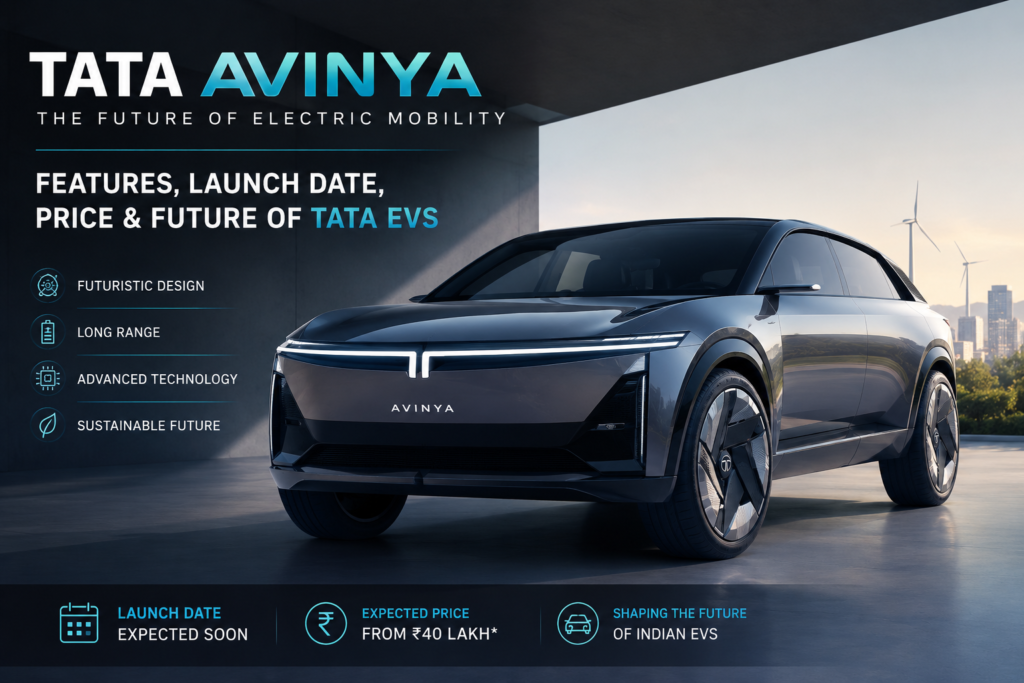
The exterior design features clean lines, minimalistic surfaces, and distinctive lighting elements that give the vehicle a futuristic presence. The front fascia is dominated by an elegant LED signature that stretches across the width of the vehicle, creating a modern and recognizable identity.
The absence of a conventional grille reflects the vehicle’s electric nature, while aerodynamic design elements contribute to improved efficiency and performance. Every aspect of the exterior appears carefully engineered to maximize both aesthetics and functionality.
The result is a vehicle that feels less like a traditional automobile and more like a mobility solution designed for the future.
Spacious and Sustainable Interior Design
Inside the Avinya, Tata Motors has taken a completely different approach compared to conventional vehicles. The cabin emphasizes openness, comfort, and sustainability.
Thanks to its dedicated electric platform, the Avinya benefits from a flat floor architecture that creates significantly more interior space. Passengers enjoy enhanced legroom and greater freedom of movement compared to traditional internal combustion vehicles.
The dashboard adopts a minimalist design philosophy with fewer physical controls and a stronger emphasis on digital interfaces. Advanced infotainment systems, connected technologies, and intuitive controls are expected to play a major role in the user experience.
Sustainability also extends to the materials used throughout the cabin. Tata Motors has indicated that eco-friendly and recycled materials will form an important part of the vehicle’s construction, aligning with the broader environmental goals of electric mobility.
Advanced Electric Vehicle Architecture
The Tata Avinya is expected to be built on a dedicated next-generation EV platform specifically developed for electric mobility. This architecture offers several advantages over platforms originally designed for internal combustion engines.
A dedicated EV platform enables optimized battery placement, better weight distribution, increased cabin space, and improved safety performance. It also allows engineers to design vehicles with greater flexibility in terms of dimensions and configurations.
The architecture is expected to support multiple body styles and future Avinya models, creating an entire family of premium electric vehicles. This strategy would allow Tata Motors to expand the Avinya brand into different segments while maintaining a consistent technological foundation.
Such an approach is similar to the strategies employed by leading global EV manufacturers, highlighting Tata Motors’ ambitions to compete at an international level.
Battery Technology and Driving Range Expectations
Range anxiety remains one of the primary concerns among electric vehicle buyers. Recognizing this challenge, Tata Motors has indicated that the Avinya will prioritize long-range capabilities and fast charging solutions.
Industry experts expect the production version of the Avinya to offer a driving range that competes with global electric vehicle standards. Advanced battery technologies, improved energy density, and sophisticated battery management systems are likely to play key roles in achieving this objective.
Fast charging capabilities are also expected to be a major selling point. Tata Motors has previously suggested that future Avinya models could support ultra-fast charging technologies, allowing drivers to replenish a substantial portion of battery capacity within a relatively short period.
These capabilities would make the vehicle more practical for both urban commuting and long-distance travel.
Intelligent Connectivity Features
Modern vehicles are increasingly becoming digital platforms on wheels, and the Tata Avinya is expected to embrace this trend fully.
Connectivity features are likely to include cloud-based services, over-the-air software updates, smartphone integration, voice-controlled systems, and advanced navigation solutions. These technologies ensure that the vehicle continues to improve over time through software enhancements and feature additions.
Artificial intelligence may also play a role in personalizing the driving experience. From customized cabin settings to intelligent route planning, connected technologies can significantly enhance convenience and usability.
As consumers become more accustomed to smart devices in their daily lives, seamless connectivity will be an essential aspect of future mobility solutions.
Safety and Driver Assistance Technologies
Safety is expected to be a major focus area for the Tata Avinya. Modern premium vehicles increasingly incorporate advanced driver assistance systems designed to enhance safety and reduce driver workload.
Potential features may include adaptive cruise control, lane-keeping assistance, automatic emergency braking, blind-spot monitoring, collision avoidance systems, and driver attention monitoring.
The vehicle’s dedicated electric architecture can also contribute to improved crash protection through optimized structural design and battery placement.
As safety regulations continue to evolve globally, advanced safety technologies are becoming a critical differentiator in the automotive market. The Avinya is expected to reflect Tata Motors’ commitment to delivering high levels of occupant protection.
Tata Avinya and Global Ambitions
The Avinya project is not solely focused on the Indian market. Tata Motors has repeatedly emphasized its desire to create products capable of competing on a global stage.
The premium electric vehicle segment represents a significant growth opportunity worldwide. By developing advanced EVs under the Avinya brand, Tata Motors aims to strengthen its international presence and showcase India’s engineering capabilities.
This global perspective influences every aspect of the vehicle, from design and technology to quality standards and user experience. If successful, the Avinya could become an important symbol of India’s growing influence in the global electric vehicle industry.
Expected Launch Timeline
While the Avinya concept generated excitement upon its introduction, bringing such an advanced vehicle to production requires substantial development and testing.
Recent industry reports suggest that Tata Motors continues to refine its premium EV strategy, with production timelines evolving alongside technological and market considerations. The company remains focused on ensuring that the final product meets the expectations associated with a next-generation electric vehicle.
As development progresses, automotive enthusiasts eagerly await official announcements regarding launch schedules, specifications, and model variants.
Expected Price and Market Positioning
The Tata Avinya is expected to occupy the premium end of Tata Motors’ electric vehicle portfolio. Industry estimates suggest pricing could begin around ₹40 lakh and extend significantly higher depending on variant and feature levels.
This positioning places the Avinya above the company’s existing EV lineup and closer to premium international electric vehicles. The strategy reflects Tata Motors’ intention to attract customers seeking luxury, advanced technology, and distinctive design.
By offering premium experiences while leveraging its understanding of the Indian market, Tata Motors hopes to create a compelling alternative to established global competitors.
Why Tata Avinya Matters for India
The importance of the Tata Avinya extends beyond the launch of a single vehicle. It represents the growing maturity of India’s automotive industry and its ability to develop sophisticated products capable of competing internationally.
The project demonstrates how Indian manufacturers are moving beyond cost-focused engineering and embracing innovation, sustainability, and premium design. As electric mobility becomes increasingly important worldwide, vehicles like the Avinya help position India as a significant player in the future of transportation.
For consumers, the Avinya offers a glimpse into what next-generation mobility could look like—cleaner, smarter, safer, and more connected than ever before.
Conclusion
The Tata Avinya stands as one of the most ambitious projects ever undertaken by Tata Motors. Combining futuristic design, advanced electric vehicle technology, premium comfort, intelligent connectivity, and sustainable engineering, it represents a bold vision for the future of mobility.
Although the production version is still under development, the excitement surrounding the Avinya continues to grow. The vehicle has the potential to redefine consumer expectations and elevate India’s position within the global electric vehicle industry.
As the automotive world moves toward an increasingly electric future, the Tata Avinya may ultimately become one of the defining vehicles of the next generation. Its success could shape not only the future of Tata Motors but also the broader direction of India’s rapidly evolving EV ecosystem.
FAQs
What is Tata Avinya?
Tata Avinya is a futuristic premium electric vehicle concept developed by Tata Motors to showcase its next-generation EV technology and design philosophy.
What does Avinya mean?
The word Avinya is derived from Sanskrit and represents innovation and forward-thinking mobility solutions.
Is Tata Avinya an SUV?
The concept combines elements of SUVs, MPVs, and crossovers, creating a unique body style focused on comfort and space.
What will be the expected price of Tata Avinya?
Industry estimates suggest a starting price of around ₹40 lakh, depending on the final production specifications.
When will Tata Avinya launch?
Tata Motors has not finalized all launch details, but the Avinya is expected to arrive as part of the company’s future premium EV strategy.