|
Getting your Trinity Audio player ready...
|
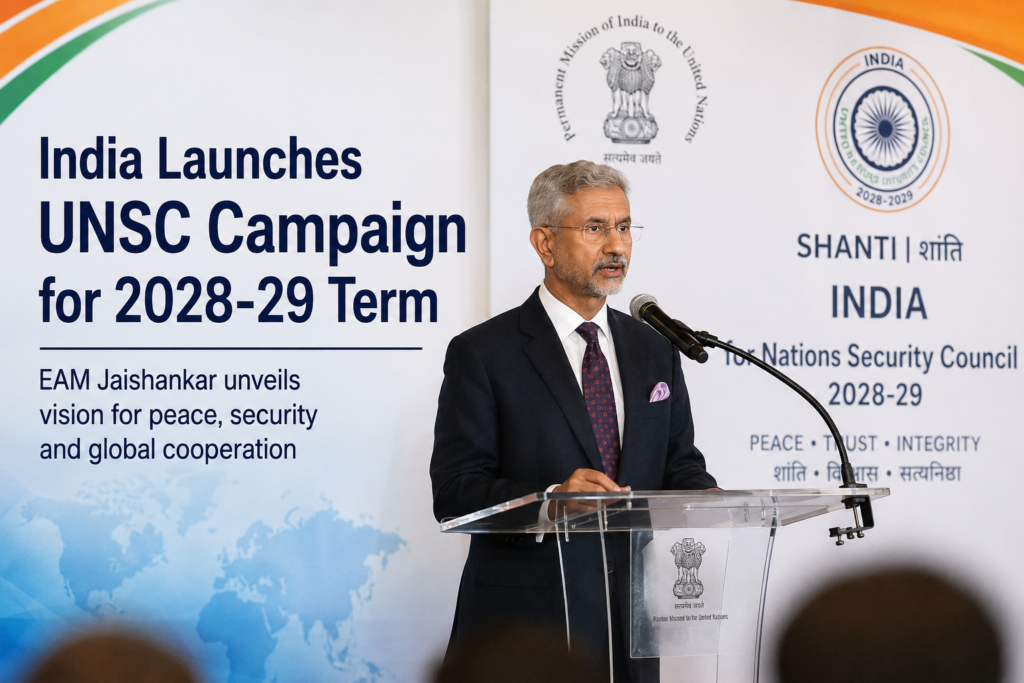
India has formally launched its campaign for election as a non-permanent member of the United Nations Security Council (UNSC) for the 2028–29 term, marking the beginning of an important diplomatic effort aimed at strengthening the country’s role in global governance. External Affairs Minister Dr. S. Jaishankar unveiled India’s campaign during an event in New York, presenting a strategic vision that reflects India’s aspirations to contribute more actively to international peace, security, development, and multilateral cooperation.
The campaign launch comes at a time when global institutions are facing increasing pressure from geopolitical conflicts, terrorism, technological disruptions, climate challenges, and growing demands for reforms in international organizations. India’s latest bid for a seat on the Security Council is not merely an election campaign but also a reflection of its broader ambition to shape the future of global decision-making.
As one of the world’s fastest-growing major economies and a leading voice of the Global South, India is positioning itself as a responsible stakeholder capable of addressing emerging international challenges while advocating for a more representative and effective United Nations system.
India’s Official Launch of the UNSC 2028–29 Campaign
During the launch event, Jaishankar outlined India’s vision for its prospective tenure on the Security Council, emphasizing the country’s longstanding commitment to peacekeeping, development partnerships, maritime security, counter-terrorism, and global cooperation. The campaign introduces the concept of SHANTI, a framework that represents India’s priorities and values within the international system.
According to reports, the SHANTI framework focuses on several key areas that India intends to champion at the United Nations, including:
- Strengthening international peace and security
- Reforming global institutions
- Modernizing peacekeeping operations
- Promoting human-centric artificial intelligence
- Enhancing maritime security
- Combating terrorism and terror financing
- Supporting sustainable development initiatives
These priorities reflect India’s broader diplomatic agenda and align with its efforts to increase its influence in global policymaking.
Understanding the United Nations Security Council
The United Nations Security Council remains one of the most influential bodies in international relations. Established in 1945, it is responsible for maintaining international peace and security and possesses the authority to impose sanctions, authorize peacekeeping missions, and approve military actions under specific circumstances.
The Council consists of fifteen members:
Five permanent members:
- United States
- United Kingdom
- France
- Russia
- China
Ten non-permanent members elected for two-year terms.
Non-permanent members do not possess veto powers but play an important role in shaping discussions, negotiating resolutions, and influencing global security decisions.
For countries like India, serving on the Security Council provides a significant platform to advance national interests while contributing to global governance.
Why the 2028–29 UNSC Seat Matters for India
India’s bid for the 2028–29 term carries both symbolic and strategic significance.
Over the past two decades, India has emerged as one of the world’s most influential economies and geopolitical actors. The country’s growing role in international trade, technology, defense cooperation, climate initiatives, and development partnerships has strengthened its claim for greater representation in global institutions.
Winning a seat on the Security Council would allow India to:
Strengthen Global Influence
A Security Council seat offers India an opportunity to directly participate in critical decisions affecting global peace and security.
Advance Global South Interests
India has increasingly positioned itself as a voice for developing nations, advocating equitable development, financial inclusion, technology access, and fair representation in global institutions.
Promote Counter-Terrorism Efforts
India has consistently called for stronger international cooperation against terrorism and the financing of extremist activities. The Security Council provides an important platform for advancing these objectives.
Push for UN Reforms
India has long argued that the current structure of the United Nations no longer reflects modern geopolitical realities. A successful Security Council campaign reinforces India’s position in ongoing reform discussions.
India’s Historical Relationship with the Security Council
India is no stranger to the Security Council.
The country has served multiple terms as a non-permanent member and has played a significant role in discussions related to peacekeeping, counter-terrorism, maritime security, and conflict resolution. India’s most recent term covered 2021–2022, during which it chaired several important discussions and initiatives.
Throughout its previous tenures, India has consistently emphasized:
- Respect for international law
- Peaceful conflict resolution
- Development-focused diplomacy
- Multilateral cooperation
- Support for developing nations
This track record forms a major component of India’s current campaign narrative.
The SHANTI Vision Explained
One of the most notable aspects of the campaign launch was the introduction of the SHANTI framework.
The vision seeks to present India as a constructive and solution-oriented global actor capable of addressing contemporary challenges through cooperation and consensus-building.
Security and Peacekeeping
India remains one of the largest contributors to UN peacekeeping operations. The country has deployed thousands of personnel to missions around the world and has consistently supported efforts to strengthen peacekeeping effectiveness.
Human-Centric Technology
India has increasingly emphasized the need for ethical and human-focused approaches to emerging technologies, particularly artificial intelligence. This area is expected to feature prominently in India’s campaign messaging.
Anti-Terrorism Cooperation
Counter-terrorism continues to be a central pillar of India’s foreign policy. Officials have repeatedly highlighted the need for stronger international action against terrorism and terror financing networks.
Maritime Security
As a major maritime nation located in the Indo-Pacific region, India views freedom of navigation and maritime stability as essential components of global security.
Institutional Reforms
India continues to advocate reforms that would make the United Nations more representative, transparent, and responsive to modern challenges.
The Challenge Ahead: Competition from Tajikistan
While India enjoys strong diplomatic relationships across many regions, its path to the Security Council is not entirely uncontested.
Reports indicate that India and Tajikistan will compete for the Asia-Pacific Group seat allocated for the 2028–29 term. The election is expected to take place during the United Nations General Assembly in 2027.
Some reports suggest that Tajikistan may receive support from sections of the Organisation of Islamic Cooperation (OIC), potentially making the contest more competitive than previous elections.
As a result, India is expected to undertake extensive diplomatic outreach over the coming months to secure broad international support.
India’s Global South Strategy
A major theme of India’s foreign policy in recent years has been its emphasis on representing the interests of developing countries.
From climate finance and sustainable development to food security and digital inclusion, India has consistently advocated policies aimed at addressing the concerns of emerging economies.
This positioning has strengthened India’s relationships across:
- Africa
- Latin America
- Southeast Asia
- Pacific Island nations
- Caribbean countries
Such partnerships are expected to play a crucial role in the Security Council election campaign.
Why India Wants UNSC Reform
India’s push for Security Council reform predates the current campaign by several decades.
Indian leaders have repeatedly argued that the existing structure reflects the geopolitical realities of 1945 rather than those of the 21st century. They contend that major developing countries remain underrepresented in decision-making processes despite their growing economic and demographic significance.
India has consistently advocated:
- Expansion of permanent membership
- Expansion of non-permanent membership
- Greater representation for developing countries
- Improved transparency in decision-making
Many nations have expressed support for India’s aspiration to assume a larger role in a reformed Security Council.
What This Means for India’s Foreign Policy
The launch of the UNSC campaign reflects broader shifts in India’s international posture.
India increasingly seeks to balance multiple strategic priorities, including:
- Economic growth
- National security
- Regional stability
- Technology leadership
- Climate action
- Global governance reform
The campaign provides an opportunity to showcase India’s achievements and reinforce its image as a responsible global actor capable of contributing to solutions for complex international challenges.
International Reactions and Expectations
The international response to India’s campaign is expected to evolve over the coming year as diplomatic outreach intensifies.
Many observers believe India’s strong economic performance, democratic institutions, development partnerships, and peacekeeping contributions provide a compelling case for greater involvement in global governance.
At the same time, geopolitical rivalries and competing regional interests may influence voting dynamics within the United Nations system.
Looking Ahead to the 2027 Election
The election for the 2028–29 Security Council term will take place during the 81st session of the United Nations General Assembly in 2027. India will spend the next year engaging member states, strengthening partnerships, and building support for its candidacy.
Success would mark another milestone in India’s long-standing effort to expand its influence within global institutions while advancing priorities related to peace, development, security, and international cooperation.
Conclusion
The launch of India’s campaign for a non-permanent seat on the United Nations Security Council for the 2028–29 term represents more than a routine diplomatic exercise. It reflects India’s ambition to play a larger role in shaping the international order and addressing the challenges facing the world today. Through the SHANTI vision, India has outlined a framework centered on peace, security, development, technology governance, maritime cooperation, and institutional reform.
As the campaign gathers momentum ahead of the 2027 election, the outcome will not only determine India’s position within the Security Council but also serve as an indicator of its growing diplomatic influence on the global stage.
FAQs
What is India’s UNSC campaign for 2028–29?
India has officially launched its bid to become a non-permanent member of the United Nations Security Council for the 2028–29 term.
What is the SHANTI vision announced by Jaishankar?
SHANTI is India’s diplomatic framework focusing on peace, security, UN reforms, maritime security, human-centric AI, and counter-terrorism cooperation.
When will the UNSC election take place?
The election for the 2028–29 term is expected to be held during the UN General Assembly session in 2027.
Who is competing with India for the seat?
Reports indicate that Tajikistan is competing with India for the Asia-Pacific Group seat.
Why does India seek a larger role in the UNSC?
India believes global institutions should better reflect modern geopolitical realities and provide greater representation to developing nations.