|
Getting your Trinity Audio player ready...
|
For most Indians, Sonam Wangchuk is known as the engineer and education reformer whose work inspired the character of Phunsukh Wangdu in 3 Idiots. However, in recent years, Wangchuk has emerged as one of the strongest voices advocating for Ladakh’s environmental protection, constitutional safeguards, and democratic rights.
Unlike many activists who rely on rallies and political campaigns, Wangchuk has repeatedly chosen the path of non-violent resistance inspired by Mahatma Gandhi. Through hunger strikes, climate fasts, padyatras, and peaceful protests, he has attempted to draw national attention to issues affecting the fragile Himalayan region of Ladakh. While not all of his demands have been fulfilled, his protests have forced governments, media organisations, and citizens to engage with concerns that were once largely ignored.
Why Sonam Wangchuk Started Protesting
The roots of Wangchuk’s activism lie in the constitutional changes that followed the abrogation of Article 370 in 2019. Ladakh became a Union Territory without a legislative assembly. While many residents welcomed Union Territory status initially, concerns soon emerged regarding land rights, employment opportunities, environmental protection, and local governance.
Wangchuk argued that Ladakh’s unique ecological and tribal identity required stronger constitutional safeguards. He repeatedly demanded inclusion under the Sixth Schedule of the Constitution, which provides protections for tribal regions through autonomous councils. Alongside this, he supported demands for statehood, job reservations for locals, protection of natural resources, and greater participation of Ladakhis in decision-making.
The 2023 Fast: The Beginning of a National Movement
January 2023 Hunger Strike
In January 2023, Sonam Wangchuk undertook a five-day fast in freezing temperatures in Ladakh. The protest was aimed at highlighting concerns regarding large-scale mining, industrialisation, and environmental degradation in the Himalayan region.
The protest was jointly supported by the Leh Apex Body and the Kargil Democratic Alliance, two major organisations representing different regions and communities of Ladakh. Wangchuk warned that unchecked industrial activity could damage one of the world’s most sensitive ecosystems and threaten local livelihoods.
Key Demands
- Constitutional safeguards under the Sixth Schedule
- Environmental protection of Ladakh
- Protection against large-scale industrial exploitation
- Greater local participation in governance
- Safeguards for tribal communities
Outcome
The protest succeeded in generating national attention. More importantly, the Ministry of Home Affairs formed a High-Powered Committee (HPC) in January 2023 to discuss Ladakh’s demands. Multiple rounds of discussions followed between government representatives and Ladakhi organisations. Although no immediate constitutional changes were announced, the protest ensured that Ladakh’s concerns entered mainstream policy discussions.
The 2024 Climate Fast
The 21-Day Hunger Strike
One of Wangchuk’s most widely covered protests began in March 2024 when he launched a 21-day “Climate Fast”. Unlike traditional political protests, he framed the movement as a fight to protect the Himalayan ecosystem and future generations.
The fast attracted support from environmentalists, students, social activists, and citizens across India. Social media campaigns amplified his message, turning a regional issue into a national conversation.
Main Demands
- Sixth Schedule status for Ladakh
- Statehood for Ladakh
- Parliamentary representation safeguards
- Protection of tribal identity
- Environmentally sustainable development
- Strong regulations on mining and industrial projects
Why the Protest Resonated
Ladakh is one of the regions most vulnerable to climate change. Glaciers are shrinking, water resources are becoming less predictable, and traditional livelihoods are under pressure. Wangchuk argued that rapid commercial development without environmental safeguards could permanently damage the region.
His message connected climate action with constitutional rights, making the protest unique in India’s modern political landscape.
Outcome
On March 26, 2024, Wangchuk ended the 21-day fast and announced a larger movement that would continue through peaceful means. While the government did not grant Sixth Schedule status or statehood, the protest dramatically increased public awareness and renewed negotiations regarding Ladakh’s future.
Delhi Chalo Padyatra 2024
Following the climate fast, Wangchuk launched a march from Ladakh towards Delhi. The journey covered nearly 1,000 kilometres and sought to bring Ladakh’s concerns directly to the national capital.
The march drew attention from across the country. However, protesters were detained near Delhi before reaching their destination. Images and reports of the detention spread widely across traditional and social media platforms, further increasing public interest in the movement.
Outcome
Although the march did not culminate in a major policy announcement, it significantly increased pressure on policymakers and kept Ladakh’s demands in the national spotlight.
The 2025 Hunger Strike and Ladakh Crisis
Hunger Strike Begins Again
On September 10, 2025, Wangchuk joined a 35-day hunger strike initiated by the Leh Apex Body. Fifteen protesters participated in the movement demanding concrete action rather than prolonged discussions.
Major Demands
- Statehood for Ladakh
- Sixth Schedule protection
- Greater autonomy
- Local job protection
- Stronger constitutional safeguards
Escalation of Protests
As the fast continued, frustration grew among supporters. Several hunger strikers experienced health complications and required medical attention. Public demonstrations expanded across Ladakh, and pressure on authorities intensified.
Violence and End of Fast
The situation deteriorated when protests turned violent. According to reports, deaths and injuries occurred during unrest in the region. Concerned about the direction of the movement, Wangchuk ended the hunger strike and appealed for peace.
What Did the Protest Achieve?
The 2025 movement produced the most tangible policy outcomes of any Ladakh protest in recent years.
The Government accepted and notified several measures:
- 85% reservation for local residents
- 15-year domicile requirement
- 33% reservation for women in Hill Councils
- Recognition of five official languages in Ladakh
However, the two biggest demands—Statehood and Sixth Schedule status—remained unresolved.
Arrest and Detention
Following unrest linked to the Ladakh movement, Wangchuk was detained and reportedly spent around 170 days in custody before being released in 2026.
His detention became another major talking point among supporters, who argued that peaceful democratic voices should be heard rather than suppressed. The episode further elevated his profile as a national activist.
The 2026 Hunger Strike: Current Movement
Sonam Wangchuk Joins Students’ Fight Against Exam Irregularities
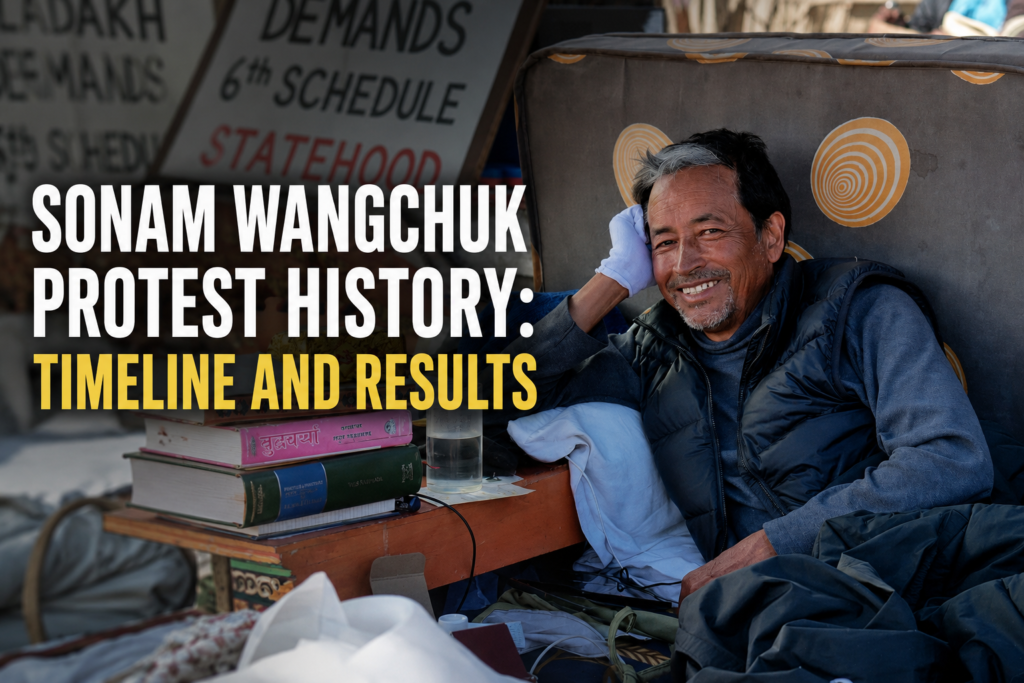
The latest chapter in Sonam Wangchuk’s protest journey began on 28 June 2026 when he launched an indefinite hunger strike at Jantar Mantar in New Delhi. Unlike his earlier movements focused primarily on Ladakh’s constitutional rights and environmental protection, this protest was centred around alleged examination irregularities, including the NEET-UG 2026 paper leak controversy and demands for accountability in India’s education system.
Wangchuk joined hands with Abhijeet Dipke, founder of the rapidly growing youth movement known as the Cockroach Janta Party (CJP). The organisation emerged as a powerful voice for students frustrated with repeated exam controversies, unemployment concerns, and what they describe as a lack of accountability within the education system. According to reports, the movement has attracted millions of supporters online and gained national visibility through demonstrations at Jantar Mantar.
Why Did Sonam Wangchuk Join?
Wangchuk stated that the issue was not limited to a single examination. He argued that recurring exam leaks and administrative failures were affecting the future of millions of students. His participation transformed the protest from a student movement into a nationwide campaign demanding transparency, accountability, and reforms in the examination process.
Main Demands of the 2026 Protest
- Accountability for alleged NEET-UG 2026 irregularities
- Transparent investigation into examination leaks
- Reforms in India’s examination system
- Protection of students’ interests
- Greater institutional accountability
- Resignation of Union Education Minister Dharmendra Pradhan, a key demand raised by CJP leaders and supporters.
Health Concerns and Public Support
As the hunger strike continued into mid-July 2026, Wangchuk’s health became a major concern. Reports indicated that he had lost more than 8 kilograms and was showing signs of physical weakness. Medical experts and supporters repeatedly urged him to end the fast, but he remained firm, stating that the government should engage in dialogue instead of remaining silent.
The movement has received support from students, activists, opposition leaders, academics, and public figures across the country. Several political leaders visited or expressed solidarity with the protesters at Jantar Mantar.
Abhijeet Dipke’s Role
Abhijeet Dipke has emerged as one of the central faces of the movement. As founder of CJP, he has repeatedly criticised the government’s response and accused authorities of ignoring students’ concerns. Dipke has publicly questioned why no meaningful dialogue has been initiated despite Wangchuk’s prolonged hunger strike and growing public support.
Under his leadership, CJP announced a Parliament March scheduled for 20 July 2026, aiming to further increase pressure on policymakers and keep the issue in national focus.
Government Response
One of the biggest criticisms from protesters has been the perceived lack of engagement from authorities. According to protest leaders, repeated appeals for discussion have not produced a satisfactory response. This criticism intensified as Wangchuk’s health worsened and the hunger strike entered its third week.
Delhi High Court Intervention
The Delhi High Court recently agreed to examine concerns related to Wangchuk’s deteriorating health. Notices were issued to relevant authorities seeking clarification regarding medical care and the government’s response to the situation. This development brought additional attention to the ongoing protest.
Current Status (16 July 2026)
As of 16 July 2026:
- Sonam Wangchuk’s hunger strike has entered its 18th day.
- He remains at Jantar Mantar, New Delhi.
- The protest continues alongside CJP activists led by Abhijeet Dipke.
- Support campaigns and solidarity fasts are being organised across the country.
- CJP is preparing for a Parliament March on 20 July.
- The Delhi High Court is examining concerns related to Wangchuk’s health.
- No major breakthrough has yet been announced by the government.
Did Sonam Wangchuk’s Hunger Strikes Achieve Results?
Critics often point out that Ladakh has not yet received Sixth Schedule status or statehood. However, measuring the success of Wangchuk’s protests solely by legislative outcomes overlooks their broader impact.
Achievements
✔ National awareness about Ladakh
✔ Formation of High-Powered Committee discussions
✔ Policy concessions on domicile and reservations
✔ Increased environmental debate around Himalayan ecosystems
✔ Greater visibility for tribal rights
✔ National discussion on climate-sensitive development
Demands Still Pending
✖ Sixth Schedule status
✖ Statehood for Ladakh
✖ Full constitutional safeguards
✖ Legislative Assembly restoration
Conclusion
Sonam Wangchuk’s protest journey represents one of the most significant non-violent movements in contemporary India. From fasting in freezing Himalayan temperatures to leading climate campaigns and indefinite hunger strikes, he has consistently focused on protecting Ladakh’s people, culture, and environment.
While many of his central demands remain unresolved, his movements have succeeded in transforming Ladakh from a regional issue into a national conversation. Whether one agrees with his methods or not, there is little doubt that Wangchuk has become one of India’s most influential voices on environmental protection, democratic participation, and sustainable development.