|
Getting your Trinity Audio player ready...
|
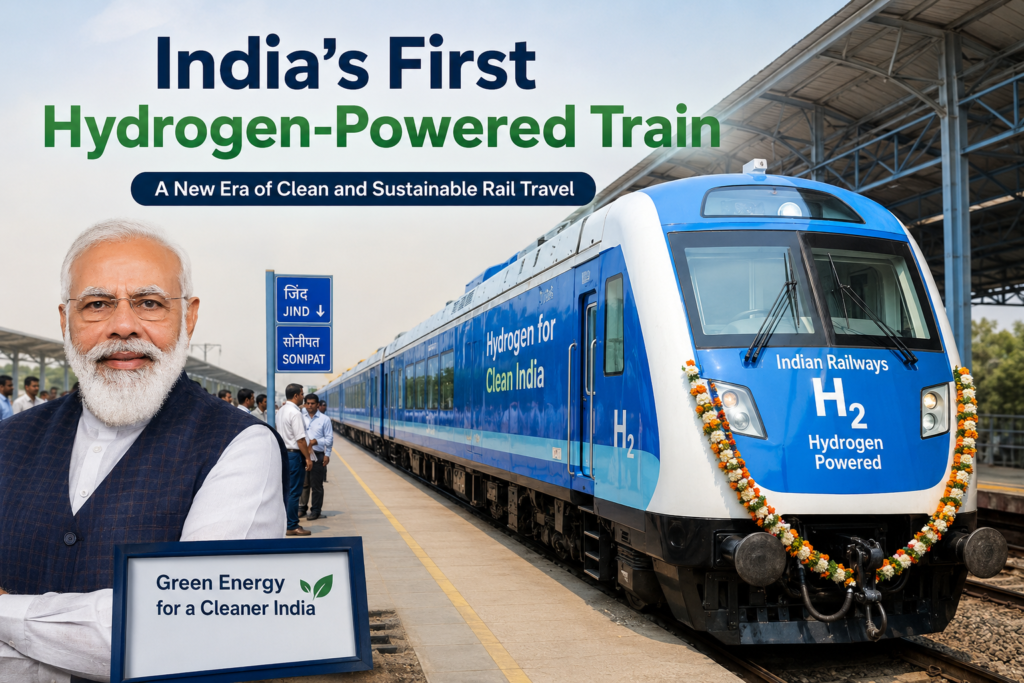
India has officially entered the era of hydrogen-powered rail transportation. On 17 July 2026, Indian Railways launched the country’s first Hydrogen Fuel Cell Train, a landmark project that places India among a select group of nations experimenting with hydrogen-based railway technology. The train was flagged off on the Jind–Sonipat route in Haryana and represents a major step towards cleaner, greener and more sustainable transportation.
The launch is significant not only because it introduces a new form of rail propulsion but also because it supports India’s broader goals of reducing carbon emissions, achieving energy independence and promoting green hydrogen under the National Green Hydrogen Mission.
What Is India’s First Hydrogen-Powered Train?
India’s first hydrogen-powered train is a passenger train that uses hydrogen fuel cells instead of diesel engines. Unlike traditional trains that rely on fossil fuels, hydrogen trains generate electricity onboard by combining hydrogen and oxygen inside fuel cells. The only by-product produced during this process is water vapour, making it a near-zero-emission transportation system.
The train has been developed under the “Make in India” initiative and includes indigenous engineering and integration. It is designed specifically for non-electrified and semi-electrified railway routes where diesel trains are still commonly used.
Route of India’s Hydrogen Train
The country’s first hydrogen train operates on the Jind–Sonipat railway section in Haryana.
Key Route Details
- Route: Jind to Sonipat
- State: Haryana
- Distance: Approximately 89 kilometres
- Travel Time: Around 2 hours
- Launch Date: 17 July 2026
- Operator: Indian Railways
The route was chosen as a pilot corridor because it offers an ideal environment for testing and demonstrating hydrogen rail technology under real-world operating conditions.
Features of India’s Hydrogen Fuel Cell Train
The train incorporates advanced engineering and safety systems designed to make hydrogen transportation practical and reliable.
Major Specifications
Power Output
The hydrogen train delivers approximately 2,400 kW of power, making it one of the most powerful hydrogen-powered train projects developed in the region.
Passenger Capacity
The train can accommodate around 2,600 passengers, making it suitable for high-density Indian railway operations.
Coach Configuration
- Two hydrogen-powered driving cars
- Eight passenger trailer coaches
This configuration enables efficient operation while maintaining passenger comfort.
Maximum Speed
Reports indicate a maximum design speed of approximately 110 km/h, with operational speeds around 75 km/h on the selected route. Trial runs reportedly touched higher speeds during testing.
How Does a Hydrogen Train Work?
One of the most searched questions online is:
How does a hydrogen-powered train work?
The answer lies in fuel cell technology.
Train stores compressed hydrogen in specially designed tanks. Inside the fuel cell, hydrogen reacts with oxygen from the air.
This chemical reaction produces:
- Electricity
- Heat
- Water vapour
The generated electricity powers electric motors that drive the train. Unlike diesel engines, there is no combustion process producing carbon dioxide or particulate pollution.
Step-by-Step Process
- Hydrogen is stored onboard.
- Oxygen is drawn from the atmosphere.
- Fuel cells convert hydrogen into electricity.
- Electric motors propel the train.
- Water vapour is released as exhaust.
This makes hydrogen trains one of the cleanest rail transport options available today.
Hydrogen Refuelling Infrastructure
A major challenge in hydrogen transportation is fuel availability.
To support the project, Indian Railways established a dedicated hydrogen production, storage and refuelling facility at Jind.
The facility can reportedly produce approximately 420–430 kilograms of hydrogen daily, ensuring continuous train operations.
This infrastructure serves as a model for future hydrogen railway corridors across India.
Why Is This Train Important for India?
1. Reducing Carbon Emissions
Indian Railways is among the world’s largest railway networks. Replacing diesel trains with hydrogen-powered alternatives can significantly reduce greenhouse gas emissions.
2. Supporting Green Hydrogen Mission
India aims to become a global leader in green hydrogen production. The railway sector can become a major consumer of domestically produced hydrogen.
3. Energy Independence
Hydrogen can be produced locally, reducing dependence on imported fossil fuels.
4. Cleaner Air
Unlike diesel locomotives, hydrogen trains do not emit harmful pollutants such as:
- Carbon dioxide
- Sulphur oxides
- Nitrogen oxides
- Particulate matter
5. Global Leadership
India now joins countries such as Germany, France, China, Japan and Italy that are actively testing or operating hydrogen-powered trains.
Safety Measures in the Hydrogen Train
Many people ask:
Is hydrogen train technology safe?
Indian Railways has integrated multiple safety systems including:
- Hydrogen leak detection systems
- Fire detection systems
- Heat monitoring sensors
- Emergency shutdown mechanisms
- Special storage technology for hydrogen tanks
These measures are designed to ensure safe passenger operations.
Challenges Facing Hydrogen Rail Technology
Despite the excitement, hydrogen trains still face several challenges.
High Infrastructure Costs
Hydrogen production and refuelling facilities require significant investment.
Hydrogen Storage
Hydrogen must be stored under high pressure, requiring specialised tanks.
Production Costs
Green hydrogen remains more expensive than conventional fuels.
Network Expansion
Large-scale deployment will require nationwide infrastructure development.
However, costs are expected to decline as hydrogen adoption increases globally.
Future of Hydrogen Trains in India
Indian Railways plans to evaluate the performance of the Jind–Sonipat project before expanding hydrogen-powered operations to additional routes.
Reports suggest heritage routes and other non-electrified sections may eventually become candidates for hydrogen train deployment.
Industry experts believe hydrogen trains could play a major role in achieving Indian Railways’ long-term sustainability goals.
FAQs
Which is India’s first hydrogen-powered train?
The first hydrogen-powered train in India operates on the Jind–Sonipat route in Haryana and was launched on 17 July 2026.
What fuel does the train use?
The train uses hydrogen fuel cells that generate electricity through a chemical reaction between hydrogen and oxygen.
What is the speed of India’s hydrogen train?
The train has a design speed of around 110 km/h and operates at lower commercial speeds based on route requirements.
What is the passenger capacity?
The train can carry approximately 2,600 passengers.
Why is hydrogen train technology important?
It helps reduce emissions, supports green energy goals and decreases dependence on fossil fuels.