|
Getting your Trinity Audio player ready...
|
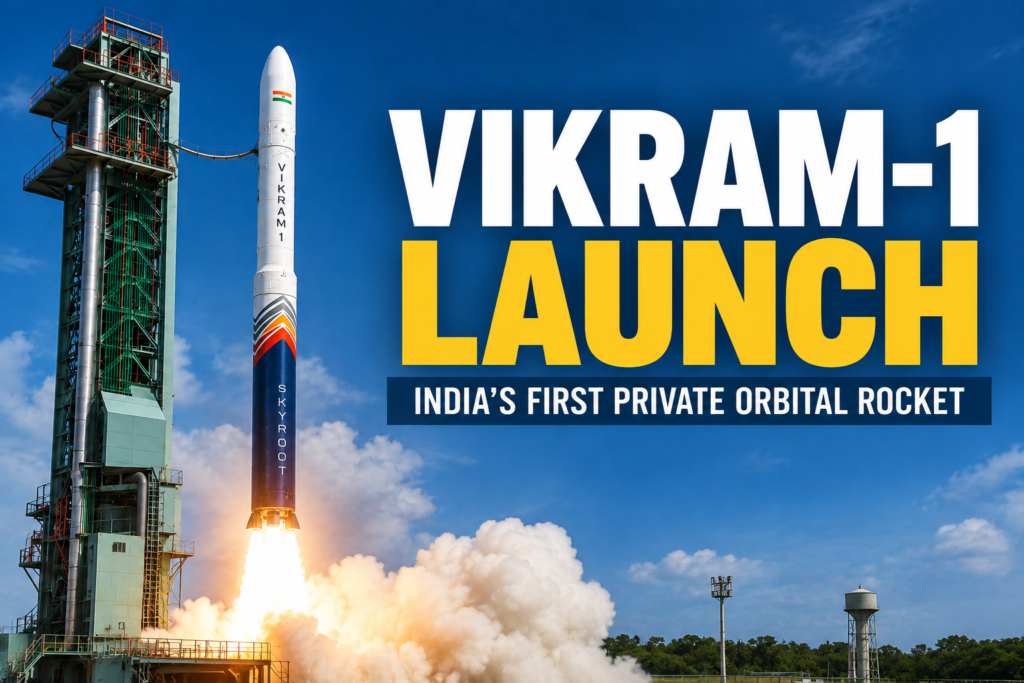
India is on the verge of creating another historic milestone in space exploration as Vikram-1, the country’s first privately developed orbital launch vehicle, prepares for liftoff from the Satish Dhawan Space Centre (SDSC), Sriharikota. The mission, developed by Hyderabad-based Skyroot Aerospace, is far more than just another rocket launch—it represents the beginning of a new era in which private Indian companies play a major role alongside the Indian Space Research Organisation (ISRO). The launch is part of Mission Aagaman, the maiden orbital flight of Vikram-1, and is expected to place multiple technology demonstration payloads into Low Earth Orbit (LEO). If successful, the mission will become one of the most significant achievements in India’s commercial space sector.
For decades, ISRO has been the face of India’s remarkable achievements in space. From launching satellites for dozens of countries to the successful Chandrayaan and Mars Orbiter missions, India has consistently demonstrated that world-class space technology can be developed at a fraction of global costs. However, the opening of India’s space sector to private participation has created entirely new opportunities. Companies like Skyroot Aerospace are now preparing to compete in the rapidly growing global launch market, and Vikram-1 is their biggest test yet.
The Vikram-1 mission has generated excitement not only within India but also among international space agencies, commercial satellite operators, investors, and aerospace enthusiasts. Success would demonstrate that India’s private sector possesses the technological capability to independently develop and launch orbital-class rockets, significantly strengthening the country’s position in the global commercial space industry.
Why the Vikram-1 Launch Is Historic
India has previously witnessed private companies manufacturing satellite components, propulsion systems, and supporting launch operations. However, Vikram-1 represents the country’s first privately developed orbital launch vehicle, making it a landmark achievement.
Until recently, orbital launches in India were exclusively carried out by ISRO using rockets such as PSLV, GSLV, and LVM3. Following reforms introduced by the Government of India, private companies gained access to ISRO facilities, technical support, and launch infrastructure through IN-SPACe. These reforms opened the door for Indian startups to build complete launch vehicles.
Skyroot Aerospace has emerged as one of the biggest beneficiaries of these reforms. Founded in 2018 by former ISRO scientists, the company has rapidly evolved into India’s leading private launch startup. Within just a few years, it progressed from designing rocket engines to preparing its first orbital mission, an achievement that has attracted global attention.
Unlike experimental sounding rockets, orbital launch vehicles require extremely precise engineering. They must survive intense aerodynamic pressure, deliver payloads into accurately calculated orbits, maintain communication throughout flight, and perform complex stage separations flawlessly. Successfully achieving these objectives on a maiden flight would establish Skyroot as a serious competitor in the international launch market.
What Is Vikram-1?
Vikram-1 is a four-stage small satellite launch vehicle specifically designed for placing satellites into Low Earth Orbit. The rocket is named after Dr. Vikram Sarabhai, the visionary scientist widely regarded as the father of India’s space programme.
Standing nearly seven storeys tall, Vikram-1 combines solid propulsion in its lower stages with a restartable liquid-fuel upper stage. This design allows the rocket to deploy multiple satellites into precise orbital positions, making it particularly attractive for commercial customers launching small satellites and technology demonstration missions.
One of the biggest advantages of Vikram-1 is its modular design. Skyroot has focused heavily on reducing manufacturing time, improving reliability, and simplifying integration processes. Many structural components have been manufactured using advanced carbon composite materials and 3D printing technologies, reducing overall weight while maintaining strength.
The company has also developed several indigenous propulsion systems, including the Kalam series of solid rocket motors and the Raman liquid engine used during the rocket’s final orbital insertion phase.
Mission Aagaman Explained
The maiden orbital mission has been named Mission Aagaman, a Sanskrit word meaning “arrival.” The name symbolises the arrival of India’s private launch industry into the global commercial space ecosystem.
Mission Aagaman is not only intended to validate Vikram-1’s engineering but also to demonstrate that private Indian companies can independently deliver payloads into orbit.
The mission will carry multiple technology demonstration payloads from Indian and international customers. These payloads include experimental satellites designed to test communications, space technologies, and commercial applications. According to reports, the mission will also carry symbolic payloads, including a handwritten message from Prime Minister Narendra Modi, celebrating India’s growing role in space exploration.
For Skyroot Aerospace, Mission Aagaman serves as the first of three planned developmental launches. Each mission will help validate systems, improve reliability, and prepare the company for routine commercial operations in the future.
Skyroot Aerospace: The Startup Behind Vikram-1
Skyroot Aerospace was founded in 2018 by former ISRO engineers Pawan Kumar Chandana and Naga Bharath Daka, who envisioned creating India’s first private orbital launch company.
Starting with a small engineering team, the Hyderabad-based startup quickly gained attention for developing indigenous rocket engines, advanced composite structures, and innovative launch technologies. Investors recognised the company’s potential, enabling rapid expansion of its research and manufacturing facilities.
Today, Skyroot has become India’s first space technology unicorn and one of the country’s fastest-growing aerospace companies. The startup operates one of India’s largest private rocket manufacturing facilities and continues developing future launch vehicles capable of carrying larger payloads.
A major milestone came in November 2022 when Skyroot successfully launched Vikram-S, India’s first privately built suborbital rocket. That mission demonstrated many of the technologies now incorporated into Vikram-1 and provided valuable flight data for the company’s orbital ambitions.
How Vikram-1 Differs from ISRO Rockets
Although Vikram-1 and ISRO’s PSLV both serve satellite launch markets, they target different customer segments.
PSLV has earned a global reputation for launching medium-sized satellites with exceptional reliability. Vikram-1, however, focuses specifically on the rapidly growing small satellite market.
Small satellites have become increasingly popular because they are cheaper, quicker to manufacture, and suitable for Earth observation, climate monitoring, agriculture, defence, telecommunications, disaster management, and scientific research.
Instead of waiting months or years for shared launch opportunities, satellite operators increasingly prefer dedicated launch services tailored to their specific missions.
Vikram-1 has been designed precisely for this growing demand.
The Importance of Private Space Companies in India
The global space economy is expanding rapidly, with increasing demand for satellite launches, Earth observation, broadband constellations, defence applications, and scientific missions.
Private companies have played a crucial role in transforming the international launch industry. Organisations such as SpaceX have demonstrated how commercial innovation can reduce launch costs while increasing launch frequency.
India hopes to replicate similar success by encouraging domestic private companies.
Government reforms allowing startups to access ISRO’s infrastructure have accelerated innovation across the sector.
Companies are now developing launch vehicles, satellites, propulsion systems, space manufacturing technologies, and deep-space exploration capabilities.
If Vikram-1 succeeds, it will significantly strengthen investor confidence in India’s emerging commercial space ecosystem and encourage further innovation from startups across the country.
Payloads Flying on Vikram-1
Although the rocket itself is the centre of attention, the payloads onboard Mission Aagaman are equally important. Unlike traditional missions that carry a single large satellite, Vikram-1 is designed to deploy multiple technology demonstration payloads, showcasing the flexibility of India’s emerging commercial launch ecosystem.
One of the primary payloads is SCOPE, Skyroot Aerospace’s own experimental CubeSat. It has been developed to validate onboard technologies that will be used in future missions. The satellite carries an Earth-imaging camera and several experimental systems that will provide valuable data after reaching orbit.
Another major payload is Solaras S3, developed by Indian startup Grahaa Space. The satellite is designed to test the company’s nanosatellite platform, laying the foundation for future commercial satellite services. Grahaa Space aims to use the knowledge gained from this mission to expand India’s capabilities in Earth observation and satellite-based applications.
The mission also carries EMBRACE, an innovative payload from Cosmoserve Space that demonstrates robotic technology capable of operating in orbit. The experiment focuses on advanced robotic mechanisms that could eventually contribute to servicing satellites and addressing the growing issue of space debris.
International collaboration is also part of Mission Aagaman. German aerospace company DCUBED has contributed in-orbit validation hardware, including deployment mechanisms that will be tested under real space conditions. Successful operation of these systems would open opportunities for future international partnerships with Indian launch providers.
Adding a symbolic touch to the mission, Vikram-1 will carry Prime Minister Narendra Modi’s handwritten postcard bearing the words “Vande Mataram.” The mission will also include artistic and commemorative payloads celebrating India’s growing private space capabilities.
Mission Timeline: From Liftoff to Orbit
Mission Aagaman has been carefully planned to validate every major subsystem of the Vikram-1 launch vehicle.
Immediately after liftoff, the first solid-fuel stage generates the thrust needed to clear the launch tower and begin ascent. Within seconds, the rocket performs its pitch manoeuvre and accelerates beyond the speed of sound while experiencing maximum aerodynamic pressure, commonly known as Max-Q.
After the first stage completes its burn, it separates automatically, allowing the second stage to ignite. As the rocket climbs higher, atmospheric resistance decreases significantly. Once outside the dense atmosphere, the protective payload fairing separates, exposing the satellites.
The third stage then continues accelerating the vehicle toward orbital velocity before separating. Finally, Vikram-1’s restartable Orbital Adjustment Module (OAM) ignites its liquid-fuel Raman engines to perform precise orbit insertion at approximately 450 kilometres above Earth. If every stage performs as planned, the payloads will be deployed into Low Earth Orbit before the mission concludes.
Engineering Innovations Behind Vikram-1
One reason Vikram-1 has attracted worldwide attention is the advanced engineering incorporated into its design.
Unlike many conventional launch vehicles, Vikram-1 uses extensive carbon composite structures, making the rocket lighter while maintaining exceptional strength. Lower structural weight allows more of the rocket’s mass to be dedicated to fuel and payload capacity.
Skyroot has also embraced 3D printing for manufacturing several engine components. This approach reduces manufacturing time, lowers production costs, and simplifies future upgrades.
Another innovation is the rocket’s modular architecture. Individual stages can be manufactured, tested, and integrated more efficiently, reducing turnaround time between launches. Such flexibility is essential for commercial customers who increasingly demand faster launch schedules.
The restartable Raman liquid engine represents another significant technological achievement. Unlike conventional upper stages that burn continuously until fuel depletion, the Raman engine can restart in orbit, allowing satellites to be deployed into more precise orbital positions. This capability significantly increases Vikram-1’s commercial value for satellite operators.
Why the Global Space Industry Is Watching
The global demand for launching small satellites has grown dramatically over the past decade. Governments, universities, defence agencies, startups, and multinational corporations are deploying thousands of satellites for Earth observation, weather forecasting, navigation, broadband internet, environmental monitoring, scientific research, and national security.
Market analysts estimate that thousands of additional small satellites will require launch services during the coming years.
Until recently, many satellite operators depended primarily on launch providers in the United States, Europe, Russia, and China. India’s private launch industry now hopes to become another reliable option by offering cost-effective and flexible launch services.
If Vikram-1 succeeds, Skyroot Aerospace could begin attracting commercial customers from around the world, strengthening India’s position in the rapidly expanding global space economy. The company has already outlined plans for future vehicles such as Vikram-II, with greater payload capacity, as well as long-term ambitions for reusable launch systems.
Challenges Facing the Mission
Every maiden rocket launch carries significant technical risk.
Unlike software, rockets cannot simply be updated after launch. Every subsystem—including propulsion, avionics, telemetry, stage separation, guidance, navigation, thermal protection, structural integrity, and communications—must function perfectly during flight.
Even minor anomalies can prevent a mission from reaching orbit.
Skyroot has attempted to minimise these risks by conducting hundreds of engine tests and incorporating technologies previously validated during the successful Vikram-S suborbital mission. Company officials have indicated that roughly 80% of the systems used on Vikram-1 have already undergone testing, increasing confidence ahead of the launch.
What Success Would Mean for India
A successful Vikram-1 mission would represent much more than the achievement of a single startup.
- It would validate India’s policy reforms encouraging private participation in the space sector.
- It would inspire more entrepreneurs to establish space technology companies.
- It would encourage investors to support Indian aerospace innovation.
- It would create high-skilled engineering jobs.
- It would strengthen India’s manufacturing ecosystem.
Most importantly, it would demonstrate that Indian private companies can independently design, build, test, and launch sophisticated orbital rockets capable of competing internationally.
This achievement would complement ISRO’s remarkable legacy while expanding India’s overall presence in the global space economy.
Final Thoughts
The launch of Vikram-1 is a defining moment for India’s private space industry. Developed by Skyroot Aerospace, Mission Aagaman symbolises years of innovation, engineering excellence, and collaboration between government institutions and private enterprise. From advanced composite materials and 3D-printed engines to commercial satellite deployment capabilities, Vikram-1 showcases how far India’s aerospace ecosystem has evolved in just a few years.
Beyond its technical achievements, the mission represents a broader transformation in India’s approach to space exploration. By opening the sector to startups, encouraging innovation, and providing access to world-class launch infrastructure, India is creating an environment where private companies can compete on the global stage.
Whether viewed as an engineering milestone, an economic opportunity, or a symbol of India’s technological ambitions, Vikram-1 stands as one of the country’s most important space missions in recent history. If Mission Aagaman successfully reaches orbit, it will not only make history for Skyroot Aerospace but also signal the beginning of a new chapter in India’s journey toward becoming a global space powerhouse.