|
Getting your Trinity Audio player ready...
|
For decades, the Indian Space Research Organisation (ISRO) has been a symbol of India’s scientific excellence. From launching satellites at record-low costs to historic missions like Chandrayaan-3, Aditya-L1, and the upcoming Gaganyaan human spaceflight programme, ISRO has earned global recognition for achieving extraordinary results with limited resources.
However, the organisation is now facing a different kind of challenge—retaining its scientists.
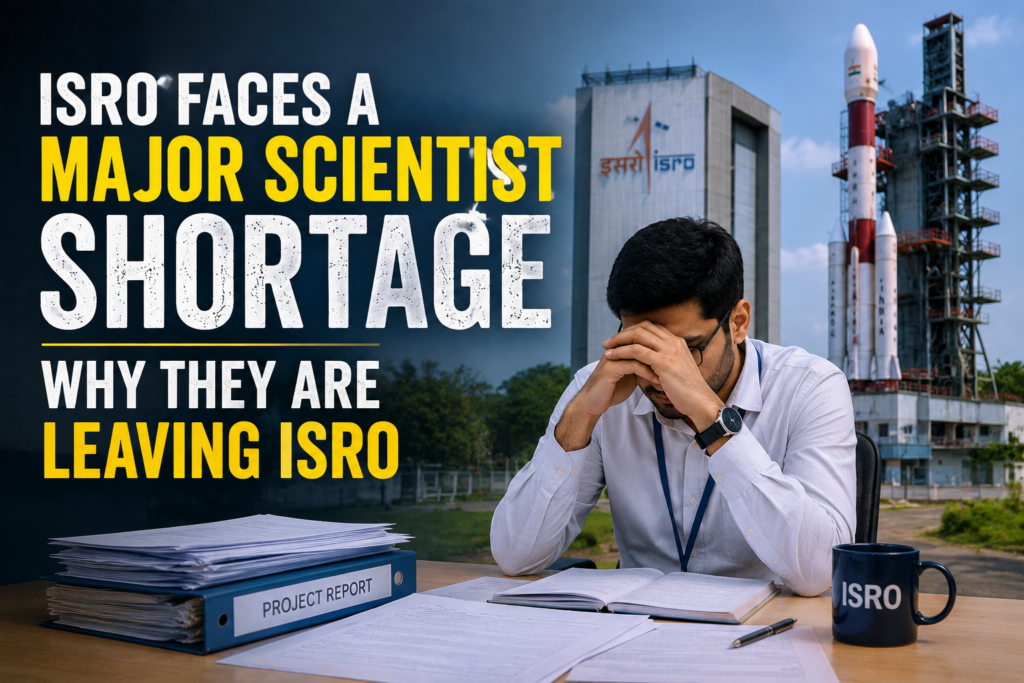
Recent reports indicate that more than 100 scientists and engineers have resigned or taken voluntary retirement in recent months, while the Department of Space is also dealing with its highest vacancy rate in around 25 years, with nearly 30% of sanctioned posts lying vacant. The situation has become serious enough that the government has tightened resignation and voluntary retirement rules for scientists working on strategic missions such as Gaganyaan.
This has raised an important question:
Why are ISRO scientists leaving at a time when India’s space programme is entering its most ambitious phase?
The answer isn’t as simple as “low salaries.” It is the result of multiple factors that have transformed India’s space industry over the last few years.
ISRO’s Growing Ambitions Need More Scientists Than Ever
Today’s ISRO is very different from the organisation it was a decade ago.
Instead of managing only satellite launches, it is simultaneously working on:
- Gaganyaan – India’s first human spaceflight mission
- Chandrayaan-4 lunar sample-return mission
- Future Mars exploration
- Shukrayaan (Venus mission)
- NISAR Earth observation mission
- India’s own space station
- Navigation, communication, and defence satellites
Each mission requires highly specialised engineers, propulsion experts, avionics specialists, software developers, and mission planners.
At the same time, staffing has not kept pace with the expanding workload, creating significant pressure on existing teams.
The Biggest Reason: India’s Private Space Revolution
The biggest reason behind the recent resignations is the rapid growth of India’s private space industry.
Until a few years ago, ISRO was virtually the only major employer for aerospace scientists in India.
That changed after the Indian government opened the space sector to private companies in 2020.
Today, startups such as Skyroot Aerospace, Agnikul Cosmos, Pixxel, Bellatrix Aerospace, Digantara, Dhruva Space, and others are building rockets, satellites, propulsion systems, and Earth-observation technologies.
These companies actively recruit experienced ISRO scientists because they already possess years of hands-on experience in mission-critical technologies.
Better Salaries Are Hard to Ignore
ISRO follows the Central Government pay structure.
Although the salaries are respectable, they often cannot compete with the compensation offered by private aerospace companies.
Many startups and commercial space firms provide:
- Higher salaries
- Performance bonuses
- Employee stock ownership (ESOPs)
- Faster salary growth
- Attractive joining packages
For mid-career scientists supporting families and planning their financial future, these opportunities can be difficult to decline.
Faster Career Growth
Career progression within ISRO follows government service rules, where promotions are generally linked to experience, seniority, and available positions.
In contrast, private companies reward performance more aggressively.
A young engineer may become:
- Team Lead
- Technical Manager
- Project Head
- Chief Engineer
much earlier than would typically be possible in a traditional government organisation.
This appeals particularly to ambitious young scientists eager to take on leadership responsibilities.
Greater Freedom to Innovate
Private space companies often operate with fewer administrative layers.
Scientists can:
- Test new technologies more quickly.
- Work directly with founders and decision-makers.
- Build commercial products for global markets.
- See their ideas implemented faster.
For engineers passionate about innovation, this environment can be highly motivating.
Heavy Workload and Staff Shortages
One of the biggest concerns is the increasing workload.
ISRO is preparing multiple flagship missions while reports indicate that nearly three out of every ten sanctioned posts are vacant. This means existing scientists often have to manage additional responsibilities across complex programmes.
Why the Government Stepped In
The government is not concerned simply because scientists are leaving—it is concerned because experienced scientists working on strategic national missions are leaving.
Replacing an engineer who has spent years working on rocket propulsion, spacecraft navigation, or crew safety is not something that can be done overnight.
To reduce disruption, the Department of Space has directed ISRO centres not to routinely approve resignations or voluntary retirement requests from scientific and technical personnel associated with critical missions like Gaganyaan.
Does This Mean ISRO Is in Trouble?
Not necessarily.
ISRO continues to launch satellites, develop new spacecraft, and prepare for future missions.
However, retaining experienced talent has become one of its biggest organisational challenges.
Many experts believe the current situation reflects a broader shift: India’s space ecosystem is expanding beyond a single government agency. Scientists now have opportunities in startups, private aerospace firms, research organisations, and international collaborations.
The challenge for ISRO is to remain an employer where the country’s brightest engineers choose to build long-term careers while also supporting a thriving commercial space sector.
How Can ISRO Retain Its Best Talent?
Experts have suggested several measures:
- Introduce more competitive salary structures for specialised roles.
- Expand recruitment to reduce staffing shortages.
- Create faster promotion pathways for high-performing scientists.
- Strengthen research partnerships with universities and startups.
- Offer greater flexibility for innovation and interdisciplinary projects.
- Provide additional incentives for scientists working on strategic national missions.
These steps could help ISRO retain experienced professionals while continuing to support India’s growing private space industry.
Final Thoughts
ISRO’s recent talent shortage is not the result of a failing space programme. On the contrary, it reflects the rapid evolution of India’s space sector. As private aerospace companies flourish, scientists now have more career choices than ever before.
The reported departure of more than 100 scientists and the nearly 30% vacancy rate highlight the need for stronger workforce planning and retention policies, especially as India prepares for landmark missions like Gaganyaan, Chandrayaan-4, and its future space station.
India’s ambitions in space are bigger than ever. Ensuring that ISRO continues to attract and retain world-class scientific talent will be just as important as building the next rocket or landing on the Moon.