|
Getting your Trinity Audio player ready...
|
India has produced many leaders who have shaped its history through politics, governance, science, and social reform. Among them stands Anna Hazare, a man who never held a constitutional office yet became one of the most influential public figures in modern India. Through peaceful protests, hunger strikes, and unwavering commitment to transparency, Hazare transformed the conversation around corruption and citizen participation in governance. His movement inspired millions of Indians to demand greater accountability from those in power and demonstrated that a single determined individual could mobilize an entire nation.
Long before he became the face of the historic India Against Corruption Movement in 2011, Anna Hazare had already earned respect as a grassroots reformer. After serving in the Indian Army, he returned to his drought-stricken village of Ralegan Siddhi in Maharashtra and transformed it into one of India’s finest examples of rural development. His efforts in water conservation, afforestation, education, renewable energy, and village self-governance attracted national and international recognition.
More than a decade after the anti-corruption movement captured global attention, Anna Hazare continues to influence public life. Even in 2026, he remains active on issues related to transparency, governance, farmers’ welfare, and the Right to Information (RTI), proving that his commitment to public service has never diminished.
This article explores Anna Hazare’s life, military service, social reforms, anti-corruption campaigns, achievements, awards, controversies, and the enduring legacy that has made him one of India’s most respected social activists.
Who is Anna Hazare?
Anna Hazare, born Kisan Baburao Hazare, is an Indian social activist, former Army soldier, and Gandhian reformer best known for leading the India Against Corruption Movement and transforming Ralegan Siddhi into a model village. Throughout his life, he has promoted transparency, accountability, rural development, environmental conservation, and ethical governance.
Unlike many public figures, Hazare never entered electoral politics despite enjoying immense popularity. Instead, he chose to remain an independent social reformer who believes that real change comes through public participation rather than political power.
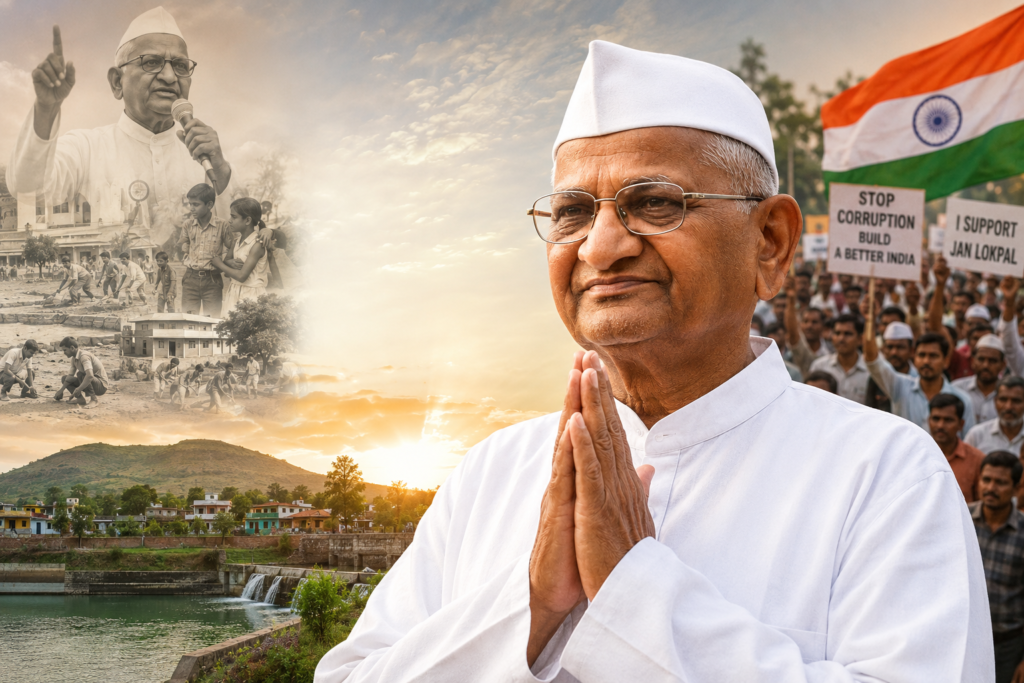
His simple lifestyle, white khadi attire, Gandhi cap, and commitment to non-violence have become symbols of his philosophy and have earned him admiration from millions of Indians.
Early Life and Family Background
Anna Hazare was born on 15 June 1937 in Bhingar, near Ahmednagar in present-day Maharashtra.
His father, Baburao Hazare, worked as an unskilled labourer, while his mother, Laxmibai Hazare, managed the household despite severe financial difficulties. The family struggled to meet basic needs, and after the death of his grandfather, they returned to their ancestral village, Ralegan Siddhi.
Because of poverty, Anna was sent to Mumbai to live with an aunt. There, he studied up to the seventh standard before leaving school to support his family financially. He worked in a flower shop and later started a small flower business.
Although his formal education ended early, Hazare developed strong values of discipline, honesty, and self-reliance. These experiences shaped his understanding of rural poverty and inspired his lifelong commitment to serving society.
Joining the Indian Army
In 1960, Anna Hazare joined the Indian Army Service Corps as a driver.
His military career marked a turning point in his life. Serving the nation exposed him to discipline, responsibility, and sacrifice. During the 1965 Indo-Pakistani War, he narrowly escaped death when enemy aircraft attacked his convoy near the Punjab border.
The attack claimed the lives of several fellow soldiers, while Hazare survived. This experience profoundly changed his outlook on life. He later described it as a moment that made him question why he had survived while others had not.
During his years in the Army, Hazare spent much of his free time reading books by Swami Vivekananda, Mahatma Gandhi, and Vinoba Bhave. Their teachings convinced him that the purpose of life was not personal success but service to humanity.
After completing around fifteen years of military service, he voluntarily retired in 1975 and returned to his native village with a mission to transform rural India.
Anna Hazare’s Complete Life Timeline (1937–2026)
Birth
Born as Kisan Baburao Hazare on 15 June 1937 in Bhingar, Maharashtra.
Family Struggles
Family moved back to Ralegan Siddhi due to financial hardship.
Mumbai Journey
Moved to Mumbai, worked in a flower shop and helped support his family.
Joined the Indian Army
Enlisted as a driver in the Army Service Corps.
Life-Changing War
Survived the Indo-Pakistani War, inspiring him to dedicate his life to serving society.
Army Retirement
Retired from military service and returned to Ralegan Siddhi to begin social work.
Village Transformation
Led watershed development, rainwater harvesting, afforestation, prohibition and educational reforms that transformed the village.
National Recognition
Received the Indira Priyadarshini Vrikshamitra Award for environmental conservation.
Padma Shri
Honoured with India’s prestigious Padma Shri award.
Padma Bhushan
Awarded the Padma Bhushan, India’s third-highest civilian honour.
Fight Against Corruption
Strengthened anti-corruption campaigns across Maharashtra demanding transparency and accountability.
RTI Movement
Became one of India’s strongest advocates for transparency and the Right to Information.
India Against Corruption
Led the historic nationwide movement demanding the Jan Lokpal Bill.
International Honour
Received the prestigious Allard Prize for International Integrity.
Continuing Public Service
Advocated electoral reforms, anti-corruption measures, Lokpal implementation, farmers’ welfare and transparency.
Still Inspiring India
Continued public campaigns for governance reforms, protection of the RTI Act and Gandhian values while remaining one of India’s most respected social activists.
Transforming Ralegan Siddhi into a Model Village
When Anna Hazare returned to Ralegan Siddhi after retiring from the Army, he found a village suffering from severe drought, unemployment, alcoholism, low agricultural productivity, and widespread poverty.
Rather than waiting for government intervention, Hazare believed that the villagers themselves had the power to change their future.
He encouraged the community to work together on long-term development projects.
Some of his major initiatives included:
- Rainwater harvesting
- Watershed development
- Construction of check dams
- Afforestation programmes
- Soil conservation
- Promotion of dairy farming
- Ban on alcohol production and sale
- Encouraging voluntary labour (Shramdaan)
- Expansion of education
- Village sanitation campaigns
- Promotion of renewable energy
- Community-led governance
These reforms dramatically improved groundwater levels, increased agricultural production, reduced migration, and improved the overall quality of life.
Today, Ralegan Siddhi is recognised as one of India’s most successful examples of sustainable rural development. Policymakers, researchers, students, and international visitors continue to study the village as a model for community-driven progress.
Gandhian Philosophy That Guided Anna Hazare
Anna Hazare has always described himself as a follower of Mahatma Gandhi rather than a politician. His methods of protest and reform are rooted in the Gandhian principles of truth (Satya), non-violence (Ahimsa), self-discipline, and public service.
Instead of using aggression or political influence, Hazare relied on peaceful demonstrations, fasting, dialogue, and community participation to bring about change. His belief was that lasting reforms could only be achieved when citizens themselves accepted responsibility for improving society.
He also drew inspiration from Swami Vivekananda, whose writings motivated him to dedicate his life to serving others, and Vinoba Bhave, whose Bhoodan Movement demonstrated the power of voluntary social reform.
This philosophy became the foundation of every campaign Anna Hazare led, from village development to the nationwide anti-corruption movement.
Anna Hazare’s Fight Against Corruption
After successfully transforming Ralegan Siddhi, Anna Hazare realised that corruption within government departments was one of the biggest obstacles to India’s development. He believed that even the best policies could not benefit ordinary citizens if corruption continued unchecked.
During the late 1980s and early 1990s, Hazare began exposing alleged corruption involving government officials and ministers in Maharashtra. Instead of organising violent demonstrations, he chose peaceful protests and indefinite hunger strikes to pressure authorities into taking action.
His campaigns resulted in several official inquiries, disciplinary actions, and increased public awareness about corruption in government offices. Over time, he became one of Maharashtra’s most respected anti-corruption activists.
Hazare repeatedly argued that corruption was not merely about financial losses but also about denying citizens their rights. According to him, every act of corruption reduced opportunities for the poor by diverting resources intended for education, healthcare, agriculture, and rural development.
His campaigns inspired thousands of ordinary citizens to demand greater transparency and accountability from public institutions.
The Right to Information (RTI) Movement
One of Anna Hazare’s greatest contributions to Indian democracy was his role in promoting transparency through the Right to Information (RTI) movement.
He firmly believed that corruption flourishes when governments operate without public scrutiny. If citizens had the legal right to access government records, officials would be forced to become more accountable.
In Maharashtra, Hazare organised several protests demanding stronger transparency laws. His efforts played an important role in creating public pressure for information rights, eventually contributing to the nationwide movement that led to the Right to Information Act, 2005.
The RTI Act empowered every Indian citizen to request information from public authorities regarding government decisions, expenditure, recruitment, and administration.
Today, millions of RTI applications are filed every year, making it one of India’s strongest tools against corruption.
The India Against Corruption Movement (2011)
Although Anna Hazare had spent decades working as a social activist, he became a household name in 2011 when he launched one of the largest public movements in independent India.
On 5 April 2011, Hazare began an indefinite hunger strike at Jantar Mantar in New Delhi, demanding the introduction of the Jan Lokpal Bill, an independent anti-corruption institution with powers to investigate complaints against public officials.
The movement quickly spread throughout the country.
People from every section of society joined the campaign, including:
- Students
- Working professionals
- Retired citizens
- Entrepreneurs
- Farmers
- Government employees
- Civil society organisations
Across India, thousands participated in:
- Peace marches
- Candlelight vigils
- Public rallies
- Signature campaigns
- Social media awareness drives
- Voluntary fasting
The movement became known as India Against Corruption (IAC) and represented one of the largest non-violent protests in modern Indian history.
Television channels provided continuous coverage, while social media platforms helped mobilise millions of supporters. For many young Indians, it was the first time they had actively participated in a national civic movement.
What Was the Jan Lokpal Bill?
The Jan Lokpal Bill was proposed as a stronger version of the government’s anti-corruption legislation.
Anna Hazare and his supporters argued that existing agencies investigating corruption lacked sufficient independence because they often functioned under political influence.
The proposed Jan Lokpal aimed to establish an independent institution with powers to:
- Investigate corruption complaints against public officials.
- Conduct inquiries without political interference.
- Complete investigations within a fixed time frame.
- Recommend prosecution where appropriate.
- Improve accountability across government departments.
Although Parliament eventually passed the Lokpal and Lokayuktas Act, 2013, it differed in several respects from the original Jan Lokpal proposal. Nevertheless, the movement significantly accelerated national discussions on anti-corruption reforms and institutional accountability.
Nationwide Support and Public Response
The India Against Corruption movement generated an unprecedented response across India.
Major cities including Delhi, Mumbai, Pune, Bengaluru, Chennai, Hyderabad, Ahmedabad, Jaipur, Kolkata, and Lucknow witnessed peaceful demonstrations.
Schools, colleges, resident associations, professionals, and social organisations organised awareness campaigns supporting Hazare’s demands.
Many participants viewed the movement as a symbol of hope against corruption and believed it represented the collective voice of ordinary citizens seeking cleaner governance.
The movement also demonstrated the growing influence of digital platforms in mobilising public participation, making it one of India’s first large-scale social movements to combine traditional protests with social media activism.
Political Impact of the Movement
Although Anna Hazare repeatedly stated that he did not wish to enter politics, the India Against Corruption movement had a significant influence on India’s political landscape.
Several prominent members associated with the movement later entered electoral politics and formed political organisations.
Hazare himself chose to remain independent and maintained that his objective was never political power but systemic reform.
The movement permanently changed public expectations regarding transparency, accountability, and citizen participation in governance.
Even today, anti-corruption remains a major issue in election campaigns, public debates, and policy discussions, reflecting the lasting influence of the movement.
Major Achievements of Anna Hazare
Throughout his remarkable journey, Anna Hazare has accomplished numerous milestones that continue to inspire people across India.
Some of his most significant achievements include:
- Successfully transformed Ralegan Siddhi from a drought-prone village into one of India’s leading models of sustainable rural development.
- Introduced effective watershed management and rainwater harvesting techniques that significantly improved agricultural productivity.
- Promoted afforestation and environmental conservation, helping restore ecological balance in the region.
- Encouraged voluntary community participation (Shramdaan), strengthening unity and local governance.
- Led statewide campaigns against corruption that resulted in inquiries into allegations involving public officials.
- Played an influential role in promoting the Right to Information movement, empowering citizens to seek transparency.
- Became the face of the India Against Corruption Movement, inspiring millions to participate peacefully in democratic reforms.
- Helped bring corruption to the forefront of national political discourse.
- Encouraged ethical leadership based on Gandhian values rather than political ambition.
- Inspired young Indians to become active participants in public affairs and governance.
Awards and Honours
Anna Hazare’s lifelong dedication to public service has earned him numerous national and international honours.
| Year | Award |
|---|---|
| 1986 | Indira Priyadarshini Vrikshamitra Award |
| 1989 | Krushi Bhushan Award (Government of Maharashtra) |
| 1990 | Padma Shri |
| 1992 | Padma Bhushan |
| 1996 | Shiromani Award |
| 1997 | Mahaveer Award |
| 1998 | CARE International Award |
| 1999 | Leading Social Contributor Award |
| 2003 | Integrity Award by Transparency International |
| 2005 | Honorary Doctorate – Gandhigram Rural University |
| 2008 | Jit Gill Memorial Award (World Bank) |
| 2011 | NDTV Indian of the Year (Shared) |
| 2013 | Allard Prize for International Integrity |
| 2014 | Dinanath Mangeshkar Jeevan Gaurav Award |
| 2021 | Lifetime Achievement Award |
These honours reflect recognition of Hazare’s work in rural development, environmental conservation, transparency, anti-corruption advocacy, and public service.
Leadership Style and Gandhian Principles
Anna Hazare’s leadership is unique because it is built on moral authority rather than political authority.
His approach is guided by:
- Truth (Satya)
- Non-violence (Ahimsa)
- Simplicity
- Transparency
- Self-discipline
- Community participation
- Accountability
Unlike many activists, Hazare has consistently avoided seeking political office. Instead, he has relied on peaceful protests, fasting, dialogue, and public awareness campaigns to influence policy and encourage reform.
His simple lifestyle, wearing traditional white khadi clothing and the iconic Gandhi cap, has become a symbol of his lifelong commitment to Gandhian ideals.
Criticism and Controversies
Like many influential public figures, Anna Hazare’s work has also attracted criticism and debate. While millions admire him for his honesty and dedication to public service, some of his campaigns, opinions, and methods have been questioned by political leaders, activists, and scholars.
One of the most discussed criticisms concerns his use of indefinite hunger strikes as a means of pressuring governments. Supporters consider fasting a legitimate Gandhian method of peaceful protest, while critics argue that repeated hunger strikes may place moral pressure on elected governments and Parliament.
Another area of debate has been the governance model implemented in Ralegan Siddhi. While the village is widely recognised for its remarkable transformation, some observers have questioned certain community rules, arguing that they are strict and may not be suitable for every village. Hazare has consistently maintained that these decisions were made collectively by villagers and were aimed at improving social welfare.
The India Against Corruption Movement also became politically controversial after some of its prominent members entered electoral politics. Hazare chose not to join any political party and publicly clarified that he wished to remain an independent social activist. Over the years, he has continued to emphasise that his mission is to improve governance rather than seek political office.
Despite these debates, Anna Hazare’s image as a clean, honest, and dedicated public servant has largely remained intact. Even many of his critics acknowledge his personal integrity and commitment to non-violent activism.
Anna Hazare in 2026
Even at the age of 89, Anna Hazare continues to be an active voice in India’s public life.
In 2026, he remained committed to protecting transparency, accountability, and democratic values. He continued advocating for the effective implementation of anti-corruption laws and stronger governance reforms across the country.
Hazare also voiced concerns regarding proposed changes to the Right to Information (RTI) Rules in Maharashtra, arguing that transparency is essential for a healthy democracy. Staying true to his Gandhian principles, he announced his willingness to undertake another peaceful hunger strike if citizens’ rights to access government information were weakened.
During the same period, Hazare appealed to the Central Government to hold peaceful discussions with activist Sonam Wangchuk, emphasising that dialogue should always take precedence over confrontation in a democratic society.
These actions demonstrate that even after decades of public service, Anna Hazare continues to participate in national conversations about governance, transparency, and citizens’ rights.
Interesting Facts About Anna Hazare
Although Anna Hazare is widely known for his anti-corruption campaigns, there are many lesser-known facts about his life.
- His real name is Kisan Baburao Hazare.
- He served in the Indian Army for nearly fifteen years before becoming a social activist.
- The 1965 Indo-Pakistani War changed the course of his life after he survived an attack that killed several fellow soldiers.
- Inspired by Swami Vivekananda, Mahatma Gandhi, and Vinoba Bhave, he decided to dedicate his life to public service.
- He has remained unmarried throughout his life and follows a simple lifestyle based on Gandhian values.
- Anna Hazare does not own luxurious property or expensive vehicles and has consistently promoted simple living.
- Ralegan Siddhi has become an internationally recognised model village for sustainable rural development.
- Millions of Indians participated in the India Against Corruption Movement, making it one of the largest peaceful public movements in independent India.
- His iconic white Gandhi cap and khadi attire have become symbols of honesty, simplicity, and public service.
- Despite receiving offers to enter politics, Anna Hazare has consistently refused to contest elections.
Anna Hazare’s Legacy
Anna Hazare’s contribution to India extends far beyond a single anti-corruption movement.
He demonstrated that meaningful change does not always require political power. Through determination, honesty, and peaceful activism, one individual can inspire millions of people and influence national policy.
His transformation of Ralegan Siddhi proved that rural development can be achieved through community participation, water conservation, environmental protection, and responsible local leadership. Today, development experts continue to study the village as one of India’s most successful examples of sustainable rural transformation.
The India Against Corruption Movement fundamentally changed public discourse in India. It encouraged citizens to question corruption, demand transparency, and participate actively in democratic processes. The movement also inspired a new generation of young Indians to become more aware of governance, accountability, and civic responsibility.
Anna Hazare’s greatest legacy lies not only in the laws he influenced but also in the confidence he gave ordinary citizens—that peaceful, non-violent action can bring national issues to the forefront and inspire reform.
FAQs
Who is Anna Hazare?
Anna Hazare is an Indian social activist, former Army soldier, and Gandhian reformer best known for leading the India Against Corruption Movement and transforming Ralegan Siddhi into a model village.
What is Anna Hazare’s real name?
His real name is Kisan Baburao Hazare.
Why is Anna Hazare famous?
He is famous for his anti-corruption campaigns, his role in promoting transparency and the Right to Information, and for leading the nationwide movement demanding the Jan Lokpal Bill in 2011.
What is the India Against Corruption Movement?
It was a nationwide peaceful movement launched in 2011 under Anna Hazare’s leadership to demand stronger anti-corruption laws and greater accountability in public administration.
What is the Jan Lokpal Bill?
The Jan Lokpal Bill proposed an independent anti-corruption institution with the authority to investigate allegations against public officials without political interference.
Which village did Anna Hazare transform?
Anna Hazare transformed Ralegan Siddhi in Maharashtra into one of India’s most successful model villages through water conservation, afforestation, education, and community participation.
Is Anna Hazare still alive in 2026?
Yes. As of 2026, Anna Hazare is alive and continues to participate in public discussions related to transparency, governance, farmers’ welfare, and citizens’ rights.
Which awards has Anna Hazare received?
He has received numerous honours, including the Padma Shri, Padma Bhushan, the Allard Prize for International Integrity, the Indira Priyadarshini Vrikshamitra Award, and several other recognitions for rural development and public service.
Conclusion
Anna Hazare’s life is a remarkable example of how integrity, discipline, and selfless service can create lasting social change. From his humble beginnings in Maharashtra to his service in the Indian Army and his transformation of Ralegan Siddhi into a model village, every phase of his journey reflects an unwavering commitment to the welfare of society.
His leadership during the India Against Corruption Movement in 2011 brought corruption, transparency, and accountability to the centre of India’s national conversation. While his methods and opinions have occasionally sparked debate, his dedication to peaceful protest, Gandhian values, and ethical governance has earned him widespread respect.
Even in 2026, Anna Hazare continues to remind the nation that democracy thrives when citizens remain informed, engaged, and willing to stand up for truth and accountability. His influence extends beyond awards and movements—he has inspired generations of Indians to believe that honest leadership and collective action can bring meaningful change.
Anna Hazare’s story is not just the biography of a social activist; it is the story of a man who proved that determination, simplicity, and non-violent action can leave an enduring mark on a nation’s history.