|
Getting your Trinity Audio player ready...
|
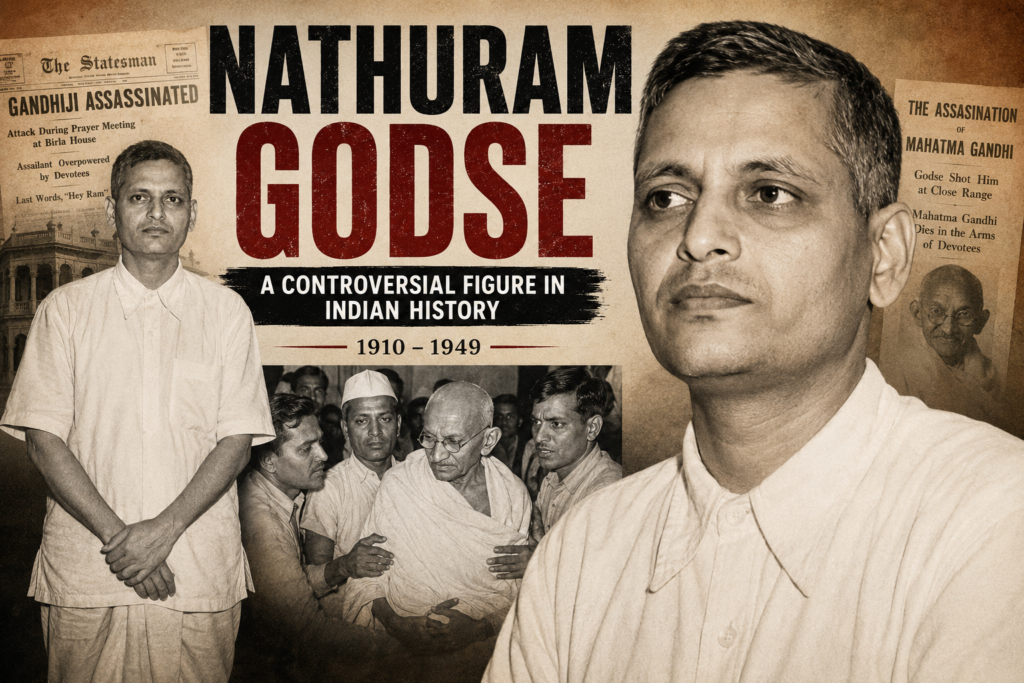
Few names in modern Indian history evoke as much debate and controversy as Nathuram Vinayak Godse. He is primarily remembered as the man who assassinated Mahatma Gandhi, the leader of India’s non-violent freedom movement, on 30 January 1948. The event shocked the newly independent nation and remains one of the most significant moments in India’s political history.
More than seven decades later, historians continue to examine Godse’s life, his political ideology, the circumstances surrounding the assassination, and its lasting impact on India. While some discussions focus on his motivations, the assassination itself is widely regarded as a defining act of political violence that profoundly altered the course of Indian history.
This article presents a factual, balanced, and historically grounded overview of Nathuram Godse’s life, political journey, the assassination of Mahatma Gandhi, the subsequent trial, and his historical legacy.
Who Was Nathuram Godse?
Nathuram Vinayak Godse was born on 19 May 1910 in Baramati, in present-day Maharashtra, then part of the Bombay Presidency under British rule. He was born into a Marathi Chitpavan Brahmin family.
His birth name was Ramachandra Vinayak Godse. According to family accounts, after several male children in the family died in infancy, his parents followed a local custom and raised him for a period as a girl, piercing his nose and dressing him in female clothing in the hope that this would protect him from a similar fate. This practice eventually led to the nickname “Nathuram”, meaning “Ram with a nose ring (nath).”
As he grew older, he resumed a conventional upbringing and received his education in Maharashtra. Although he did not complete formal higher education, he developed a keen interest in politics, history, and public affairs. He became an avid reader and participated in discussions on India’s struggle for independence, nationalism, and social reform.
Early Life and Family Background
Godse grew up during a period of major political change in India. The Indian independence movement was gaining momentum, and public debates surrounding colonial rule, self-governance, nationalism, and communal relations were widespread.
Coming from a modest middle-class family, he initially assisted with family responsibilities and later worked in different occupations, including tailoring and journalism. Over time, he became increasingly interested in political organisations that advocated Hindu nationalism.
Friends and contemporaries described him as disciplined, articulate, and deeply interested in political issues. His writings and speeches indicate that he closely followed national events and formed strong opinions about the future of India.
Political Activities and Ideological Background
During the 1930s and 1940s, Nathuram Godse became associated with Hindu nationalist circles. Historical records indicate that he had connections at different times with organisations such as the Rashtriya Swayamsevak Sangh (RSS) and later worked closely with the Hindu Mahasabha, although the nature and duration of those associations have been debated by historians.
Godse eventually became involved in publishing newspapers that expressed nationalist viewpoints. He served as an editor for publications including Agrani, which was later renamed Hindu Rashtra.
His articles frequently discussed politics, Partition, communal relations, and the future direction of independent India. These writings reflected his ideological disagreements with Mahatma Gandhi’s political philosophy, particularly Gandhi’s emphasis on non-violence, Hindu-Muslim unity, and reconciliation during the Partition period.
As communal violence intensified in the final years before Independence, political tensions across the country also increased dramatically.
India Before Partition
The years leading up to 1947 were among the most turbulent in India’s history.
The demand for Pakistan, increasing communal violence, negotiations with the British government, and disagreements among political leaders created enormous uncertainty.
When British India was partitioned into India and Pakistan in August 1947, millions of people migrated across newly created borders. The migration triggered widespread communal violence that resulted in hundreds of thousands of deaths and the displacement of millions.
Many political groups blamed one another for the tragedy. Mahatma Gandhi devoted much of his final year to promoting peace, urging communities to end violence, and encouraging reconciliation.
While Gandhi’s supporters viewed these efforts as consistent with his lifelong commitment to non-violence, some political opponents strongly disagreed with his approach. Nathuram Godse became one of Gandhi’s harshest critics during this period.
The Assassination of Mahatma Gandhi
By late 1947 and early 1948, India was struggling to recover from the devastating effects of Partition. Communal riots had claimed countless lives, millions of refugees had crossed newly drawn borders, and the newly independent nation faced enormous political and humanitarian challenges.
During this period, Mahatma Gandhi devoted himself to restoring peace. He travelled to riot-affected regions, appealed for communal harmony, and undertook several fasts to encourage an end to violence between Hindus and Muslims.
Nathuram Godse, however, strongly opposed Gandhi’s political approach. In his speeches and writings, he argued that Gandhi’s policies placed excessive emphasis on reconciliation and believed they did not adequately protect Hindu interests during the turbulent Partition period. These views later formed part of the explanation he presented during his trial.
On the evening of 30 January 1948, Mahatma Gandhi was walking toward a prayer meeting at Birla House (now Gandhi Smriti) in New Delhi. As Gandhi greeted those gathered, Nathuram Godse approached him from the crowd and fired three shots at close range using a Beretta semi-automatic pistol.
Gandhi collapsed immediately and died shortly afterwards from his injuries.
The assassination shocked India and the world. News of Gandhi’s death spread rapidly, leading to widespread grief and mourning across the country. Prime Minister Jawaharlal Nehru addressed the nation in a historic radio broadcast, announcing Gandhi’s death and describing it as a profound loss for India.
The killing of Gandhi remains one of the most significant political assassinations in modern history and marked a turning point in the newly independent Republic of India.
Arrest and Investigation
Immediately after the shooting, Nathuram Godse did not attempt to escape. He was apprehended at the scene by members of the public and security personnel before being taken into police custody.
The investigation that followed uncovered a broader conspiracy involving several individuals. Authorities examined evidence, witness statements, correspondence, and the movements of those believed to have participated in planning the assassination.
Among those charged were Narayan Apte, Vishnu Karkare, Gopal Godse, Madanlal Pahwa, Shankar Kistaiya, and others. The investigation also examined allegations concerning the involvement of Vinayak Damodar Savarkar, but the court ultimately acquitted Savarkar due to insufficient evidence linking him to the conspiracy.
The assassination also prompted the Government of India to temporarily ban the Rashtriya Swayamsevak Sangh (RSS) in 1948 while investigations were underway. Although Nathuram Godse had earlier associations with the RSS, the organisation denied involvement in the assassination. The ban was later lifted after certain conditions were met.
The Trial
The trial began in May 1948 before a Special Court established to hear the Gandhi assassination case.
Throughout the proceedings, prosecutors presented eyewitness testimony, forensic evidence, recovered weapons, documents, and statements from the accused.
Nathuram Godse admitted that he had fired the fatal shots. Rather than denying responsibility, he explained the political and ideological reasons that had motivated his actions. His courtroom statement has since become one of the most discussed documents relating to the assassination, although historians continue to debate aspects of its interpretation and historical context.
After months of hearings, the court concluded that the evidence established Godse’s guilt beyond reasonable doubt.
On 8 November 1949, Nathuram Godse and Narayan Apte were sentenced to death for the assassination of Mahatma Gandhi.
Several other accused received varying prison sentences based on their involvement in the conspiracy.
Execution
Following the dismissal of appeals, Nathuram Godse and Narayan Apte were executed by hanging on 15 November 1949 at Ambala Central Jail in present-day Haryana.
The executions brought the legal proceedings to an end, but public discussion surrounding the assassination has continued for decades.
Historians continue to study court records, contemporary documents, government archives, and political writings to better understand the circumstances that led to Gandhi’s assassination and its impact on India’s political development.
Understanding Godse’s Motives: A Historical Perspective
One of the most frequently asked questions is why Nathuram Godse assassinated Mahatma Gandhi.
According to Godse’s own statements during the trial, he believed Gandhi’s political decisions—particularly during the period surrounding Partition and efforts to promote communal harmony—were harmful to India’s interests. He criticised Gandhi’s methods and argued that they favoured reconciliation at a time of intense communal conflict.
These explanations represent Godse’s own stated motivations, and they are important historical sources for understanding his perspective.
However, it is equally important to distinguish between explaining historical motives and justifying political violence.
The Indian judicial system found Godse guilty of murder, and the assassination has been widely regarded by historians as a tragic act of political violence that deprived India of one of its foremost leaders. Studying the historical context helps explain how the event occurred, but it does not imply approval or endorsement of the act.
Immediate Impact on India
Gandhi’s assassination had profound consequences for the newly independent nation.
Millions of Indians participated in mourning ceremonies, while leaders across the political spectrum condemned the killing. The Government intensified efforts to address communal tensions and took action against organisations and individuals suspected of promoting extremist violence.
Internationally, the assassination drew widespread condemnation. Newspapers around the world described Gandhi’s death as a loss not only for India but also for the global movement for peace and non-violent resistance.
The event reinforced Gandhi’s status as an international symbol of non-violence and influenced civil rights leaders, social reformers, and peace activists for generations.
Was Nathuram Godse Right?
This question has remained one of the most debated and sensitive topics in modern Indian history. Supporters of Nathuram Godse have argued that he believed Mahatma Gandhi’s policies, particularly during the Partition of India, were harmful to the country’s interests. These arguments are reflected in Godse’s own courtroom statement and later writings.
However, the overwhelming historical and legal consensus does not regard the assassination of Mahatma Gandhi as justified. Gandhi was an unarmed leader who advocated non-violence, and his killing on 30 January 1948 was treated as a criminal act by the Indian legal system. Godse was arrested, tried in court, found guilty of murder, and executed on 15 November 1949.
Historians continue to debate the political climate, communal tensions, and ideological conflicts of the late 1940s. Those debates help explain why the assassination occurred, but they do not establish that the assassination itself was justified. Understanding the historical context is important, but it is equally important to distinguish between explaining an event and endorsing it.
Today, Nathuram Godse remains one of the most controversial figures in Indian history. His actions continue to generate discussion among historians, political scholars, and the public, while Mahatma Gandhi’s philosophy of non-violence remains internationally recognised and influential.
Nathuram Godse’s Complete Life
1910 – Birth
Nathuram Vinayak Godse was born on 19 May 1910 in Baramati, Bombay Presidency (now in Maharashtra), into a Marathi Chitpavan Brahmin family. His birth name was Ramachandra Vinayak Godse.
1910s–1920s – Childhood
He spent his early years in Maharashtra and attended local schools. Family traditions and personal experiences during childhood have often been mentioned in biographies discussing his upbringing.
1930s – Interest in Nationalist Politics
As India’s freedom movement gained momentum, Godse developed a keen interest in political affairs. During this period, he became associated with Hindu nationalist circles and participated in political discussions concerning India’s future under British rule.
Late 1930s – Journalism
Godse entered journalism and became involved in publishing newspapers expressing nationalist viewpoints. He later served as editor of Agrani, which was subsequently renamed Hindu Rashtra.
1940–1946 – Political Activism
He continued writing articles and participating in political activities. His speeches and editorials increasingly criticised Mahatma Gandhi’s political philosophy and expressed opposition to Gandhi’s views on communal harmony and national politics.
1947 – Partition of India
Following the Partition of British India into India and Pakistan, widespread communal violence erupted across the subcontinent. These events deeply influenced political discourse, and Godse became increasingly critical of Gandhi’s role during this period.
30 January 1948 – Assassination of Mahatma Gandhi
Godse assassinated Mahatma Gandhi at Birla House, New Delhi, while Gandhi was on his way to an evening prayer meeting. He was immediately arrested at the scene by members of the public and security personnel.
1948 – Gandhi Assassination Trial
Godse and several co-accused were tried before a Special Court. During the proceedings, he admitted responsibility for the shooting and presented his political reasoning in court.
8 November 1949 – Death Sentence
The court found Nathuram Godse guilty of murder and conspiracy. He and Narayan Apte were sentenced to death.
15 November 1949 – Execution
Nathuram Godse was executed by hanging at Ambala Central Jail along with Narayan Apte. He was 39 years old.
Historical Debates and Legacy
More than seven decades after the assassination of Mahatma Gandhi, Nathuram Godse remains one of the most controversial figures in Indian history.
Historians have extensively studied his writings, courtroom statement, political associations, and the broader circumstances surrounding the assassination. Research into his life often focuses on understanding the political tensions, communal violence, and ideological divisions that marked the final years of British rule and the early months of independent India.
Some scholars examine Godse’s stated motivations to better understand the historical context in which the assassination occurred. Others emphasise that Gandhi’s killing represented a tragic act of political violence that had a profound impact on India’s democracy and public life.
Understanding these differing historical perspectives is important for studying the period. At the same time, explaining the context of the assassination is not the same as endorsing or justifying it.
FAQs
Who was Nathuram Godse?
Nathuram Vinayak Godse was an Indian political activist and newspaper editor best known for assassinating Mahatma Gandhi on 30 January 1948 in New Delhi.
What was Nathuram Godse’s real name?
His birth name was Ramachandra Vinayak Godse.
When was Nathuram Godse born?
He was born on 19 May 1910 in Baramati, Bombay Presidency (present-day Maharashtra).
Why did Nathuram Godse assassinate Mahatma Gandhi?
According to his own courtroom statement, Godse believed Gandhi’s political decisions, particularly during the period surrounding Partition, were harmful to India’s interests. These were his stated motivations. The Indian courts found him guilty of murder, and historians distinguish between explaining those motivations and justifying the assassination.
When did Nathuram Godse assassinate Mahatma Gandhi?
The assassination took place on 30 January 1948 at Birla House in New Delhi during Gandhi’s evening prayer meeting.
What happened after the assassination?
Godse was arrested immediately, tried in court along with several co-accused, convicted of murder, and sentenced to death.
When was Nathuram Godse executed?
He was executed by hanging on 15 November 1949 at Ambala Central Jail, along with Narayan Apte.
How is Nathuram Godse viewed today?
He remains one of the most debated and controversial figures in Indian history. While historians continue to study his life and the political circumstances surrounding the assassination, the killing of Mahatma Gandhi is widely regarded as a pivotal act of political violence in independent India.
Conclusion
Nathuram Godse occupies a unique and deeply controversial place in India’s history because of his role in the assassination of Mahatma Gandhi. His life, political beliefs, and actions have been the subject of extensive historical research, legal analysis, and public debate.
Studying Godse’s biography provides insight into the turbulent years surrounding India’s independence and Partition, when political tensions and communal violence profoundly shaped the nation’s future. At the same time, it highlights the importance of understanding historical events within their broader social and political context.
The assassination of Mahatma Gandhi on 30 January 1948 remains one of the defining moments of modern Indian history. While historians continue to examine the motivations, circumstances, and consequences of the event, its legacy underscores the enduring significance of democratic dialogue, the rule of law, and the rejection of political violence as a means of resolving ideological differences.