|
Getting your Trinity Audio player ready...
|
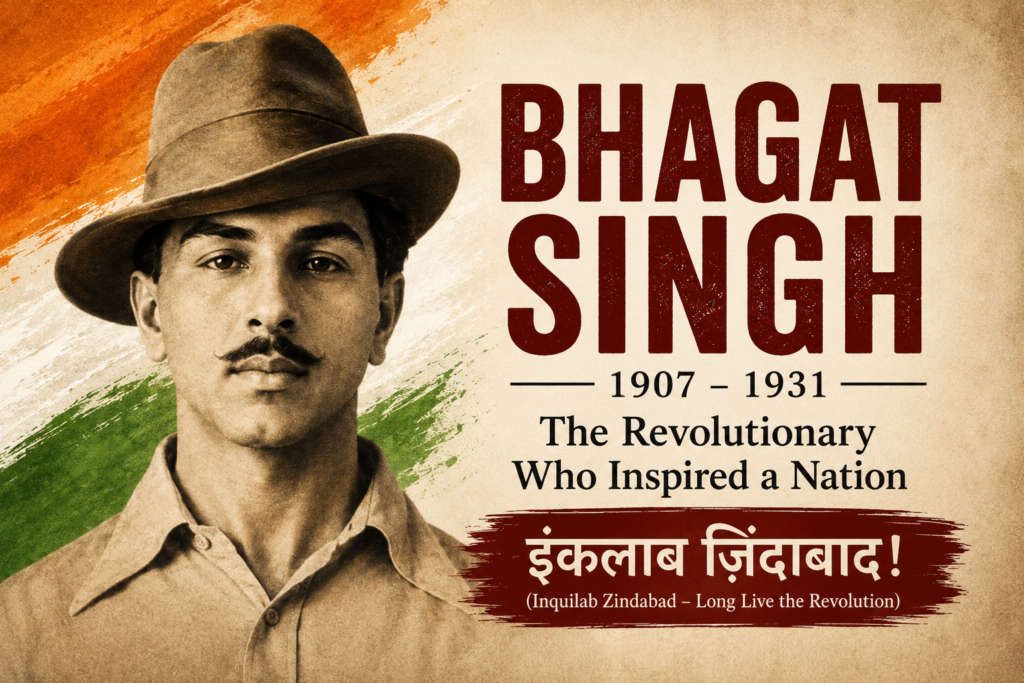
Among the countless heroes of India’s freedom struggle, Bhagat Singh stands as one of the most influential and widely remembered revolutionaries. His courage, sacrifice, and unwavering commitment to India’s independence made him an enduring symbol of patriotism. Although he lived only 23 years, his ideas and actions left a profound impact on India’s fight against British colonial rule.
Unlike many freedom fighters of his time, Bhagat Singh believed that political freedom also required social justice, equality, and the awakening of young minds. He was not only a revolutionary but also a thoughtful writer, reader, and political thinker whose ideas continue to inspire generations.
His execution by the British government on 23 March 1931, alongside Shivaram Rajguru and Sukhdev Thapar, transformed him into one of the greatest martyrs of India’s independence movement.
This article explores Bhagat Singh’s life, early years, revolutionary activities, political philosophy, trial, execution, achievements, timeline, and lasting legacy.
Who Was Bhagat Singh?
Bhagat Singh was an Indian revolutionary born on 28 September 1907 in Banga village, Lyallpur District, Punjab (now in Pakistan). He came from a Sikh family deeply involved in India’s struggle against British rule.
His father Kishan Singh, uncle Ajit Singh, and other family members actively participated in nationalist movements. Growing up in such an environment, Bhagat Singh developed patriotic ideals at an early age.
He became one of the leading members of the Hindustan Socialist Republican Association (HSRA) and played a key role in revolutionary activities aimed at challenging British colonial authority.
Although often remembered for dramatic acts of resistance, Bhagat Singh also spent considerable time reading political philosophy, history, economics, and revolutionary literature from around the world.
Early Life and Family Background
Bhagat Singh was born into a family known for its strong nationalist beliefs. His father and uncles had already been involved in protests against British rule before his birth.
As a child, he displayed exceptional curiosity and intelligence. Stories about India’s struggle for independence greatly influenced him. Family discussions frequently revolved around patriotism, political developments, and resistance against colonial rule.
One event that profoundly shaped his worldview was the Jallianwala Bagh Massacre of 1919. Following the tragic killing of hundreds of unarmed civilians in Amritsar, the young Bhagat Singh reportedly visited the site, collecting a handful of blood-stained soil as a symbol of remembrance. The incident strengthened his determination to dedicate his life to India’s freedom.
He received his education at the Dayanand Anglo-Vedic (DAV) School and later enrolled at the National College in Lahore, established by Lala Lajpat Rai to promote nationalist education free from British influence.
Education and Intellectual Growth
Bhagat Singh was far more than an armed revolutionary. He was an avid reader who studied the works of Indian and international thinkers.
His interests included:
- Indian history
- Political science
- Economics
- Socialism
- Philosophy
- World revolutions
- Anti-colonial movements
He read extensively about the French Revolution, the Russian Revolution, Irish independence, and the writings of Karl Marx, Vladimir Lenin, Giuseppe Mazzini, and other political thinkers.
These studies shaped his belief that India’s independence should lead not only to political freedom but also to a society based on equality, justice, and the upliftment of ordinary people.
His writings demonstrate a mature understanding of nationalism, secularism, and social change despite his young age.
Joining the Revolutionary Movement
By the early 1920s, Bhagat Singh had become actively involved in revolutionary politics.
He joined organisations working to end British rule through direct action and later became a prominent member of the Hindustan Socialist Republican Association (HSRA).
Unlike many underground revolutionaries, Bhagat Singh believed that revolutionary action should inspire the public rather than create fear. He argued that meaningful political change required awakening the masses and encouraging young Indians to participate in the freedom struggle.
He also worked as a journalist and contributed articles to newspapers under various pseudonyms, discussing nationalism, social justice, communal harmony, and the future of an independent India.
The Death of Lala Lajpat Rai
A major turning point came in 1928.
When the British Government appointed the Simon Commission to discuss constitutional reforms without including any Indian members, widespread protests erupted across the country.
On 30 October 1928, a peaceful demonstration in Lahore was led by veteran nationalist Lala Lajpat Rai. During the protest, police carried out a brutal lathi charge under the supervision of James A. Scott, the city’s police superintendent.
Lala Lajpat Rai sustained serious injuries and died a few weeks later.
Bhagat Singh and several fellow revolutionaries believed those responsible should be held accountable. While attempting to target Scott, they mistakenly identified and shot Assistant Superintendent of Police John Saunders on 17 December 1928.
Following the incident, Bhagat Singh and his associates went into hiding as the British authorities launched an extensive search for those involved.
The Central Legislative Assembly Bombing
After the Saunders incident, Bhagat Singh and his fellow revolutionaries shifted their focus toward drawing national attention to British colonial policies. They believed symbolic acts of resistance could awaken public opinion and inspire Indians to join the freedom movement.
One such event occurred on 8 April 1929, when Bhagat Singh and Batukeshwar Dutt entered the Central Legislative Assembly in Delhi (now the Parliament House complex).
The British Government was preparing to pass the Public Safety Bill and the Trade Disputes Bill, which many Indian leaders believed would suppress political freedoms and workers’ rights.
To protest these measures, Bhagat Singh and Dutt threw two low-intensity bombs into an empty area of the Assembly chamber after ensuring that no one would be killed. They also distributed revolutionary leaflets carrying the famous slogan:
“It takes a loud voice to make the deaf hear.”
Rather than escaping, both men deliberately remained at the scene and surrendered peacefully. Their objective was to use the courtroom as a platform to explain their revolutionary ideas to the Indian public.
The incident attracted widespread attention across India and internationally, making Bhagat Singh one of the best-known faces of the independence movement.
Arrest and Imprisonment
Following the Assembly bombing, Bhagat Singh and Batukeshwar Dutt were arrested and imprisoned.
During the investigation, British authorities linked Bhagat Singh to the earlier Saunders assassination case. This led to the reopening of investigations into revolutionary activities carried out by members of the Hindustan Socialist Republican Association (HSRA).
Several revolutionaries, including Sukhdev Thapar, Shivaram Rajguru, and others, were also arrested as the investigation expanded.
The British Government viewed the case as one of the most significant political trials of the colonial era.
The Historic Hunger Strike
While imprisoned, Bhagat Singh and other political prisoners launched a historic hunger strike.
Their demands included:
- Equal treatment for Indian and European prisoners.
- Better food and sanitation.
- Access to books and newspapers.
- Proper clothing.
- Recognition as political prisoners rather than ordinary criminals.
The hunger strike lasted for weeks and attracted nationwide attention.
One of the participants, Jatin Das, died after 63 days of fasting, becoming a martyr of the movement. His funeral procession drew massive crowds across India and intensified public criticism of British prison policies.
The hunger strike transformed Bhagat Singh into a national hero. Newspapers reported extensively on the prisoners’ conditions, and public sympathy for the revolutionaries increased significantly.
The Lahore Conspiracy Case
The British Government subsequently initiated the Lahore Conspiracy Case, charging Bhagat Singh, Rajguru, Sukhdev, and several others with conspiracy against the Crown, the murder of John Saunders, and other revolutionary activities.
The trial became one of the most closely followed legal proceedings of the Indian freedom movement.
Throughout the hearings, Bhagat Singh remained calm and composed. He frequently used the courtroom to express his political beliefs and emphasised that the revolutionaries were motivated by the desire to end colonial rule rather than by personal gain.
His conduct during the trial further enhanced his reputation among many Indians who viewed him as fearless and deeply committed to the cause of independence.
Political Philosophy and Writings
Bhagat Singh is remembered not only for his revolutionary actions but also for his intellectual contributions.
He believed that true independence should include:
- Social equality
- Economic justice
- Freedom from exploitation
- Secularism
- Scientific thinking
- Universal education
One of his most well-known essays is “Why I Am an Atheist,” written during his imprisonment. In it, he explained his personal beliefs and reflected on faith, reason, courage, and individual responsibility.
His writings reveal a thoughtful political thinker who encouraged young people to question injustice, embrace education, and participate actively in building a better society.
Even today, historians study his essays as important documents of India’s intellectual and political history.
Execution
After months of legal proceedings, the Special Tribunal sentenced Bhagat Singh, Shivaram Rajguru, and Sukhdev Thapar to death.
Despite widespread appeals from political leaders, public demonstrations, and requests for clemency from across India and abroad, the British Government decided to carry out the sentence.
On the evening of 23 March 1931, the three revolutionaries were executed at Lahore Central Jail.
According to historical accounts, they walked to the gallows with remarkable composure while raising slogans such as:
“Inquilab Zindabad” (Long Live the Revolution)
Bhagat Singh was only 23 years old.
Following the executions, their bodies were secretly taken away by British authorities and cremated near the banks of the Sutlej River. News of the executions spread rapidly, leading to widespread mourning and protests across India.
The date, 23 March, is now observed annually as Shaheed Diwas (Martyrs’ Day) in memory of Bhagat Singh, Rajguru, and Sukhdev.
Impact on India’s Freedom Struggle
Bhagat Singh’s sacrifice became one of the defining moments of India’s struggle for independence.
His courage inspired countless young Indians to join the freedom movement in different ways. While revolutionary organisations admired his determination, leaders from other strands of the independence movement also acknowledged his patriotism and sacrifice, even if they differed with his methods.
His execution intensified public opposition to British rule and strengthened nationalist sentiment throughout the country.
Today, Bhagat Singh is remembered not only as a revolutionary but also as a symbol of courage, intellectual curiosity, and dedication to India’s freedom.
To protest these measures, Bhagat Singh and Batukeshwar Dutt threw two low-intensity bombs into an empty area of the Assembly chamber after ensuring that no one would be killed. They also distributed revolutionary leaflets and raised the iconic slogan:
“इंकलाब ज़िंदाबाद!” (Inquilab Zindabad – Long Live the Revolution)
The slogan, originally popularised by Urdu poet Maulana Hasrat Mohani and later widely adopted by Bhagat Singh and his fellow revolutionaries, became one of the most powerful rallying cries of India’s freedom movement. It symbolised the desire for freedom, justice, and revolutionary change rather than indiscriminate violence.
Rather than escaping after the bombing, Bhagat Singh and Batukeshwar Dutt deliberately surrendered to the police. Their aim was to use the courtroom as a platform to explain their revolutionary ideas and inspire the people of India to join the struggle against British colonial rule.
The incident received widespread attention across India and internationally, making Bhagat Singh one of the most recognised faces of the Indian independence movement.
Bhagat Singh in Popular Culture
Bhagat Singh’s extraordinary life has inspired numerous books, documentaries, television programmes, and films. One of the most well-known portrayals is the 2002 Hindi film The Legend of Bhagat Singh, directed by Rajkumar Santoshi and starring Ajay Devgn in the lead role. The film depicts Bhagat Singh’s early life, revolutionary activities, the Assembly bombing, the Lahore Conspiracy Case, and his execution. Ajay Devgn received the National Film Award for Best Actor for his performance, and the film is widely regarded as one of the finest cinematic portrayals of the revolutionary.
Bhagat Singh’s Complete Life Timeline (1907–1931)
1907 – Birth
Bhagat Singh was born on 28 September 1907 in Banga village, Lyallpur District, Punjab (now in Pakistan), into a patriotic Sikh family actively involved in India’s freedom movement.
1919 – Jallianwala Bagh Massacre
At just 11 years old, Bhagat Singh was deeply affected by the Jallianwala Bagh Massacre in Amritsar. Historical accounts state that he visited the site soon afterwards and collected blood-stained soil, vowing to dedicate his life to India’s independence.
1923 – Joined National College, Lahore
He enrolled at National College, Lahore, founded by Lala Lajpat Rai, where he studied history, politics, literature, and revolutionary philosophy while participating in nationalist activities.
1924 – Joined Revolutionary Activities
Bhagat Singh became actively involved with revolutionary organisations working against British colonial rule and began associating with young freedom fighters across northern India.
1926 – Founded the Naujawan Bharat Sabha
He established the Naujawan Bharat Sabha, a youth organisation dedicated to inspiring patriotism, unity, and resistance against British rule among India’s younger generation.
1928 – Death of Lala Lajpat Rai & Saunders Incident
Following the death of Lala Lajpat Rai after a police lathi charge during protests against the Simon Commission, Bhagat Singh, Rajguru, and their associates targeted Assistant Superintendent John Saunders on 17 December 1928, believing they were avenging Rai’s death.
1929 – Central Legislative Assembly Bombing
On 8 April 1929, Bhagat Singh and Batukeshwar Dutt threw low-intensity bombs into the Central Legislative Assembly in Delhi to protest repressive British laws. They intentionally avoided causing fatalities, distributed revolutionary leaflets, raised the slogan “इंकलाब ज़िंदाबाद!”, and surrendered peacefully.
1929 – Historic Hunger Strike
While imprisoned, Bhagat Singh led a prolonged hunger strike demanding equal rights and humane treatment for Indian political prisoners. The protest gained nationwide attention and made him a symbol of resistance.
1930 – Lahore Conspiracy Case
The British Government prosecuted Bhagat Singh, Rajguru, Sukhdev, and others in the Lahore Conspiracy Case, charging them with conspiracy and the murder of John Saunders.
1931 – Execution
On 23 March 1931, Bhagat Singh, Shivaram Rajguru, and Sukhdev Thapar were executed at Lahore Central Jail. Bhagat Singh was only 23 years old, and the day is now commemorated annually as Shaheed Diwas (Martyrs’ Day).
Major Achievements
Although Bhagat Singh’s life was brief, his influence on India’s freedom struggle was extraordinary.
- Became one of the leading revolutionaries of the Hindustan Socialist Republican Association (HSRA).
- Founded the Naujawan Bharat Sabha to mobilise Indian youth.
- Helped transform revolutionary politics into a movement that inspired millions of young Indians.
- Used the Central Legislative Assembly protest to draw national and international attention to British colonial policies.
- Led a historic hunger strike that highlighted the treatment of political prisoners.
- Authored influential essays, including “Why I Am an Atheist,” reflecting his political philosophy and intellectual depth.
- Became one of the most enduring symbols of patriotism and sacrifice in India’s history.
Interesting Facts About Bhagat Singh
- His father Kishan Singh and uncle Ajit Singh were active freedom fighters.
- He was an avid reader with a personal library containing books on history, politics, economics, philosophy, and world revolutions.
- Bhagat Singh admired thinkers such as Karl Marx, Vladimir Lenin, Giuseppe Mazzini, and Thomas Paine, alongside Indian nationalist leaders.
- He often wrote articles under pseudonyms for revolutionary newspapers.
- His famous essay “Why I Am an Atheist” remains one of the most widely read writings by an Indian revolutionary.
- The slogan “इंकलाब ज़िंदाबाद!” became closely associated with him and continues to symbolise the spirit of freedom and resistance.
- Every year, 23 March is observed as Shaheed Diwas in honour of Bhagat Singh, Rajguru, and Sukhdev.
- Numerous schools, universities, roads, airports, parks, and public institutions across India are named after him.
Bhagat Singh in Popular Culture
Bhagat Singh’s life has inspired numerous books, documentaries, television programmes, and films. Among the most acclaimed is the 2002 Hindi film The Legend of Bhagat Singh, directed by Rajkumar Santoshi and starring Ajay Devgn in the lead role. The film portrays Bhagat Singh’s revolutionary journey, from his early political awakening to his execution. Ajay Devgn won the National Film Award for Best Actor for his performance, and the film is widely regarded as one of the finest cinematic depictions of the legendary freedom fighter.
Legacy
More than ninety years after his martyrdom, Bhagat Singh remains one of India’s most celebrated national heroes.
His courage, determination, and willingness to sacrifice his life for the cause of independence inspired countless freedom fighters during the colonial era and continue to inspire young people today. Beyond his revolutionary actions, Bhagat Singh’s writings reveal a thoughtful individual who believed that true freedom required equality, education, secularism, and social justice.
His legacy extends far beyond the events of 1928–1931. He represents the spirit of fearless patriotism, intellectual curiosity, and commitment to building a just and independent nation. Across India, memorials, museums, educational institutions, and annual commemorations ensure that his ideals remain alive for future generations.
FAQs
Who was Bhagat Singh?
Bhagat Singh was an Indian revolutionary and freedom fighter who became one of the leading figures in the struggle against British colonial rule.
When was Bhagat Singh born?
He was born on 28 September 1907 in Banga village, Lyallpur District, Punjab (now in Pakistan).
Why is Bhagat Singh famous?
He is remembered for his revolutionary activities against British rule, his role in the Central Legislative Assembly protest, his writings, his hunger strike, and his sacrifice for India’s independence.
What was Bhagat Singh’s famous slogan?
The slogan most closely associated with Bhagat Singh is “इंकलाब ज़िंदाबाद!” (Inquilab Zindabad – Long Live the Revolution).
What is “Why I Am an Atheist”?
It is one of Bhagat Singh’s most famous essays, written while he was in prison, explaining his personal beliefs and reflecting on reason, courage, and individual responsibility.
When was Bhagat Singh executed?
Bhagat Singh, Rajguru, and Sukhdev were executed on 23 March 1931 at Lahore Central Jail.
Which movie is based on Bhagat Singh’s life?
One of the most acclaimed films is The Legend of Bhagat Singh (2002) starring Ajay Devgn, who won the National Film Award for Best Actor for his portrayal.
Conclusion
Bhagat Singh’s life is a remarkable story of courage, conviction, and sacrifice. Though he lived for only 23 years, his contributions to India’s freedom struggle made him one of the nation’s greatest revolutionaries. His determination to challenge colonial rule, his commitment to justice, and his powerful writings continue to inspire millions.
His martyrdom on 23 March 1931 transformed him into an enduring symbol of patriotism. Today, Bhagat Singh is remembered not only for his revolutionary actions but also for his vision of an India founded on equality, education, secularism, and social justice. His legacy remains deeply woven into the history of India’s independence movement and continues to motivate generations to serve the nation with courage, integrity, and dedication.