|
Getting your Trinity Audio player ready...
|
The Indian Business ecosystem is rapidly changing. The rise of technology, changing consumer behaviour patterns, favourable government policies and changes in the global markets are redefining how businesses operate and compete. By now, you already know that good or bad, you need to be aware of what are the up and coming trends in business — No matter if it is a startup or MSME or even a large enterprise for that matter.
Identifying the Indian context — The Top Business Trends Every Indian Company Will Face in 2026 Talk About Opportunities and Threats that Will Shape How Businesses Do Well to the Next Generation Firms that drive innovation, use technology well, and adapt to changing customer expectations will thrive in an increasingly competitive landscape. This article reviews the most impactful business trends in India 2026 with concrete examples and implementable strategies for Indian businesses to gain competitive advantage.
1. Artificial Intelligence Becoming a Business Necessity
Artificial Intelligence (AI) is no longer just for the enterprise level By the start of 2026, every business is using AI in some manner to enhance efficiency, reduce costs and deliver better customer experiences.
AI is transforming:
- Customer support through AI chatbots
- Marketing with automated content and campaign optimization
- Sales forecasting using predictive analytics
- Inventory management
- Employee productivity through AI assistants
Example
Such as an AI-powered chatbot where an Indian e-commerce seller can respond to customer queries 24/7 and automatically suggest products as per previous purchases.
Actionable Tips
- Start with affordable AI tools before investing in enterprise solutions.
- Automate repetitive tasks such as email responses and report generation.
- Use AI-powered analytics for better decision-making.
2. Digital Transformation Beyond Large Enterprises
The digital transformation was earlier confined only to MNCs. Today, even small-size businesses are using cloud based technologies to stay in the race.
Key technologies include:
- Cloud accounting software
- ERP systems
- CRM platforms
- Workflow automation
- Digital payment solutions
For MSMEs, the implementation of digital tools results in operational efficiencies while minimising manual work and errors.
Example
A manufacturing MSME can integrate inventory, procurement, accounting, and sales into a single ERP system, saving time and improving visibility.
Benefits for MSMEs
- Faster operations
- Better customer management
- Reduced paperwork
- Improved collaboration
- Enhanced scalability
Digital transformation India is becoming one of the strongest drivers of business growth across industries.
3. Sustainability is Becoming a Competitive Advantage
Businesses are no longer run in a vacuum, as consumers, investors and regulators demand responsibility from companies. Consumers are working environmental and social responsibility into their purchasing decisions and brand loyalty.
Companies are focusing on:
- Eco-friendly packaging
- Renewable energy adoption
- Waste reduction
- Carbon footprint management
- ESG (Environmental, Social, and Governance) initiatives
Real-World Scenario
Improving Branded Image A food delivery company that transitions to biodegradable packaging can boost its brand image, while attracting eco-friendly consumers.
Actionable Tips
- Reduce plastic usage.
- Invest in energy-efficient equipment.
- Publish sustainability goals.
- Encourage recycling within the workplace.
Sustainability has moved from being merely good ethics to becoming good business.
4. Data-Driven Decision Making
Successful businesses are using data to eliminate guesswork.
Modern organizations rely on:
- Business analytics
- Customer behavior analysis
- Sales dashboards
- KPI tracking
- Predictive analytics
Instead of waiting to resolve issues, companies can seize opportunities ahead of their competition.
Example
For example, a retail chain may review customer buying patterns to forecast seasonal needs and adjust stock levels.
Key Metrics to Monitor
- Customer acquisition cost
- Customer lifetime value
- Revenue growth
- Conversion rate
- Employee productivity
- Customer satisfaction
Businesses that use data effectively make smarter and faster decisions.
5. Rise of Hyper-Personalized Customer Experiences
Today’s customers expect brands to understand their preferences and deliver personalized experiences.
Businesses are using AI and analytics for:
- Personalized product recommendations
- Customized email campaigns
- Dynamic website content
- Personalized offers
- Omnichannel customer engagement
Example
An online fashion retailer can recommend clothing based on browsing history, previous purchases, and regional preferences.
Benefits
- Higher conversion rates
- Improved customer loyalty
- Increased repeat purchases
- Better customer satisfaction
Hyper-personalization is becoming a major differentiator in Indian business trends.
6. Expansion of India’s Startup Ecosystem
India continues to strengthen its position as one of the world’s leading startup hubs.
The startup trends India ecosystem is benefiting from:
- Government incentives
- Improved access to funding
- Growing digital infrastructure
- Rising entrepreneurial culture
- Increasing investor confidence
Emerging sectors include:
- Artificial Intelligence
- HealthTech
- FinTech
- AgriTech
- ClimateTech
- Electric Vehicles
- DeepTech
- SaaS
Practical Opportunity
Traditional businesses can collaborate with startups to adopt innovative technologies without building everything internally.
The expanding startup ecosystem is creating exciting future business opportunities across multiple industries.
7. Remote, Hybrid & Flexible Work Models
Flexible work arrangements are becoming a permanent part of modern business operations.
Companies now recognize that hybrid work can improve productivity while reducing infrastructure costs.
Popular collaboration tools include:
- Microsoft Teams
- Google Workspace
- Slack
- Zoom
- Notion
Advantages
- Access to skilled professionals across India
- Better employee satisfaction
- Reduced office expenses
- Increased workforce diversity
- Improved work-life balance
Actionable Tips
- Establish clear communication guidelines.
- Use project management software.
- Focus on outcomes rather than working hours.
Flexible workplaces are becoming a competitive advantage in talent acquisition.
8. Cybersecurity Will Become a Top Priority
As businesses become more digital, cyber threats continue to increase.
Common risks include:
- Phishing attacks
- Ransomware
- Data breaches
- Financial fraud
- Identity theft
Even small businesses are frequent targets because they often have weaker security systems.
Best Practices
- Enable multi-factor authentication.
- Regularly update software.
- Conduct employee cybersecurity training.
- Encrypt sensitive customer data.
- Perform regular backups.
- Develop an incident response plan.
Strong cybersecurity builds customer trust while ensuring regulatory compliance.
9. Growth of Tier-2 & Tier-3 Markets
One of the most significant future business in India trends is the rapid growth of Tier-2 and Tier-3 cities.
Several factors are driving this expansion:
- Affordable smartphones
- Faster internet connectivity
- Digital payments
- Growing disposable income
- Expanding e-commerce
Real-World Example
An online education company can reach students in smaller cities through affordable digital courses and regional language content.
Business Opportunities
- Local manufacturing
- Healthcare services
- Retail expansion
- Logistics
- Digital commerce
- Financial services
Businesses that establish an early presence in these markets can gain a significant competitive advantage.
10. Government Policies Supporting Business Growth
Government initiatives continue to accelerate the Indian economy 2026 by promoting innovation, manufacturing, and entrepreneurship.
Major initiatives include:
Make in India
Encourages domestic manufacturing while attracting global investment.
Digital India
Promotes digital infrastructure, e-governance, and technology adoption.
Startup India
Supports entrepreneurs through tax benefits, funding opportunities, and simplified regulations.
Production Linked Incentive (PLI) Scheme
Encourages manufacturing across strategic sectors by rewarding increased production.
Ease of Doing Business Reforms
Simplifies business registration, compliance, and digital governance.
Actionable Tips
- Monitor new government incentives relevant to your industry.
- Explore export opportunities.
- Leverage available MSME support schemes.
- Invest in technology to maximize policy benefits.
Businesses that align their growth strategies with government priorities are likely to gain long-term advantages.
Conclusion
The Top Business Trends Every Indian Company Should Watch in 2026 show that innovation, adaptability, and customer focus is what the future has in store for businesses. These trends, from AI-based automation and digital transformation India initiatives to sustainability, cyber security, and the increased scale of Tier-2 business markets are changing the competitive game across verticals. In addition, strong government assistance and a blossoming startup culture are opening up new doors to growth.
Instead of treating these developments as threats, businesses should embrace them as opportunities to better modernize operations, nurture customer relationships and forge a resilient organization. Investing in technology, leveraging data-driven insights, switching to sustainable practices and skilling business teams at the same time will help Indian companies prepare for the long haul. Those businesses that stay proactive today will ensure they are best placed to remain competitive and take advantage of the future potential for business in India.
Frequently Asked Questions (FAQs)
1. What are the top business trends in India for 2026?
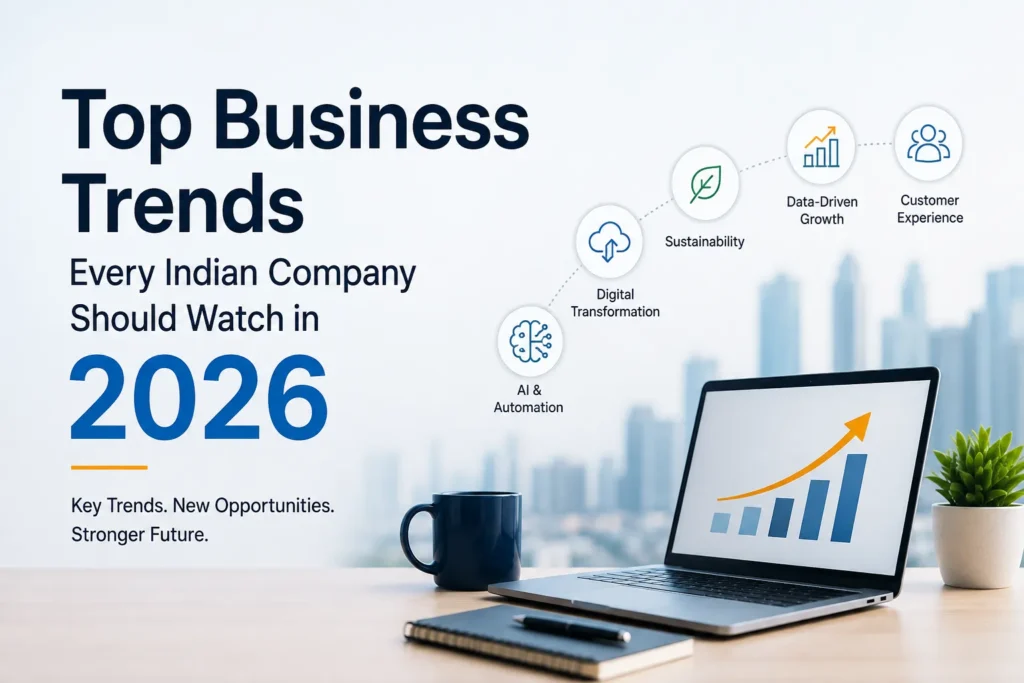
The top business trends for India in 2026 are likely to be: AI penetration, Digital transformation, Sustainability, Big data analytics, Cyber security, Startup ecosystem, Hybrid/remote working, growth into Tier 2 and Tier 3 cities.
2. Why is AI becoming important for Indian businesses?
AI enables organizations to automate mundane jobs, enhance customer support, tailor marketing, streamline operations and take improved business decisions while minimizing expenses.
3. How can MSMEs benefit from digital transformation?
MSMEs can increase their efficiency by using cloud software,ERP,CRM and automation tools and even digital payments platforms to reach faster growth with low operating expenses.
4. Why is sustainability becoming a competitive advantage?
Consumers and investors are more and more interested in companies that are environmentally responsible. Moreover, sustainable practices enhance the company’s image, cut costs, and are sustainable in the long run.
5. Which sectors offer the biggest future business opportunities in India?
Artificial Intelligence, FinTech, HealthTech, AgriTech, Electric Vehicles, renewable energy, SaaS, logistics, digital commerce, and advanced manufacturing are some of the high-growth sectors.