|
Getting your Trinity Audio player ready...
|
India’s Micro, Small, and Medium Enterprises (MSMEs) form the backbone of the nation’s economic progress. Spread across manufacturing, services, agriculture, and technology, these businesses contribute significantly to employment generation, industrial production, exports, and regional development. According to widely accepted government estimates, the MSME sector accounts for around 30% of India’s GDP, nearly half of the country’s exports, and provides employment to over 200 million people, directly and indirectly.
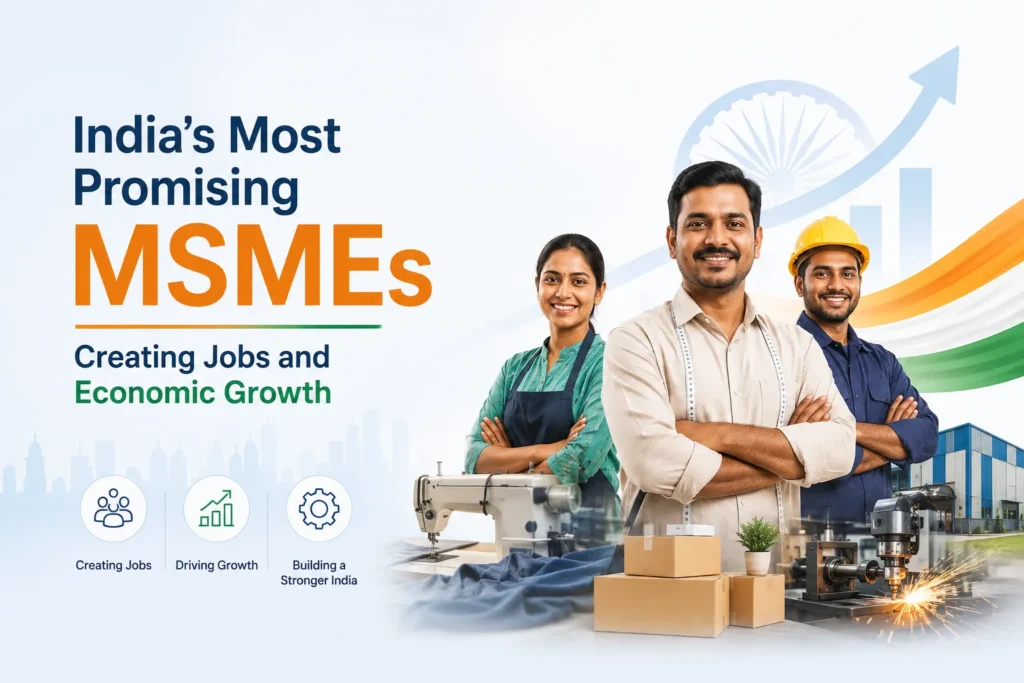
As India moves toward becoming a global manufacturing and innovation hub, India’s Most Promising MSMEs are playing an increasingly important role. By embracing digital technologies, creating local employment opportunities, and expanding into global markets, these enterprises are strengthening the Indian economy while promoting inclusive growth. Their success demonstrates how entrepreneurship, innovation, and supportive government policies can together drive sustainable economic development across urban and rural India.
What Are MSMEs?
Micro, Small, and Medium Enterprises (MSMEs) are businesses classified based on their investment in plant and machinery or equipment, along with annual turnover. The Government of India categorizes them into three groups:
- Micro Enterprises: Investment up to ₹2.5 crore and turnover up to ₹10 crore.
- Small Enterprises: Investment up to ₹25 crore and turnover up to ₹100 crore.
- Medium Enterprises: Investment up to ₹125 crore and turnover up to ₹500 crore.
These businesses operate across nearly every industry, from traditional handicrafts and food processing to software development and advanced manufacturing. Together, MSMEs in India create a vibrant ecosystem that supports innovation, entrepreneurship, and balanced regional development. They also supply components and services to large corporations, making them an essential part of India’s industrial value chain.
Why MSMEs Are the Backbone of India’s Economy
Employment Generation
One of the greatest strengths of Indian small businesses is their ability to create jobs. MSMEs employ millions of skilled, semi-skilled, and unskilled workers, making them one of the largest sources of non-agricultural employment. Their presence in smaller towns and villages reduces migration to metropolitan cities while creating local economic opportunities.
Contribution to GDP
The MSME sector contributes approximately one-third of India’s Gross Domestic Product. Its wide presence across industries ensures diversified economic activity and strengthens domestic production.
Export Growth
Manufacturing and service-oriented MSMEs contribute substantially to India’s exports by producing engineering goods, textiles, pharmaceuticals, processed foods, leather products, gems, and IT services. Their participation in international markets strengthens foreign exchange earnings and improves India’s global competitiveness.
Rural and Semi-Urban Development
Many MSMEs are located outside major cities. These businesses encourage entrepreneurship in rural and semi-urban areas, increase household incomes, and stimulate demand for local goods and services. As a result, they contribute to more balanced regional development.
Innovation and Entrepreneurship
Many successful startups begin as small enterprises. Through innovative products, niche solutions, and customer-focused business models, MSMEs continuously adapt to changing market conditions. Their flexibility allows them to respond faster than larger organizations, making them powerful drivers of economic growth.
Sectors Where Promising MSMEs Are Driving Growth
Manufacturing
Manufacturing MSMEs produce automotive components, machinery, consumer goods, electronics, chemicals, and industrial equipment. They play a vital role in domestic production and support initiatives such as Make in India.
Food Processing
India’s growing food processing industry includes dairy products, packaged foods, spices, beverages, and organic products. MSMEs add value to agricultural produce while reducing post-harvest losses and creating rural employment.
Textile and Apparel
The textile and garment sector remains one of India’s largest employment generators. MSMEs manufacture fabrics, apparel, handicrafts, and home furnishings for both domestic and export markets.
Healthcare
Healthcare MSMEs manufacture medical devices, diagnostic equipment, pharmaceuticals, wellness products, and healthcare technology solutions. Their contribution has become increasingly important in improving healthcare accessibility.
IT and SaaS
Technology-based MSMEs are developing software, cloud services, cybersecurity solutions, and artificial intelligence applications. India’s thriving startup ecosystem continues to produce globally competitive Software-as-a-Service (SaaS) companies.
Renewable Energy
Growing demand for sustainable energy has opened new opportunities for MSMEs involved in solar equipment, energy-efficient products, battery technologies, and green manufacturing solutions.
Agriculture and AgriTech
AgriTech startups and MSMEs are improving farming productivity through precision agriculture, digital marketplaces, irrigation technologies, farm equipment, and supply chain innovations.
Logistics
Rapid expansion of e-commerce has increased demand for logistics, warehousing, transportation, and supply chain management services provided by MSMEs.
E-commerce
Digital marketplaces have enabled small businesses to reach customers across India and overseas. Online selling has significantly reduced market-entry barriers for entrepreneurs.
Engineering
Engineering MSMEs manufacture industrial machinery, precision tools, electrical equipment, and specialized components that support sectors such as automotive, aerospace, and infrastructure.
Key Factors Behind Successful MSMEs
Several characteristics distinguish India’s Most Promising MSMEs from their competitors.
Technology Adoption
Businesses investing in automation, cloud computing, AI-powered solutions, and digital tools improve operational efficiency and reduce costs.
Digital Marketing
Search engine optimization, social media marketing, online advertising, and e-commerce platforms help MSMEs expand their customer base beyond local markets.
Skilled Workforce
Continuous employee training improves productivity, product quality, and customer satisfaction while enabling businesses to adopt emerging technologies.
Government Support
Access to government incentives, financial assistance, export promotion, and business development programs strengthens long-term competitiveness.
Customer-Centric Approach
Successful MSMEs focus on quality, innovation, and personalized customer service, helping them build strong brand loyalty.
Innovation
Regular product improvements and market-driven innovation enable MSMEs to remain competitive despite rapidly changing consumer preferences.
Financial Management
Effective budgeting, working capital management, and prudent investment decisions help businesses withstand economic uncertainties and sustain growth.
Government Initiatives Supporting MSMEs
The Government of India has introduced several initiatives that encourage entrepreneurship and strengthen the MSME ecosystem.
Udyam Registration
Udyam Registration provides official recognition to MSMEs, making them eligible for various government benefits, subsidies, and financial support programs.
Pradhan Mantri Mudra Yojana (Mudra Loan)
Mudra Loans provide collateral-free financing to micro and small businesses, helping entrepreneurs establish and expand their enterprises.
Credit Guarantee Fund Trust for Micro and Small Enterprises (CGTMSE)
CGTMSE encourages banks to provide collateral-free credit by offering government-backed credit guarantees, improving access to finance.
Startup India
Startup India promotes innovation through tax incentives, incubation support, easier compliance, funding opportunities, and mentorship for emerging businesses.
Make in India
The Make in India initiative encourages domestic manufacturing, attracts investment, and strengthens industrial infrastructure, creating opportunities for manufacturing MSMEs.
Digital India
Digital India supports digital infrastructure, online governance, digital payments, and internet connectivity, enabling MSMEs to embrace digital transformation.
PM Vishwakarma
PM Vishwakarma supports traditional artisans and craftspeople through skill development, modern tools, credit assistance, branding, and market access, helping preserve traditional occupations while improving livelihoods.
Skill India
Skill India develops industry-ready talent by providing vocational training, reskilling, and upskilling programs that improve workforce productivity across industries.
Together, these Government MSME schemes strengthen entrepreneurship, promote employment generation, and improve business competitiveness.
Challenges Faced by MSMEs
Despite their significant contributions, MSMEs continue to face several obstacles.
Limited Access to Finance
Many businesses struggle to secure affordable working capital and long-term financing, especially during expansion.
Rising Competition
Domestic and international competition requires continuous innovation and operational efficiency.
Technology Adoption
Although digital transformation offers substantial benefits, many smaller enterprises face high implementation costs and limited technical expertise.
Skilled Manpower Shortage
Finding and retaining qualified employees remains difficult, particularly in specialized manufacturing and technology sectors.
Supply Chain Disruptions
Global uncertainties, transportation delays, and fluctuating raw material prices can affect production schedules and profitability.
Regulatory Compliance
Meeting tax, labor, environmental, and industry-specific compliance requirements often increases administrative costs.
Inflation
Higher input costs, energy prices, and wage pressures reduce margins and challenge business sustainability.
Future of MSMEs in India
The future of MSMEs in India appears highly promising as businesses increasingly adopt digital technologies and expand globally.
Artificial intelligence and automation will improve productivity, reduce operational costs, and enhance customer experiences. Green manufacturing practices and renewable energy adoption will help businesses meet evolving sustainability expectations.
India’s integration into global supply chains presents significant export opportunities for manufacturing, engineering, pharmaceuticals, and technology-driven enterprises. Simultaneously, the digital economy will enable small businesses to access new markets through e-commerce, digital payments, and online service delivery.
Emerging sectors such as electric vehicles, clean energy, biotechnology, health technology, fintech, robotics, and AgriTech are expected to create fresh opportunities for entrepreneurs. With continued policy support, infrastructure development, and digital transformation of MSMEs, the sector will remain a major contributor to the Indian economy for decades to come.
Conclusion
India’s Most Promising MSMEs are driving inclusive and sustainable economic progress by creating employment, fostering innovation, supporting exports, and strengthening local industries. Their contribution extends far beyond business growth—they empower entrepreneurs, stimulate regional development, and enhance India’s global competitiveness.
As government initiatives, digital technologies, and expanding global markets continue to create new opportunities, MSMEs are well-positioned to become even stronger engines of economic transformation. Businesses that embrace innovation, improve productivity, invest in skilled talent, and adapt to changing market demands will lead the next phase of India’s growth story. The continued success of India’s MSME sector will play a decisive role in building a resilient, competitive, and prosperous economy.
Frequently Asked Questions
1. Why are MSMEs important for India’s economy?
MSMEs contribute significantly to GDP, exports, employment generation, entrepreneurship, and regional development, making them one of the strongest pillars of India’s economic growth.
2. How do MSMEs create employment in India?
MSMEs generate jobs across manufacturing, services, agriculture, retail, technology, logistics, and many other sectors while supporting local economies in both urban and rural areas.
3. Which sectors have the fastest-growing MSMEs?
Fast-growing sectors include manufacturing, IT and SaaS, renewable energy, food processing, healthcare, AgriTech, engineering, logistics, and e-commerce.
4. What government schemes support MSMEs?
Major schemes include Udyam Registration, Mudra Loan, CGTMSE, Startup India, Make in India, Digital India, PM Vishwakarma, and Skill India.
5. What is the future of MSMEs in India?
The future is driven by AI adoption, automation, digital transformation, green manufacturing, export expansion, and greater integration into global supply chains.