|
Getting your Trinity Audio player ready...
|
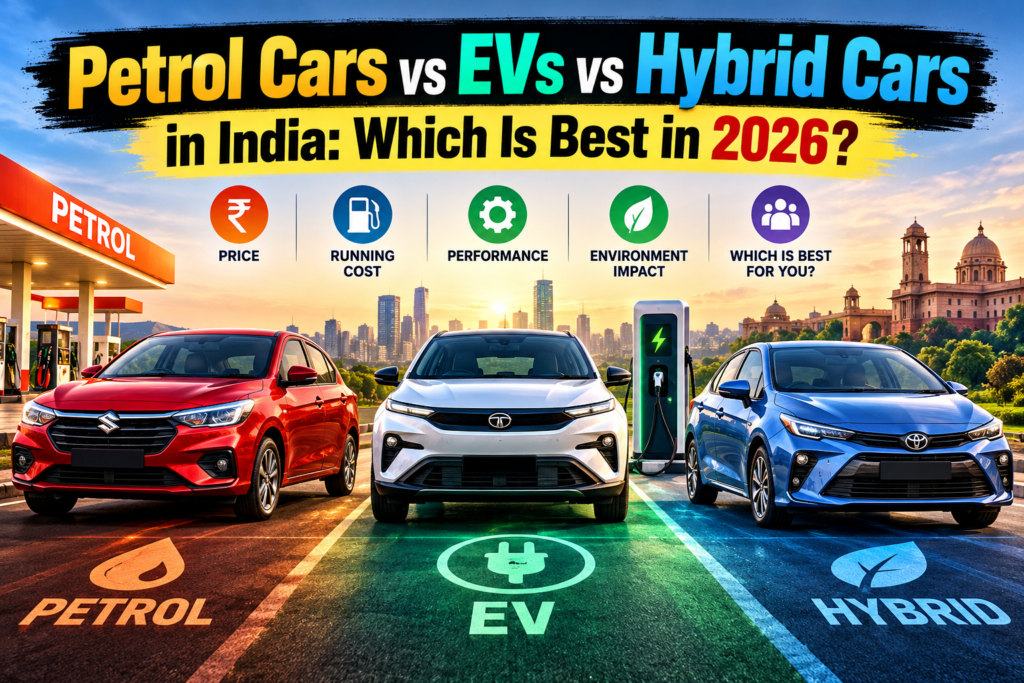
Buying a new car in India is no longer just about choosing a brand, design or mileage figure. Buyers must also decide whether to purchase a petrol car, an electric vehicle (EV) or a hybrid car. Each option offers different benefits in terms of purchase price, running costs, maintenance, convenience and environmental impact.
Petrol cars remain popular because they are easy to refuel and come in many price ranges. Electric cars are attracting buyers who want lower day-to-day running costs and quieter driving. Hybrid cars offer a middle path by combining a petrol engine with electric assistance.
But which option is best for Indian roads in 2026? The answer depends on your daily driving distance, budget, access to charging, family requirements and how long you plan to keep your car.
What Is the Difference Between Petrol, Electric and Hybrid Cars?
A petrol car uses an internal combustion engine that burns petrol to move the vehicle. You refuel it at a petrol pump, and its driving range depends on fuel-tank capacity and fuel efficiency.
An electric car uses a battery-powered electric motor. You charge its battery using a home charger or a compatible public charging station. A fully electric car does not need petrol or diesel to drive.
A hybrid car combines a petrol engine with an electric motor and battery. A conventional self-charging hybrid generally charges its battery through the engine and regenerative braking. A plug-in hybrid can also be charged externally, where that type of vehicle is available.
Petrol vs EV vs Hybrid Cars: Quick Comparison
| Feature | Petrol car | Electric car | Hybrid car |
|---|---|---|---|
| Initial purchase price | Often lower | Can be higher | Often higher than comparable petrol models |
| Running cost | Depends on petrol price and mileage | Often lower with economical charging | Can be lower than petrol, depending on usage |
| Refuelling or charging | Quick petrol refuelling | Requires charging time | Petrol refuelling; electric assistance |
| Home charging | Not required | Recommended | Usually not required for a conventional hybrid |
| Long-distance travel | Convenient with widespread fuel stations | Requires route and charging planning | Convenient with a petrol engine |
| Maintenance | Engine and mechanical servicing | Generally fewer routine powertrain service items | Has both engine and electric components |
| Driving experience | Familiar and widely available | Quiet, smooth and responsive | Smooth, with efficiency benefits in suitable conditions |
| Tailpipe emissions | Produces emissions | No tailpipe emissions | Produces emissions when the engine runs |
Actual costs, features and efficiency vary by model, driving conditions, location and vehicle type.
1. Petrol Cars in India: Are They Still Worth Buying?
Petrol cars remain a practical option for many Indian buyers. They are available across hatchbacks, sedans and SUVs, and buyers can choose from entry-level models to premium vehicles.
Advantages of petrol cars
Affordable entry options: Petrol variants often have lower starting prices than comparable electric or hybrid models. This makes them attractive to first-time buyers and families working with a fixed budget.
Easy refuelling: Petrol stations are widely available across Indian cities, highways and smaller towns. You can refuel quickly without planning charging stops.
Wide model selection: Buyers can choose from several body styles, transmission options and price brackets.
Suitable for varied travel: Petrol cars work well for daily commuting, weekend trips and occasional long-distance journeys without requiring access to charging infrastructure.
Disadvantages of petrol cars
The main drawback is recurring fuel expenditure. Petrol prices and actual mileage can significantly affect the cost of ownership, particularly for people who drive long distances every month.
Petrol engines also contain components that require routine servicing, such as engine oil and filters. Furthermore, petrol cars produce tailpipe emissions.
Who should buy a petrol car?
A petrol car may suit you if you drive relatively few kilometres each month, want a lower initial purchase price, regularly travel to places with limited charging facilities or prefer the convenience of quick refuelling.
2. Electric Cars in India: Are EVs a Better Choice?
Electric cars are becoming an important alternative for buyers who want a modern driving experience and potentially lower running costs. Models from Tata Motors, Mahindra, MG and other manufacturers offer options across different price segments.
Advantages of electric cars
Lower energy costs: Charging an EV at home can cost considerably less per kilometre than driving a petrol car, depending on your electricity tariff and the efficiency of both vehicles.
Fewer routine powertrain service requirements: EVs do not need engine oil changes, spark plugs or conventional engine servicing. However, tyres, brakes, suspension, coolant systems where applicable and other components still need attention.
Smooth and quiet driving: Electric motors deliver power smoothly and can provide strong acceleration from low speeds. This is useful in stop-and-go city traffic.
No tailpipe emissions: A fully electric car does not emit exhaust gases while driving. Its overall environmental impact still depends on electricity generation, battery production and the vehicle’s life cycle.
Disadvantages of electric cars
The initial price can be higher than that of a comparable petrol model. Charging access is another major consideration. Apartment residents without dedicated parking or charging facilities may find regular charging less convenient.
Long journeys require additional planning, especially where fast chargers are limited or busy. Charging speed also depends on the vehicle, charger output, battery temperature and charging conditions.
Battery degradation is possible over time, and replacement costs can be significant outside warranty coverage. Buyers should review the battery warranty, service network and repair arrangements before purchasing.
Who should buy an electric car?
An EV is worth considering if you drive regularly, can charge at home or work, have a predictable commute and intend to keep the vehicle for several years. High annual usage can make lower running costs more valuable.
3. Hybrid Cars in India: A Middle Ground
Hybrid cars combine a petrol engine with an electric motor. Depending on the system, the motor assists the engine, recovers energy during braking and may move the car electrically for short periods.
Popular examples of hybrid technology in India include the Toyota Innova Hycross Hybrid, Toyota Urban Cruiser Hyryder Hybrid and Maruti Suzuki Grand Vitara strong hybrid.
Advantages of hybrid cars
Improved fuel efficiency: Hybrid systems can reduce petrol consumption, particularly in city traffic where braking and acceleration occur frequently.
No routine charging for conventional hybrids: Self-charging hybrids replenish their batteries through regenerative braking and the engine. You can continue refuelling at petrol stations as usual.
Convenient for long-distance travel: A conventional hybrid can travel on highways without requiring charging stops.
Familiar ownership experience: Drivers do not need to change their refuelling habits or depend on public charging networks.
Disadvantages of hybrid cars
Hybrid models can cost more than their petrol equivalents. Whether fuel savings recover the additional purchase cost depends on the price difference, annual kilometres, fuel efficiency and petrol prices.
Hybrids also retain an engine and its associated maintenance requirements. Their batteries and electrical components may add complexity, although the precise servicing needs vary by model.
A conventional hybrid is not the same as a fully electric car. It still consumes petrol and produces tailpipe emissions when its engine runs.
Who should buy a hybrid car?
A hybrid can be a strong choice if you drive frequently in congested cities, want better fuel efficiency without depending on charging stations or regularly travel long distances.
Petrol vs EV vs Hybrid: Which Is Cheaper to Run?
The cheapest car to run is not necessarily the cheapest car to buy. Buyers should compare the total cost of ownership rather than looking only at the showroom price.
Consider a simple illustration using assumed figures:
| Cost factor | Petrol car | Electric car | Hybrid car |
|---|---|---|---|
| Assumed efficiency | 15 km/litre | 6 km/kWh | 22 km/litre |
| Assumed energy price | ₹100/litre | ₹8/kWh | ₹100/litre |
| Approximate energy cost per km | ₹6.67 | ₹1.33 | ₹4.55 |
These figures are illustrative, not current market averages or model-specific claims. Actual petrol prices, charging tariffs, efficiency and real-world driving conditions vary.
For an EV, public fast charging may cost more than home charging. A hybrid’s efficiency may also vary significantly between city and highway driving.
To make a fair decision, compare the following:
- Ex-showroom and on-road purchase prices.
- Loan interest and financing costs.
- Fuel or electricity expenditure over your expected ownership period.
- Routine maintenance and repair expenses.
- Insurance, taxes and applicable incentives.
- Resale value and battery warranty conditions.
The Council on Energy, Environment and Water’s ownership-cost research also highlights that vehicle category, state-level costs, annual usage and energy prices can change which powertrain is most economical.
Which Car Type Is Best for City Driving?
For short daily commutes, an EV can be an excellent choice if you have reliable charging access. Its quiet operation and low energy cost can make urban travel economical.
A hybrid is also well suited to stop-and-go traffic because regenerative braking and electric assistance can improve fuel efficiency.
A petrol car remains practical for occasional driving, short ownership periods and buyers who want to avoid charging arrangements.
Which Is Best for Long-Distance Driving?
Petrol and hybrid cars generally offer straightforward long-distance convenience because refuelling stations are widely available.
Electric cars can also handle highway travel, but you should plan charging stops, check charger availability and consider the extra time required. Cold weather, high speeds, heavy loads and air-conditioning use can reduce driving range.
For frequent intercity travel through areas with limited charging infrastructure, a petrol or conventional hybrid car may currently be the simpler choice.
Petrol vs EV vs Hybrid: Environmental Impact
Electric cars produce no tailpipe emissions while driving, making them particularly useful for reducing local exhaust pollution. However, electricity generation and battery manufacturing also contribute to their overall environmental footprint.
Petrol cars release exhaust emissions whenever their engines operate. Hybrids can reduce petrol consumption and emissions compared with comparable conventional vehicles, but the result depends on the model and driving conditions.
The most suitable choice depends on your priorities, charging options and how the vehicle will be used throughout its lifetime.
Final Verdict
Choose a petrol car if you want an affordable purchase, widespread refuelling access and flexibility for occasional long-distance trips.
Choose an electric car if you can charge conveniently, drive regularly and want to reduce your day-to-day energy expenses.
Choose a hybrid car if you want improved fuel efficiency while retaining the convenience of a petrol engine.
The bottom line: There is no single winner for every Indian buyer. Compare the on-road price, expected running costs, annual distance and charging access before making your final decision.
FAQs
Are electric cars cheaper than petrol cars in India?
Electric cars often cost less to run per kilometre, particularly with home charging. However, the purchase price, financing, insurance and resale value affect the overall savings.
Is a hybrid car better than an electric car?
A hybrid can be more convenient for buyers without charging access. An EV may offer lower energy costs and zero tailpipe emissions if suitable charging is available.
Which car is best for daily city use?
An EV is a strong option for predictable city commutes with convenient charging. A hybrid is another good option for congested traffic, while petrol cars remain practical for occasional use.
Do hybrid cars need charging?
Conventional self-charging hybrids generally do not need external charging. Plug-in hybrids can be charged externally and differ from conventional hybrids.
Which car has the lowest maintenance cost?
EVs generally have fewer routine powertrain servicing requirements because they do not have conventional petrol engines. Actual maintenance costs still depend on the model, tyres, repairs, battery coverage and service arrangements.
Should I buy an EV in India in 2026?
Consider an EV if you have reliable charging access, suitable daily driving needs and a service network nearby. Compare its on-road price and expected savings with equivalent petrol and hybrid models before buying.