|
Getting your Trinity Audio player ready...
|
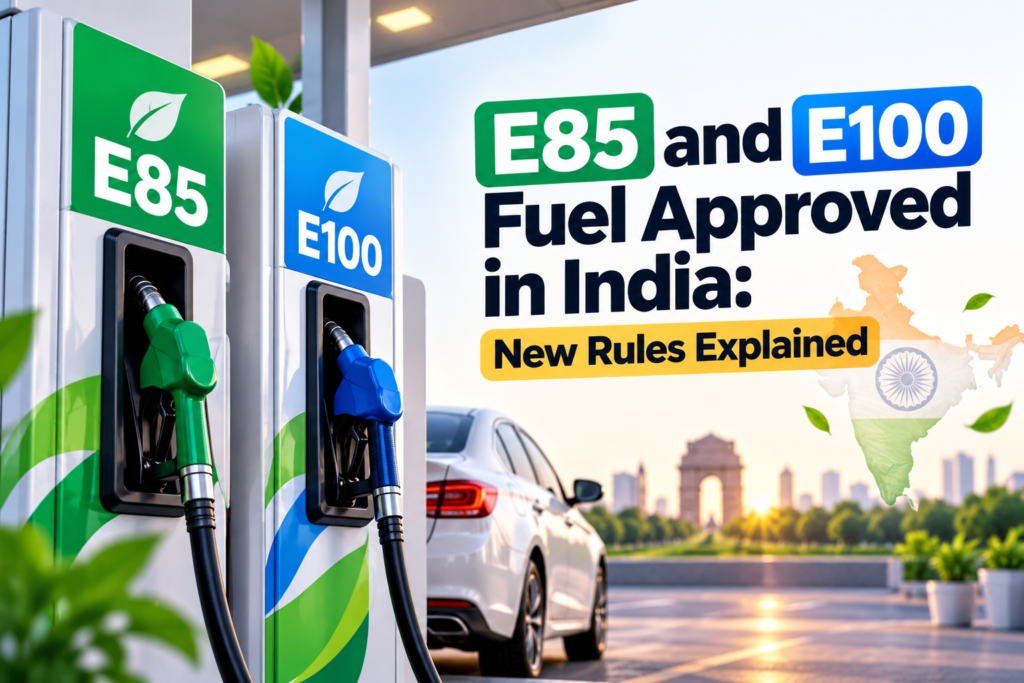
India has taken another step towards expanding the use of ethanol-based fuels. The Ministry of Road Transport and Highways (MoRTH) has amended the Central Motor Vehicles Rules (CMVR), 1989, to formally recognise E100 fuel alongside E85 for compatible flex-fuel vehicles. The amendment creates a regulatory framework for vehicles designed to operate on much higher ethanol concentrations than conventional petrol vehicles.
The government notified the Central Motor Vehicles (Amendment) Rules, 2026, through notification G.S.R. 911(E), dated October 23, 2026. The notification was published in the Gazette of India on October 26, 2026. The revised rules include changes to fuel-related emission standards and testing provisions, giving vehicle manufacturers a clearer route to develop and certify vehicles capable of using E100 fuel. <Cite refs={[“turn405342search0″,”turn405342search4”]}/>
However, this decision does not mean every petrol car in India can now use E85 or E100. The government has clarified that these fuels are intended only for vehicles specifically designed and certified by their original equipment manufacturers (OEMs) as flex-fuel vehicles.
For Indian consumers, the important questions are what E85 and E100 actually mean, whether these fuels can reduce running costs, how they may affect the automobile industry, and when drivers might be able to access them more widely.
What Are E85 and E100 Fuels?
E85 and E100 are ethanol-based fuels that contain significantly more ethanol than the E20 petrol currently used in India.
Ethanol is an alcohol-based fuel that can be produced from agricultural crops and other biomass sources. In India, sugarcane, molasses, maize and other suitable feedstocks can contribute to ethanol production. The country has promoted ethanol blending to diversify its fuel supply, support domestic producers and reduce dependence on imported crude oil.
The letter E represents ethanol, while the number indicates the approximate percentage of ethanol in the fuel.
E20 petrol contains 20% ethanol and 80% petrol. E85 generally contains approximately 85% ethanol and 15% petrol, while E100 refers to fuel consisting almost entirely of ethanol. Exact specifications can depend on the applicable fuel standard.
Although these fuels can reduce the amount of conventional petrol required, they have different properties. Engines, fuel systems and related components must be designed to handle the higher ethanol concentration safely and efficiently.
E85 vs E100 vs E20 Petrol: Key Differences
| Feature | E20 Petrol | E85 Fuel | E100 Fuel |
|---|---|---|---|
| Ethanol content | 20% | Approximately 85% | Nearly 100% |
| Conventional petrol content | 80% | Approximately 15% | Little to none |
| Intended vehicles | Vehicles compatible with E20 | Certified E85-compatible flex-fuel vehicles | Certified E100-compatible flex-fuel vehicles |
| Fuel-system requirements | Compatible with the vehicle’s approved specifications | Specially engineered for high ethanol content | Specially engineered for near-pure ethanol |
| Availability in India | Widely rolled out | Availability depends on location and supply | Wider retail availability is not established by this rule change |
| Main policy objective | Increase ethanol blending in petrol | Expand higher-ethanol fuel use | Enable near-pure ethanol-powered vehicles |
The central difference is that E20 is a petrol blend used in compatible conventional vehicles, whereas E85 and E100 require vehicles specifically approved for those fuels. The latest amendment establishes the regulatory basis for E100 within India’s vehicle rules, but it does not make every vehicle compatible with it. <Cite refs={[“turn405342search4″,”turn405342search7”]}/>
What Has the Indian Government Changed?
The government has amended several provisions under the Central Motor Vehicles Rules, particularly Rule 115 and Rule 115E, which cover emission-related requirements, fuel classifications and testing provisions.
Previously, several relevant entries referred to E85. The amendment replaces those references with E85 or E100, allowing E100 vehicles to be recognised under the relevant regulatory framework.
The changes also introduce an explanatory note specifying that E85 or E100 should be used in vehicles designed by original equipment manufacturers as flex-fuel vehicles. In addition, the rules update documentation requirements for E100 vehicles and make certain technical changes to fuel and emission tables.
The notification took effect from the date of publication in the Official Gazette, subject to any specific provisions stated in the rules. <Cite refs={[“turn405342search0″,”turn405342search3”]}/>
This is an important regulatory development because manufacturers need clear testing and certification requirements before bringing new fuel technologies to market.
However, approval under vehicle regulations is only one part of the process. Commercial adoption also depends on vehicle availability, fuel production, distribution infrastructure, pricing and consumer confidence.
Can You Use E85 or E100 in Your Existing Petrol Car?
No. An ordinary petrol car designed for E20 or lower ethanol blends must not be filled with E85 or E100 unless its manufacturer explicitly approves the vehicle for that fuel.
The new rules do not give owners of conventional petrol cars automatic permission to use high-ethanol fuels.
Ethanol has different chemical and combustion properties from petrol. Vehicles designed for higher ethanol concentrations may require changes to engine calibration, fuel injectors, fuel pumps, seals, hoses and other components. Materials used in conventional fuel systems may not be suitable for prolonged exposure to much higher ethanol concentrations.
Using an incompatible fuel can affect engine operation, fuel-system durability, cold-start performance and emissions. It may also lead to repair expenses and potential warranty complications.
Before purchasing or using a high-ethanol fuel, owners should check the vehicle handbook and obtain confirmation from the manufacturer or an authorised service centre.
The amendment is primarily intended to enable manufacturers to develop and certify suitable flex-fuel vehicles, not to encourage motorists to experiment with high-ethanol blends in existing cars.
What Is a Flex-Fuel Vehicle?
A flex-fuel vehicle, commonly called an FFV, is designed to operate on different petrol-ethanol blends within the range approved by its manufacturer.
Unlike an ordinary petrol vehicle, a flex-fuel vehicle uses compatible fuel-system components and engine controls to accommodate changes in ethanol concentration.
Depending on its design and certification, an FFV may operate on conventional petrol, E20, E85 or E100. However, not every flex-fuel vehicle supports every blend. The permitted fuels depend on the specific model.
This flexibility can give consumers more fuel choices when compatible fuels are available. It can also help automakers develop vehicles for markets that produce significant quantities of ethanol.
For India, the revised rules establish a more complete regulatory framework for manufacturers interested in high-ethanol vehicles.
Will E100 Fuel Reduce Petrol Costs in India?
Lower running costs are one of the biggest questions surrounding E100 fuel. Ethanol can be produced domestically, and greater use of locally produced fuel could help reduce some of India’s dependence on imported crude oil.
However, E100 will not automatically be cheaper to use than petrol on a per-kilometre basis.
Ethanol contains less energy per litre than petrol. As a result, a vehicle running on a high-ethanol blend generally needs more fuel by volume to cover the same distance, although the actual difference depends on the engine and driving conditions.
To understand the potential savings, motorists need to compare the price of the fuel with the distance a vehicle can travel on each litre.
For example, imagine a petrol car that achieves 15 kilometres per litre. If a compatible ethanol-powered vehicle achieves 11 kilometres per litre, the comparison would look like this:
| Fuel price | Mileage | Approximate cost per km |
|---|---|---|
| Petrol at ₹100 per litre | 15 km/litre | ₹6.67 |
| Ethanol fuel at ₹70 per litre | 11 km/litre | ₹6.36 |
| Ethanol fuel at ₹80 per litre | 11 km/litre | ₹7.27 |
These figures are hypothetical examples, not current E100 prices or verified mileage figures for a production vehicle.
In this example, ethanol fuel at ₹70 per litre costs slightly less per kilometre, while fuel at ₹80 per litre costs more. Actual results would depend on the vehicle, fuel price, engine efficiency and driving conditions.
Therefore, the final benefit for Indian consumers will depend on how E100 is priced, how efficiently vehicles use it and whether adequate fuel supplies become available.
Why Is India Promoting Ethanol-Based Fuels?
India imports substantial quantities of crude oil to meet its energy needs. This makes domestic transport fuel demand an important economic concern, particularly when international oil prices rise or supply routes face disruptions.
Ethanol blending offers one way to diversify the country’s fuel supply. By using domestically produced ethanol, India can potentially reduce the volume of petrol required for transport.
The wider ethanol programme can also create demand for agricultural feedstocks and support parts of the sugar and grain-processing industries. However, the overall benefits depend on how ethanol is produced, its cost, and the management of agricultural resources.
The government has already promoted E20 petrol as part of its ethanol-blending programme. In July 2026, the Press Information Bureau reported that E85 had been introduced exclusively for flex-fuel vehicles designed and certified for that fuel. It also stated that no decision had been taken at that time to raise the nationwide base ethanol-blending level beyond E20. <Cite refs={[“turn405342search5”]}/>
The latest amendment concerning E100 should therefore be understood as a change to the regulatory framework for eligible vehicles, not as an announcement that all petrol sold across India will immediately contain more ethanol.
Benefits of E85 and E100 Fuel
1. Potentially lower dependence on imported crude oil
Higher ethanol use can reduce the quantity of conventional petrol required by compatible vehicles. If domestic ethanol production and consumption increase sustainably, this could contribute to lower oil-import requirements.
The actual impact will depend on the scale of adoption, production costs and the amount of petrol displaced.
2. Support for domestic agriculture and ethanol production
India’s ethanol industry can create additional demand for suitable agricultural feedstocks and processing capacity. This may create opportunities for farmers, distilleries and associated supply-chain businesses.
However, the benefits are not automatic. Feedstock availability, food security, water use and the economics of production remain important considerations.
3. A new opportunity for automobile manufacturers
The updated rules provide a clearer regulatory pathway for manufacturers to develop and certify vehicles capable of using E100.
Companies that invest in flex-fuel technology may gain opportunities to develop new engines, fuel systems and compatible vehicles for the Indian market.
4. Potential environmental benefits
Ethanol produced from suitable renewable sources can reduce lifecycle greenhouse gas emissions compared with fossil fuels, depending on the feedstock, manufacturing process, transport and land-use impacts.
Higher ethanol blends may also reduce certain tailpipe pollutants under suitable engine conditions. However, the overall environmental outcome depends on how the fuel is produced and how the vehicle performs.
It would be inaccurate to assume that every E100 vehicle automatically produces zero emissions or has no environmental impact.
Challenges That Could Slow Down E100 Adoption
Despite the potential benefits, several challenges need to be addressed before E100 becomes a mainstream transport fuel in India.
Limited availability of compatible vehicles
The new rules do not make existing petrol cars compatible with E100. Manufacturers must develop suitable vehicles, complete the required testing and certification, and bring models to market at competitive prices.
Fuel distribution infrastructure
Consumers need reliable access to the fuel their vehicles require. Wider E100 adoption would depend on production, transportation, storage and retail distribution arrangements, including suitable dispensing facilities.
The regulatory amendment itself does not confirm nationwide E100 availability at petrol pumps.
Fuel economy concerns
Because ethanol has a lower energy content per litre than petrol, vehicles may travel fewer kilometres per litre when operating on high-ethanol fuel. The lower price of the fuel, if achieved, would need to compensate for this difference to produce savings.
Vehicle price and maintenance
Specially designed flex-fuel vehicles may require additional engineering and testing. The effect on purchase prices, maintenance costs and long-term reliability will depend on the model and its design.
Sustainable ethanol production
Expanding ethanol production requires careful management of feedstocks, water, agricultural land and energy consumption. The environmental benefits will depend partly on whether production can grow sustainably.
What Does the E100 Approval Mean for India’s Automobile Industry?
The amendment could encourage automobile manufacturers to increase their investment in flex-fuel technology. With E100 now recognised in the relevant regulatory provisions, manufacturers have a clearer framework for testing and certifying vehicles that operate on near-pure ethanol.
This could eventually create opportunities across passenger cars, two-wheelers and other vehicle categories, subject to the applicable technical standards and certification requirements.
However, the amendment does not guarantee that manufacturers will immediately launch a wide range of E100 models. Companies must consider development costs, customer demand, fuel infrastructure, vehicle performance and the availability of ethanol.
For consumers, the practical benefits will become clearer when compatible vehicles and dependable fuel supplies are available at scale.
E85 and E100 Fuel in India: What Happens Next?
The immediate impact of the rule change is regulatory rather than a sudden change in everyday refuelling.
Manufacturers can work within the updated framework to develop and certify eligible vehicles. Fuel producers and distributors would also need to support any increase in demand for higher-ethanol blends.
Consumers should watch for official announcements about compatible vehicle launches, manufacturer-approved fuel specifications, retail fuel availability and pricing.
Until those developments take place, motorists should continue using the fuel specified by their vehicle manufacturer. The government’s decision is an important step towards expanding India’s fuel options, but the success of E100 will depend on how effectively the vehicle and fuel ecosystems develop together.
FAQs
Is E100 fuel officially recognised in India?
Yes. The Ministry of Road Transport and Highways amended the Central Motor Vehicles Rules, 1989, to recognise E100 alongside E85 in relevant provisions for eligible flex-fuel vehicles. The notification was published on October 26, 2026.
Can I use E100 fuel in my E20 petrol car?
No, not unless the vehicle manufacturer explicitly certifies the car for E100. Conventional petrol vehicles designed for E20 should not use E100 without specific manufacturer approval.
What is the difference between E85 and E100 fuel?
E85 generally contains approximately 85% ethanol and 15% petrol. E100 consists almost entirely of ethanol. Both require compatible vehicles designed and certified for the relevant fuel.
Will E100 fuel be cheaper than petrol?
Not necessarily. The final cost per kilometre depends on the retail price of E100 and the vehicle’s fuel efficiency. A lower price per litre does not always translate into lower running costs.
Is E100 fuel available at every petrol pump in India?
No. The regulatory amendment does not establish nationwide retail availability. Consumers should check local fuel availability before considering a vehicle that requires E100.
Does the new rule mean India is replacing E20 petrol with E100?
No. The amendment creates a regulatory framework for E100-capable flex-fuel vehicles. It does not announce an immediate nationwide replacement of E20 petrol.
What is the main benefit of the E100 fuel amendment?
The key benefit is that it provides a clearer regulatory pathway for manufacturers to develop and certify vehicles designed to run on near-pure ethanol. Wider adoption could diversify India’s transport fuel supply and potentially reduce dependence on imported crude oil.
Conclusion
India’s decision to recognise E100 alongside E85 under the Central Motor Vehicles Rules is an important development for the country’s ethanol-fuel programme. It creates a clearer path for automakers to develop and certify vehicles capable of running on higher ethanol blends.
However, the change should not be confused with universal E100 availability or permission to use the fuel in conventional petrol cars. Vehicle compatibility, fuel pricing, distribution infrastructure and sustainable ethanol production will determine how quickly the technology reaches ordinary consumers.
For now, Indian motorists should follow their vehicle manufacturer’s fuel recommendations while keeping an eye on future developments in flex-fuel vehicles and ethanol-based transport technology