|
Getting your Trinity Audio player ready...
|

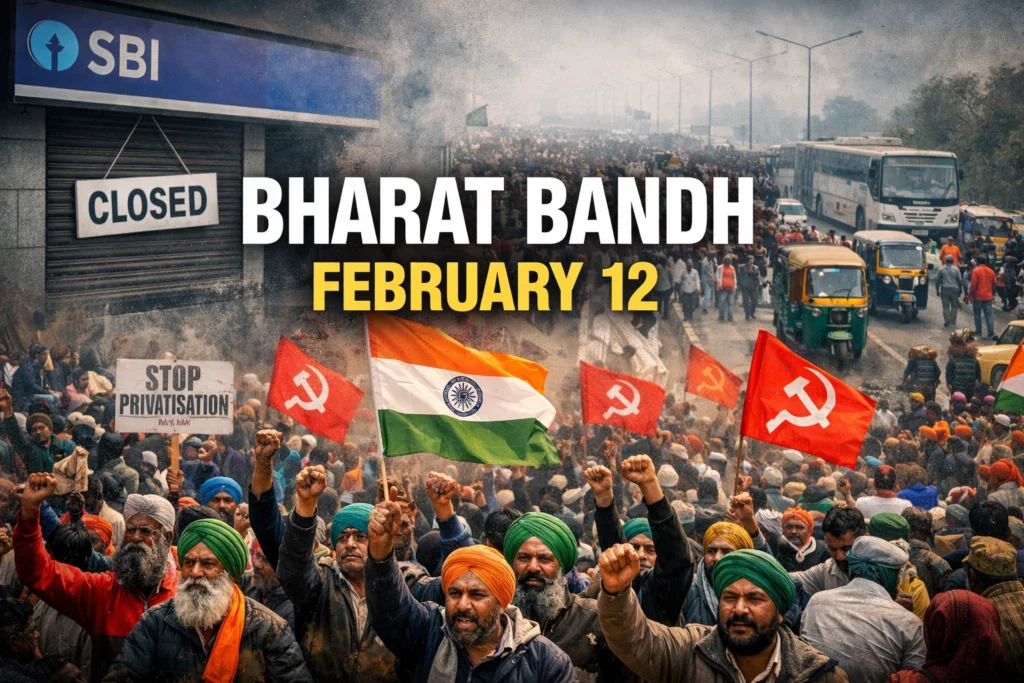
India witnessed a nationwide Bharat Bandh Today following a joint call by central trade unions and farmer groups protesting against government policies. The strike led to disruptions in banking, transport, and several public services across multiple states, while essential services continued to operate.
According to reports published by The Times of India and other national media outlets, the bandh was supported by several major labour organisations along with farmer unions. The protest was directed at the implementation of new labour codes, concerns over privatisation, and trade-related issues that unions claim could negatively affect workers and agricultural communities.
Why the Strike Was Called
The nationwide strike was backed by prominent trade unions including All India Trade Union Congress, Centre of Indian Trade Unions, Indian National Trade Union Congress and Self Employed Women’s Association. Farmer organisations such as the Samyukt Kisan Morcha also extended support to the bandh.

Union leaders stated that the strike aimed to oppose what they described as anti-worker policies, weakening of labour protections, and economic reforms that allegedly threaten job security and rural livelihoods.
Impact on Banking and Government Offices
Public sector banks in several regions reported limited operations as employees affiliated with unions participated in the strike. Many government offices functioned with reduced staff presence, and certain public sector undertakings experienced temporary work stoppages.
However, private banks and financial institutions largely remained operational, and digital banking services continued without interruption.
Transport Services Affected in Several States
Public transport services faced disruptions in several parts of the country. State transport authorities reduced bus frequency in multiple cities, and officials temporarily suspended some routes due to protest activity.
In metropolitan areas such as Delhi, authorities continued transport operations but warned commuters about potential delays. According to reports from Hindustan Times, metro rail services operated on schedule, although demonstrations slowed road traffic in certain areas.
States including Kerala, Odisha and Assam recorded higher participation in the strike. Local unions and protest groups actively blocked roads and organised rallies, which led to noticeable disruptions in bus services and temporary closures of local markets.
Additional Impact on Transport and Local Movement
- Transport unions in several districts halted bus operations during peak morning hours.
- Protesters staged road blockades at key junctions, causing traffic congestion on major highways.
- Commuters in affected regions shifted to private vehicles and ride-hailing services to avoid delays.
- Local authorities deployed additional police personnel to manage traffic flow and prevent clashes.
- Auto-rickshaw and taxi services operated selectively depending on regional union participation.
- Freight movement slowed in some corridors as transport workers joined the strike.
- Inter-state bus services experienced delays where border checkpoints witnessed demonstrations.
This active participation across transport networks amplified the visible impact of the Bharat Bandh, particularly in states where labour unions and farmer groups mobilised in large numbers.
Schools, Colleges and Businesses
Educational institutions in some regions remained closed as a precautionary measure or in support of the strike. In other states, schools and colleges functioned as usual.
Local markets and small businesses shut operations in areas where the bandh received significant backing. However, major private sector companies, IT firms, and corporate offices across urban centres largely remained open.
Essential Services Remained Operational
Healthcare facilities, including hospitals and emergency services, continued functioning across the country. Airport operations were not significantly affected, and scheduled flights operated normally.
Essential services such as pharmacies, milk supply chains, and online services remained available. Reports from LiveMint noted that while certain ATMs faced minor delays in replenishment, digital transactions were unaffected.
Regional Variations in Impact
The intensity of the bandh varied from state to state. In regions with strong union presence, participation was more visible, with rallies, demonstrations, and road blockades reported. In other areas, daily activities continued with minimal disruption.
Authorities in multiple states deployed additional security personnel to maintain law and order and prevent any untoward incidents.
Conclusion
The Bharat Bandh on February 12 highlighted ongoing tensions between trade unions, farmer groups, and the central government over labour reforms and economic policies. While the strike caused partial disruptions in banking, transport, and government operations, essential services and much of the private sector continued to function.
The varying impact across states reflected differences in union strength and regional support, underscoring the complex landscape of labour and economic reform debates in the country.