|
Getting your Trinity Audio player ready...
|
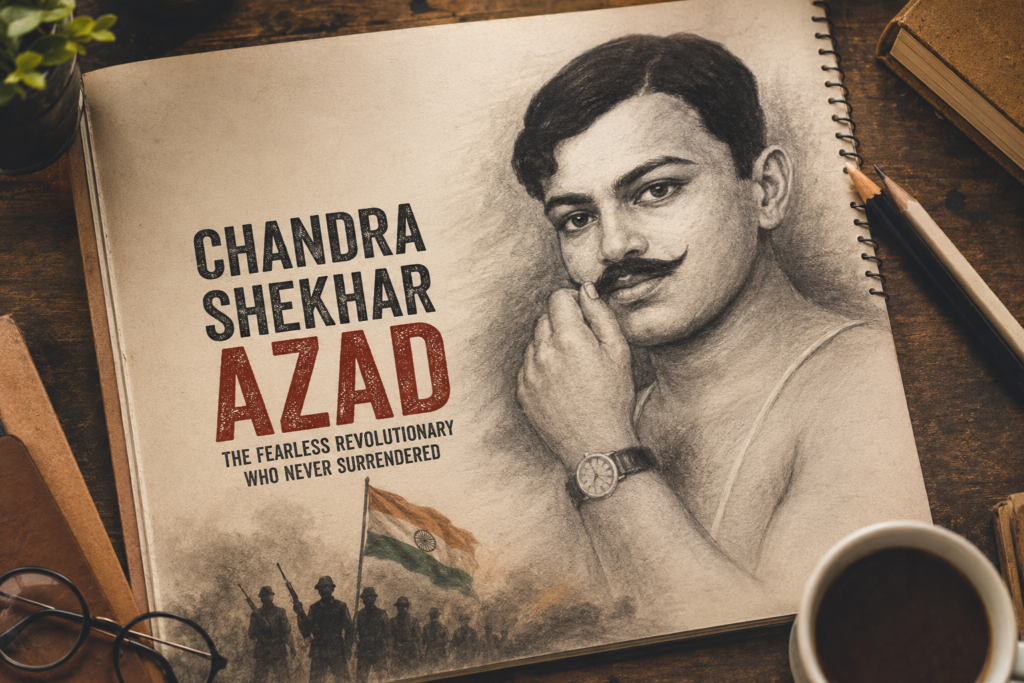
India’s freedom struggle was shaped by countless brave men and women who sacrificed everything for the dream of an independent nation. Among the greatest revolutionaries was Chandra Shekhar Azad, a fearless freedom fighter whose courage, determination, and patriotism inspired generations. His life became a symbol of resistance against British rule, and his promise to never be captured alive made him one of the most respected heroes of India’s independence movement.
Even today, more than nine decades after his martyrdom, Chandra Shekhar Azad remains an icon of bravery. His life story reminds every Indian that true freedom often demands extraordinary sacrifice.
Early Life of Chandra Shekhar Azad
Chandra Shekhar Azad was born as Chandra Shekhar Sitaram Tiwari on 23 July 1906 in Bhavra village, located in present-day Alirajpur district, Madhya Pradesh. His father, Pandit Sitaram Tiwari, and mother, Jagrani Devi, belonged to a modest Brahmin family. His parents valued education and hoped their son would become a respected Sanskrit scholar.
As a child, Azad was energetic, athletic, and deeply influenced by stories of Indian heroes. His mother encouraged him to study Sanskrit, leading him to Varanasi, where he attended a Sanskrit school. However, the political atmosphere of the country soon changed the course of his life.
The Jallianwala Bagh Massacre of 1919 and the growing movement against British rule left a deep impact on the young Azad. Like many teenagers of his generation, he felt a strong desire to fight for India’s freedom.
Why Was He Called “Azad”?
In 1921, at just 15 years old, Chandra Shekhar participated in Mahatma Gandhi’s Non-Cooperation Movement. He was arrested by British authorities for taking part in protests.
When presented before the magistrate, he boldly answered:
- Name: Azad (Free)
- Father’s Name: Swatantrata (Freedom)
- Residence: Jail
The judge sentenced him to 15 lashes. Instead of crying, the young revolutionary shouted slogans praising India after every whip.
From that day onward, the nation knew him as Chandra Shekhar Azad. His fearless response became legendary and reflected his lifelong commitment to freedom.
Turning Towards Revolutionary Activities
When Mahatma Gandhi suspended the Non-Cooperation Movement after the Chauri Chaura incident in 1922, many young nationalists were disappointed. Azad believed that stronger action was needed to end British rule.
He joined the Hindustan Republican Association (HRA), founded by Ram Prasad Bismil and other revolutionaries. After several leaders were arrested or executed following the Kakori incident, Azad reorganized the movement, which later became the Hindustan Socialist Republican Association (HSRA).
Under his leadership, the organization became one of the most active revolutionary groups fighting British colonial rule.
Kakori Train Action
One of the most famous events associated with Azad was the Kakori Train Action in 1925.
The revolutionaries intercepted a government train carrying British treasury money. Their objective was not personal gain but to raise funds for the independence movement.
Several revolutionaries were arrested afterward, including Ram Prasad Bismil, Ashfaqulla Khan, Rajendra Lahiri, and Roshan Singh, who were later executed. Azad successfully escaped arrest, making him one of the British government’s most wanted revolutionaries.
Association with Bhagat Singh
After the Kakori case, Azad worked closely with revolutionary leaders including:
- Bhagat Singh
- Sukhdev
- Rajguru
- Shiv Verma
- Bhagwati Charan Vohra
Azad played a major role in training young revolutionaries, organizing secret meetings, and collecting weapons for the freedom movement.
He was respected not only for his courage but also for his discipline and leadership. Many younger revolutionaries regarded him as their mentor.
Revenge for Lala Lajpat Rai’s Death
In 1928, freedom fighter Lala Lajpat Rai was severely injured during a police lathi charge while protesting against the Simon Commission. He later died due to his injuries.
To avenge his death, Bhagat Singh, Rajguru, and Chandra Shekhar Azad planned an attack on British police officer John Saunders, who was mistakenly targeted instead of James Scott.
The operation was successful, and Azad played a crucial role in helping the revolutionaries escape safely from Lahore. This incident intensified British efforts to capture him.
Leadership of HSRA
Following the execution of senior revolutionaries after the Kakori case, Azad became the commander of the HSRA.
He believed that armed revolution would awaken Indians against colonial oppression. However, he also emphasized discipline, unity, and sacrifice among his fellow revolutionaries.
Operating secretly across northern India, Azad constantly changed locations and disguises, successfully avoiding arrest for years despite an extensive British manhunt.
The Last Battle at Alfred Park
On 27 February 1931, Azad was meeting a fellow revolutionary at Alfred Park in Allahabad (now Chandra Shekhar Azad Park) when someone betrayed his location to the British police.
The police surrounded the park.
Azad fought alone for nearly an hour, using trees as cover while allowing his companion to escape safely.
When he realized he had only one bullet remaining and capture was inevitable, he fulfilled the promise he had made years earlier—he would never allow the British to arrest him alive.
He used his final bullet on himself, embracing martyrdom at just 24 years of age.
His sacrifice fulfilled his famous pledge that he would always remain “Azad” (free).
Famous Quotes of Chandra Shekhar Azad
Some of his most remembered words include:
“Dushman ki goliyon ka hum saamna karenge, Azad hi rahe hain, Azad hi rahenge.”
Another famous declaration associated with him is:
“Azad Hoon, Azad Rahunga.”
These statements continue to inspire millions of Indians.
Legacy of Chandra Shekhar Azad
Although Chandra Shekhar Azad lived only 24 years, his contribution to India’s independence movement remains immense.
His legacy includes:
- Inspiring countless young revolutionaries.
- Strengthening the revolutionary movement after Kakori.
- Guiding Bhagat Singh and other freedom fighters.
- Becoming a lasting symbol of courage and patriotism.
- Demonstrating unwavering commitment to India’s independence.
Today, many schools, universities, parks, roads, and public institutions across India are named after him. His birthplace and memorial continue to attract visitors who wish to honor one of India’s greatest revolutionaries.
Lesser-Known Facts About Chandra Shekhar Azad
- His birth name was Chandra Shekhar Sitaram Tiwari.
- He was only 15 years old when he was first arrested.
- He became famous after declaring his name as “Azad” in court.
- He mastered disguises and escaped British police numerous times.
- He served as the commander of the HSRA.
- He participated in the Kakori action and the Saunders retaliation.
- He fulfilled his promise of never being captured alive.
- He died on 27 February 1931 in Allahabad at the age of 24.
Timeline of Chandra Shekhar Azad’s Life
| Year | Event |
|---|---|
| 1906 | Born in Bhavra, Madhya Pradesh |
| 1921 | Joined Non-Cooperation Movement and adopted the name “Azad” |
| 1922 | Joined revolutionary activities after the movement was withdrawn |
| 1925 | Participated in the Kakori Train Action |
| 1928 | Helped avenge Lala Lajpat Rai’s death through the Saunders operation |
| 1928–1931 | Led the Hindustan Socialist Republican Association |
| 1931 | Martyred at Alfred Park, Allahabad |
Conclusion
Chandra Shekhar Azad’s life stands as one of the most inspiring chapters in India’s freedom struggle. His courage, discipline, and unwavering patriotism transformed him into a legendary revolutionary whose influence extended far beyond his years.
Even in death, he remained true to his word, choosing freedom over surrender. His sacrifice continues to inspire generations of Indians to value courage, self-respect, and love for the nation. Chandra Shekhar Azad was not merely a revolutionary—he became the enduring symbol of an unbreakable spirit that refused to bow before oppression.
FAQs
Who was Chandra Shekhar Azad?
Chandra Shekhar Azad was one of India’s greatest revolutionary freedom fighters who played a major role in the struggle against British colonial rule.
What was Chandra Shekhar Azad’s real name?
His real name was Chandra Shekhar Sitaram Tiwari.
Why was he called Azad?
He declared his name as “Azad” before a British magistrate after his arrest during the Non-Cooperation Movement, and the name remained with him for life.
How did Chandra Shekhar Azad die?
He was surrounded by British police at Alfred Park in Allahabad on 27 February 1931. Rather than surrender, he used his final bullet on himself, keeping his promise never to be captured alive.
What is Chandra Shekhar Azad famous for?
He is remembered for leading the HSRA, participating in revolutionary actions such as Kakori, mentoring Bhagat Singh and fellow revolutionaries, and sacrificing his life for India’s freedom.