|
Getting your Trinity Audio player ready...
|
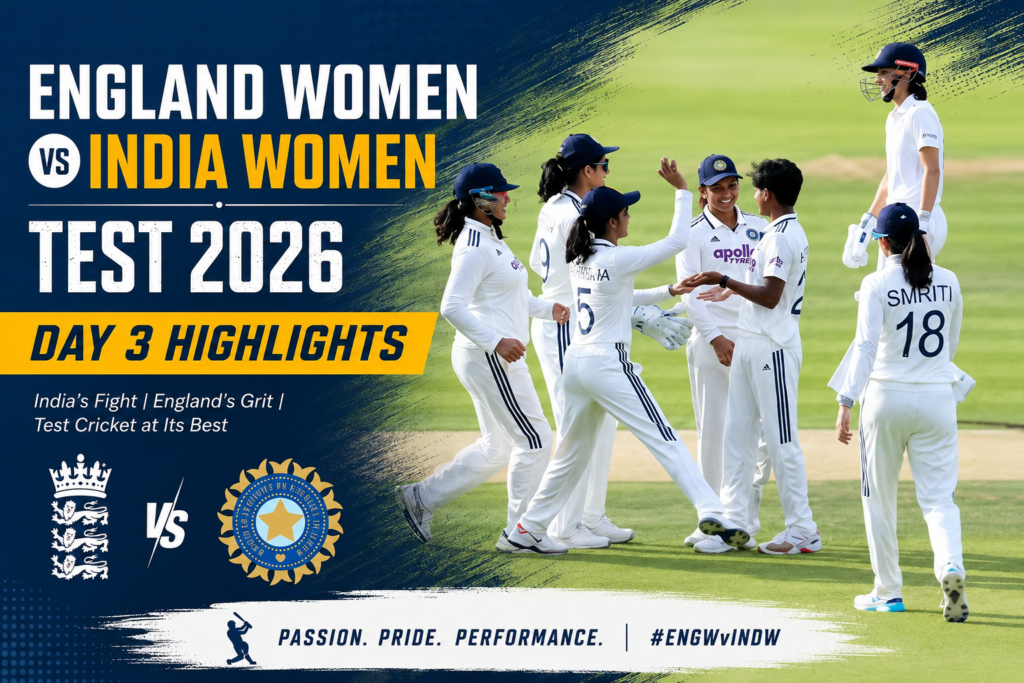
Women’s cricket witnessed another landmark chapter at the iconic Lord’s Cricket Ground as India Women tightened their grip on the one-off Test against England Women. Day Three of the historic encounter produced memorable performances, emotional farewells, record-breaking achievements, and a dominant display from the visiting Indian side.
With Yastika Bhatia scripting history through a magnificent century and India’s bowlers dismantling England’s batting lineup, the visitors moved within touching distance of a famous Test victory. By the close of play, England were staring at an almost impossible task, needing hundreds of runs with only a handful of wickets remaining.
The match has already been hailed as one of the most significant moments in women’s cricket, not only because it was Lord’s first-ever women’s Test match but also because of the quality and intensity displayed throughout the contest.
A Historic Occasion at Lord’s
The one-off Test between England and India carried immense significance even before the first ball was bowled. Lord’s, often referred to as the “Home of Cricket,” hosted its first women’s Test match, marking a milestone for the women’s game.
More than 30,000 tickets were reportedly sold across the match, highlighting the growing popularity and commercial strength of women’s cricket. The occasion also coincided with celebrations of important milestones in women’s cricket history, making the event much more than just another international fixture.
From packed stands to worldwide television audiences, the match demonstrated how far women’s cricket has progressed over the last decade.
India’s Strong Foundation
India entered Day Three with a significant advantage after establishing control through disciplined batting and aggressive bowling.
The visitors had already gained momentum thanks to important contributions in the first innings. Their batting lineup displayed patience and adaptability on a surface that offered assistance to bowlers throughout the match.
England’s bowlers, particularly Sophie Ecclestone, fought hard to keep their side in the contest, but India consistently found partnerships whenever required. This ability to build innings under pressure would later prove decisive.
The Indian camp knew that a strong second innings could effectively put the match beyond England’s reach, and that is exactly what unfolded.
Yastika Bhatia Creates History
The standout performer of Day Three was undoubtedly Yastika Bhatia.
The Indian batter produced one of the finest innings ever witnessed in women’s Test cricket at Lord’s. Her century was not merely important in the context of the match—it became a historic achievement.
Bhatia became the first woman ever to score a Test century at Lord’s, ensuring her name would forever remain part of cricketing history. Her innings combined elegance, patience, and authority as she frustrated England’s bowlers throughout the day.
What made the achievement even more remarkable was her personal journey. The century came after recovering from a serious knee injury that had threatened to derail her progress. Her comeback story added an emotional layer to an already extraordinary performance.
Every run seemed to further strengthen India’s grip on the match, while simultaneously inspiring young cricketers watching around the world.
Lower Order Contributions Strengthen India’s Position
While Bhatia deservedly grabbed the headlines, India’s lower order also played a crucial role.
Richa Ghosh and Sayali Satghare added valuable runs that frustrated England and extended the lead beyond manageable proportions. Their aggressive yet calculated approach ensured that England would face a massive target in the final innings.
These partnerships highlighted one of India’s biggest strengths in recent years—the increasing depth of their batting lineup.
Rather than relying on a handful of star players, India demonstrated that contributions can come from every position in the order. Such depth has become a defining characteristic of successful Test teams.
England’s Bowling Effort Led by Sophie Ecclestone
Despite India’s dominance, England found a bright spot in Sophie Ecclestone.
The left-arm spinner once again showcased why she is regarded as one of the world’s premier bowlers. Her five-wicket haul was a masterclass in control, accuracy, and persistence.
Ecclestone’s performance earned her a place on Lord’s honours board, making her the first England woman cricketer to achieve that distinction.
At a time when England desperately needed breakthroughs, Ecclestone delivered repeatedly. However, the lack of consistent support from the rest of the bowling attack meant India continued to build their advantage.
Even in defeat, her performance will be remembered as one of the individual highlights of the match.
India Declare with a Massive Lead
Once India’s lead crossed the 450-run mark, the declaration became inevitable.
The visitors eventually declared at 341 for 7 in their second innings, setting England an imposing target of 457 runs. Such a target would have required one of the greatest fourth-innings batting efforts in women’s Test history.
The declaration reflected India’s confidence.
They understood that the pitch was deteriorating and that England’s batting lineup had already struggled against disciplined bowling throughout the match.
With enough time remaining in the game, India’s focus shifted entirely toward taking 10 wickets.
England’s Nightmare Start
England’s chase began disastrously.
The Indian bowling attack wasted no time in applying pressure. Early wickets immediately put the hosts on the defensive, preventing them from establishing any meaningful momentum.
Experienced batters Tammy Beaumont and Heather Knight were unable to produce the resistance England desperately needed. Their dismissals further increased the pressure on the middle order.
Every wicket felt significant because the required target was already enormous.
Unlike limited-overs cricket, Test cricket demands patience and long partnerships. England failed to build either.
Emotional Farewell for Heather Knight
One of the most emotional moments of the day involved Heather Knight.
The former England captain had announced her retirement from international cricket, making this match her final appearance for the national team.
Her dismissal was greeted with heartfelt applause from teammates, opponents, and spectators alike. It marked the end of an outstanding international career spanning more than a decade and a half.
Knight leaves behind a remarkable legacy.
She played a central role in England’s growth as a women’s cricket powerhouse and inspired countless young players through her leadership and performances.
Although England found themselves in a difficult position, the respect shown toward Knight highlighted the spirit and traditions of the game.
Kranti Gaud Continues Her Dream Match
If Bhatia starred with the bat, Kranti Gaud emerged as the hero with the ball.
The fast bowler delivered another exceptional spell, continuing the form that had already earned her a place on Lord’s honours board.
Gaud became the first woman ever to enter the prestigious honours board for a five-wicket haul in a Test at Lord’s. Her performance represented a landmark achievement for Indian women’s cricket.
Her ability to generate movement, maintain disciplined lines, and exploit pressure situations proved devastating for England.
Every spell seemed to produce breakthroughs.
At just the right moments, she removed key batters and prevented any hopes of a comeback.
Amy Jones Offers Resistance
Amid the collapse, Amy Jones provided one of the few positive stories for England.
The wicketkeeper-batter showed determination and composure while wickets continued to fall around her.
Her unbeaten half-century gave England a glimmer of hope and demonstrated the resilience that has characterized her international career.
However, cricket remains a team sport.
Without substantial support from the other end, Jones’ efforts were unlikely to alter the final outcome.
Still, her fighting innings earned admiration from fans and experts alike.
Why India Have Been Superior
Several factors explain India’s dominance in this Test match.
Stronger Batting Partnerships
India consistently built partnerships whenever England threatened to gain control. Whether through top-order resilience or lower-order contributions, the visitors always found someone ready to step up.
Better Adaptation to Conditions
The Indian players adapted more effectively to the Lord’s surface. Their batters displayed patience, while the bowlers exploited conditions with remarkable discipline.
Match-Winning Individual Performances
Yastika Bhatia’s century and Kranti Gaud’s bowling heroics created a winning foundation that England struggled to counter.
Tactical Awareness
India’s captaincy and field placements reflected clear planning. The bowlers executed strategies effectively, forcing England into mistakes.
What This Means for Women’s Cricket
Beyond the result itself, this Test has broader significance.
Women’s cricket continues to push boundaries in terms of quality, audience engagement, and commercial appeal.
Historic performances at iconic venues help elevate the game’s profile globally. The achievements of players like Yastika Bhatia, Sophie Ecclestone, and Kranti Gaud will inspire the next generation of cricketers.
The strong crowd attendance and worldwide interest also strengthen the argument for more women’s Test matches in future calendars.
For years, players and fans have called for greater investment in the longest format. Matches like this provide compelling evidence that women’s Test cricket deserves more opportunities.
Looking Ahead to Day Four
As the teams prepare for the final day, India remain overwhelming favourites.
England require an extraordinary effort simply to survive, while India need only a few more wickets to complete a memorable victory. By stumps on Day Three, England were 130 for 6 and still hundreds of runs away from their target.
The visitors will enter Day Four confident and determined to finish the job.
For England, the challenge is no longer victory but survival.
Regardless of the final result, this Test match has already produced moments that will be remembered for years to come.
Conclusion
Day Three at Lord’s belonged to India Women.
Yastika Bhatia’s historic century, valuable lower-order contributions, and relentless bowling placed the visitors firmly in control. England showed flashes of resistance through Amy Jones and Sophie Ecclestone, but the overall balance of play heavily favoured India.
The match has showcased the growing strength of women’s cricket while delivering unforgettable moments at one of the sport’s most iconic venues.
With just one day remaining, India stand on the verge of a famous victory that could become one of the defining achievements in their women’s Test cricket history.