|
Getting your Trinity Audio player ready...
|
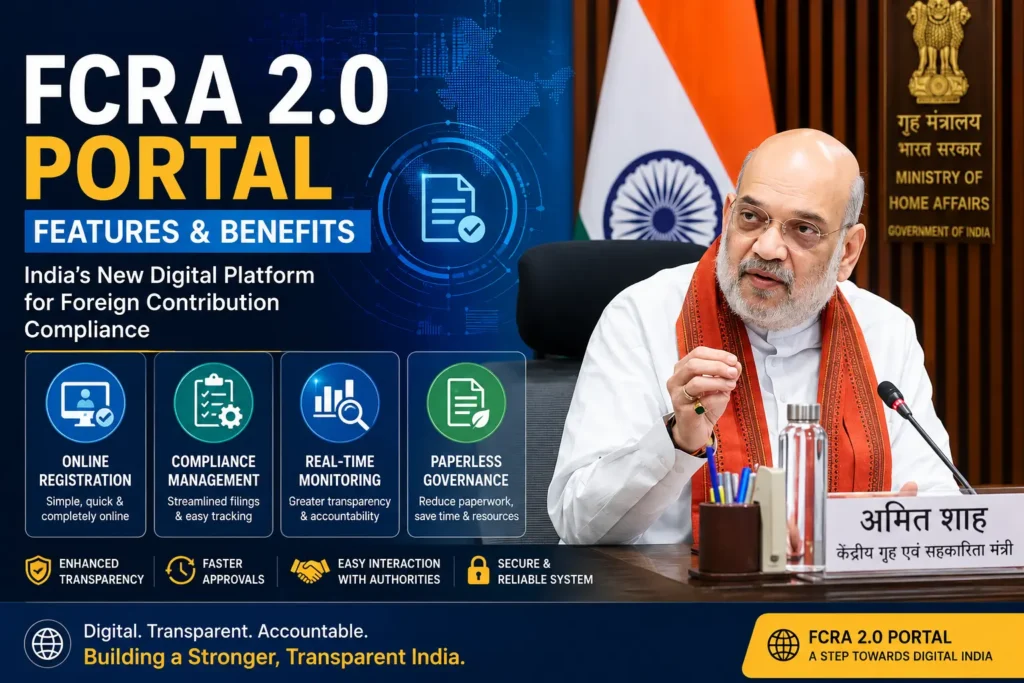
The Government of India has taken a significant step towards strengthening transparency, accountability, and digital governance with the launch of the FCRA 2.0 Portal. Introduced by Union Home Minister Amit Shah on June 30, 2026, the upgraded platform is designed to modernize the administration of foreign contributions received by NGOs, charitable trusts, educational institutions, societies, and other eligible organizations operating in India. The initiative represents one of the biggest technological upgrades to the Foreign Contribution (Regulation) Act (FCRA) ecosystem since the implementation of the FCRA Act, 2010. The portal aims to simplify compliance procedures, eliminate excessive paperwork, improve monitoring of foreign donations, and create a faster, more transparent system for organizations that depend on international funding to carry out social, educational, healthcare, environmental, and humanitarian activities.
For many years, organizations receiving foreign funds have faced challenges ranging from lengthy approval timelines and document-heavy processes to complex compliance requirements and delayed communication. With thousands of applications, renewals, and annual returns being processed every year, the need for a modern digital platform became increasingly evident. The FCRA 2.0 Portal has been developed to address these issues by bringing all major services under a single integrated digital system. The launch is also aligned with the government’s broader objective of leveraging technology to improve public service delivery while ensuring stronger oversight of foreign contributions entering the country.
Understanding FCRA and Why It Matters
Before understanding the significance of the FCRA 2.0 Portal, it is important to understand the role of the Foreign Contribution (Regulation) Act. The FCRA Act, 2010 regulates the acceptance and utilization of foreign contributions and foreign hospitality by individuals, associations, NGOs, trusts, and companies in India. The law was introduced to ensure that foreign funding does not adversely affect national interests, public policy, electoral processes, internal security, or the sovereignty of the country. Organizations intending to receive foreign donations must obtain registration or prior permission from the Ministry of Home Affairs and comply with reporting and disclosure requirements.
Over the years, FCRA has become one of the most important regulatory frameworks governing the non-profit sector in India. Thousands of organizations depend on foreign grants for activities such as education, healthcare, rural development, disaster relief, women’s empowerment, child welfare, environmental conservation, and social justice initiatives. Given the scale of foreign funding and the importance of maintaining transparency, the government has consistently worked towards improving compliance and monitoring mechanisms. The FCRA 2.0 Portal is the latest outcome of these efforts.
What is the FCRA 2.0 Portal?
The FCRA 2.0 Portal is an upgraded digital platform developed by the Ministry of Home Affairs to provide end-to-end online services related to FCRA registration, renewal, annual return filing, compliance reporting, and monitoring of foreign contributions. Unlike earlier systems that relied heavily on document submissions and manual processes, the new platform offers a fully digitized framework designed to make interactions faster, more secure, and more transparent. The portal incorporates advanced technological features, automated verification systems, integrated dashboards, and real-time monitoring capabilities that significantly enhance both user experience and administrative efficiency.
The platform has been hosted on the National Government Cloud, also known as MeghRaj, ensuring scalability, security, and reliability. It has been designed not only to streamline compliance for organizations but also to improve the government’s ability to monitor foreign fund inflows and their utilization. This dual objective of ease of compliance and stronger oversight lies at the heart of the FCRA 2.0 initiative.
Key Features of the FCRA 2.0 Portal
One of the most notable aspects of the FCRA 2.0 Portal is its extensive integration with multiple government databases and verification systems. The platform is linked with PAN, Aadhaar, OCI, NGO Darpan, and the Institute of Chartered Accountants of India’s UDIN system. These integrations enable faster verification of applicants, reduce duplication of information, and improve overall accuracy in compliance management. Instead of manually cross-checking records across different departments, the system can perform verification through API-based connectivity, significantly reducing processing time.
The portal also includes Aadhaar-based authentication, which helps verify the identity of key office bearers associated with an organization. The introduction of e-Sign functionality allows users to sign documents electronically, eliminating the need for physical signatures and courier submissions. Another major enhancement is the use of Optical Character Recognition (OCR) technology, which can automatically analyze uploaded documents and extract relevant information, reducing manual scrutiny and improving efficiency.
An integrated dashboard provides organizations with a centralized view of their registration status, compliance requirements, application progress, annual return submissions, and communication from authorities. This dashboard-based approach is expected to make compliance management significantly easier, especially for organizations handling multiple projects and funding sources.
How the New Portal Benefits NGOs and Charitable Organizations
For NGOs and charitable institutions, compliance management has traditionally been a time-consuming process. Preparing paperwork, responding to queries, tracking applications, and maintaining documentation often required considerable administrative effort. The FCRA 2.0 Portal aims to simplify these processes and reduce the operational burden on organizations.
One of the most immediate benefits is the reduction of paperwork. Since applications, renewals, annual returns, and supporting documents can now be submitted online, organizations no longer need to rely on physical submissions. This not only saves time but also reduces administrative costs. Faster processing of applications means that eligible organizations can receive approvals more efficiently, allowing them to focus on their core mission rather than regulatory procedures.
The enhanced transparency offered by the portal is another major advantage. Organizations can track the status of their applications in real time and receive updates through a centralized interface. This minimizes uncertainty and improves communication between NGOs and regulatory authorities. Furthermore, digital records create a comprehensive audit trail, helping organizations demonstrate compliance and maintain credibility with donors and stakeholders.
Real-Time Monitoring and National Security Implications
While the portal is designed to simplify compliance, it also strengthens the government’s ability to monitor foreign contributions. Real-time monitoring capabilities allow authorities to track fund inflows more effectively and identify irregularities at an earlier stage. This is particularly important because FCRA is not merely a financial regulation; it also serves as a mechanism to safeguard national interests and prevent misuse of foreign funds.
According to government officials, the new platform will help improve oversight without creating unnecessary burdens for legitimate organizations. Automated verification, integrated databases, and enhanced monitoring tools enable authorities to focus on risk-based scrutiny while providing faster services to compliant organizations. This balance between ease of doing social work and ensuring accountability is one of the key objectives behind the portal’s design.
Digital Governance and the Vision Behind FCRA 2.0
The launch of the FCRA 2.0 Portal reflects India’s broader digital governance strategy. Over the past decade, the government has introduced several technology-driven platforms aimed at improving efficiency, reducing bureaucracy, and enhancing transparency. Initiatives such as Aadhaar, UPI, DigiLocker, GSTN, and digital public infrastructure have transformed how citizens and businesses interact with government services.
The FCRA 2.0 Portal extends this digital transformation to the non-profit and foreign funding ecosystem. By leveraging cloud infrastructure, electronic authentication, automated verification, and integrated databases, the government is creating a more responsive and technology-enabled regulatory framework. The initiative aligns with the vision of “Minimum Government, Maximum Governance” by reducing manual intervention and improving service delivery through technology.
What Changes for Existing FCRA-Registered Organizations?
Organizations that already possess FCRA registration will experience a more streamlined compliance environment. Annual return filing, renewal applications, document submissions, and status tracking will now be managed through a single digital interface. Existing organizations are expected to benefit from reduced processing delays and improved access to compliance information.
The portal also incorporates provisions from the latest FCRA Amendment Rules, 2026, ensuring that organizations remain aligned with updated regulatory requirements. By embedding these changes into the platform itself, the government aims to reduce compliance confusion and encourage greater adherence to regulations.
Future Developments Expected in the Portal
Although the current version already introduces major technological improvements, the government has indicated that additional features may be added in the future. These include AI-powered chatbot support, mobile-based access, and further automation capabilities. Such enhancements could make the platform even more user-friendly and accessible, particularly for organizations operating in remote areas with limited administrative resources.
As artificial intelligence and digital governance continue to evolve, future upgrades may enable predictive compliance assistance, automated error detection, and intelligent reporting features. These developments could further reduce administrative workloads and improve the overall compliance ecosystem.
Conclusion
The launch of the FCRA 2.0 Portal marks a significant milestone in India’s efforts to modernize the management of foreign contributions. By digitizing applications, renewals, annual returns, and compliance processes, the government has created a platform that promises greater efficiency, transparency, and accountability. For NGOs, trusts, educational institutions, and charitable organizations, the portal offers a simpler and faster way to meet regulatory requirements. For the government, it provides stronger monitoring capabilities and enhanced oversight of foreign fund inflows.
As India continues its journey towards digital governance, the FCRA 2.0 Portal stands out as an example of how technology can simplify complex regulatory processes while strengthening national security and public trust. If implemented effectively and continuously improved, the platform has the potential to become a benchmark for digital compliance systems not only in India but across the world.
FAQs
What is the FCRA 2.0 Portal?
The FCRA 2.0 Portal is a fully digital platform launched by the Ministry of Home Affairs for registration, renewal, annual return filing, and monitoring of foreign contributions under the Foreign Contribution (Regulation) Act.
Who needs to use the FCRA 2.0 Portal?
NGOs, trusts, societies, educational institutions, charitable organizations, and other entities receiving foreign contributions under FCRA regulations need to use the portal.
What are the major features of the portal?
Key features include Aadhaar authentication, e-Sign, OCR document analysis, integrated dashboards, API-based verification, and real-time monitoring of foreign contributions.
How does the portal benefit NGOs?
The portal reduces paperwork, speeds up approvals, simplifies compliance, improves transparency, and provides real-time status tracking for applications and returns.
Why is FCRA important in India?
FCRA regulates foreign contributions to ensure that foreign funding is utilized transparently and does not adversely affect national interests, public policy, or internal security.