|
Getting your Trinity Audio player ready...
|

Galgotias University has built a strong reputation over the years as one of the fastest-growing private universities in India. Known for engineering, management, and emerging technology programs, the institution has attracted thousands of students aiming for strong placements and industry exposure.
However, in 2026, the university found itself at the center of national attention after a controversy linked to an AI summit presentation sparked debate about innovation claims, academic transparency, and institutional credibility. The incident created a wave of discussions across education and tech communities, forcing many to rethink how universities present research and technological achievements.
This blog breaks down the controversy, the reactions, and what it actually means for students and the future of the university.

- Background: Rising Reputation Before the Controversy
- The AI Summit Incident: What Triggered the Controversy
- Public Reaction and Media Attention
- University’s Clarification and Internal Review
- Impact on Reputation: Reality Check
- Student Perspective: Should Aspirants Be Worried?
- Bigger Picture: Pressure on Private Universities
- Future Outlook: Can the University Recover?
Background: Rising Reputation Before the Controversy
Before the incident, Galgotias University was aggressively positioning itself as a hub for innovation, artificial intelligence, and future technologies. The university promoted advanced labs, startup incubation programs, and industry-driven training to create a competitive edge in the crowded private education sector.
Many students were drawn by promises of:
- Industry-aligned curriculum
- Hands-on AI and robotics exposure
- Strong placement training
- Collaborations with tech companies
Because of this growth-focused strategy, expectations were high when the university participated in a major national AI summit in 2026.
The AI Summit Incident: What Triggered the Controversy
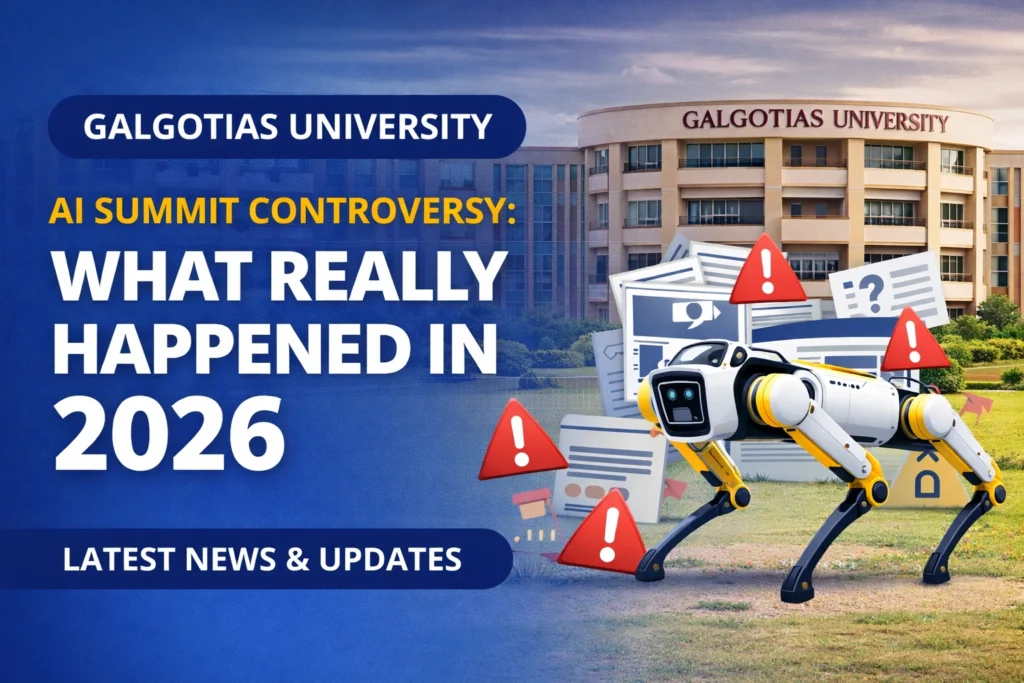
During the summit, the university showcased an AI-powered robotic dog as part of its technological demonstration. The project was presented as an innovative academic achievement connected to the institution’s research and development initiatives.
However, observers quickly questioned the originality of the showcased robot. Discussions spread online suggesting that the robot appeared similar to commercially available international robotics products rather than a fully indigenous innovation.
As debates intensified, the incident turned into a national talking point. Critics argued that universities must maintain strict transparency when presenting technology at public forums. Supporters, on the other hand, claimed that showcasing commercially sourced hardware with custom programming is a common academic practice.
The real issue was not the robot itself but the perception that innovation claims may have been exaggerated. That perception is what ignited the controversy.
Public Reaction and Media Attention
The response was immediate and intense. Social media users, tech professionals, and students began discussing the incident widely. Memes, analysis threads, and opinion posts flooded platforms, turning the summit presentation into a trending topic.
Many questioned:
- Whether universities should clearly disclose third-party hardware usage
- How originality should be defined in academic tech demonstrations
- Whether branding pressure pushes institutions to overstate achievements
The controversy exposed a larger systemic issue — the race among private universities to appear technologically superior in order to attract admissions and industry partnerships.
University’s Clarification and Internal Review
Following the backlash, the university issued clarifications addressing the confusion around the showcased technology. Officials emphasized that their intention was to demonstrate applied AI capabilities rather than claim full hardware development ownership.
An internal review process was reportedly initiated to examine communication gaps and ensure better transparency in future demonstrations. This step was crucial because reputation in academia depends heavily on trust and authenticity.
The institution attempted damage control by reaffirming its commitment to ethical academic presentation and genuine innovation. While the clarification helped calm some criticism, the incident still left a lasting impression on public perception.
Impact on Reputation: Reality Check
Let’s be brutally honest — the controversy did create a dent in the university’s innovation image. In the tech world, credibility is everything. Even a small ambiguity in presenting technology can raise big questions about authenticity.
However, this does not automatically erase the university’s academic value. Infrastructure, faculty training, placements, and student performance still matter far more than a single summit controversy. Universities are complex ecosystems, not one-event brands.
If anything, this incident forced the institution to confront a hard truth: marketing-driven narratives cannot replace real, transparent innovation.
Student Perspective: Should Aspirants Be Worried?
This is the question every prospective student is asking. The straightforward answer is no — but with a condition. Students must understand that their career success will always depend more on personal skills, internships, and portfolio strength than on any university’s promotional claims.
The controversy does not reduce the academic programs offered. Courses in AI, Computer Science, Business Analytics, and Digital Marketing still hold value if students actively build practical expertise.
In fact, this situation serves as a wake-up call. Students should focus less on university branding hype and more on measurable outcomes like:
- Hands-on project experience
- Internship exposure
- Industry certifications
- Real-world problem-solving skills
Bigger Picture: Pressure on Private Universities
This incident highlighted a larger industry trend. Private universities are competing aggressively to appear as leaders in emerging technologies such as AI, robotics, and automation. In this race, marketing sometimes moves faster than actual research depth.
That gap between promotion and proof is what triggers controversies like this. Going forward, institutions will likely become more cautious about how they present innovation claims at national and international platforms.
Ironically, this controversy might lead to stricter research validation standards across universities, which is actually a positive long-term outcome for academic credibility in India.
Future Outlook: Can the University Recover?
Absolutely — but only if actions match promises. Reputation recovery in academia depends on consistent transparency, genuine research output, and student success stories. If the university channels more investment into original research, startup incubation, and patent-driven innovation, this controversy could become just a temporary setback rather than a defining scandal.
Educational institutions are judged over decades, not days. One controversy cannot overshadow years of academic operations, provided the lessons are taken seriously and improvements are implemented.
Final Verdict
The Galgotias University AI Summit controversy was less about a robot and more about perception, transparency, and the growing pressure on universities to showcase cutting-edge innovation. The incident sparked necessary debates around academic authenticity and marketing-driven narratives in higher education.
While the controversy did raise credibility concerns, it also created an opportunity for the university to strengthen its research validation processes and rebuild trust through genuine innovation. For students, the core takeaway remains unchanged: skills, internships, and real-world exposure will always matter more than institutional hype.
In the long run, how the university evolves after this controversy will define its true position in India’s competitive private education landscape.