|
Getting your Trinity Audio player ready...
|

India has officially entered a new phase of technological self-reliance by developing and launching its own indigenous processors. This is not hype or future promise. Real silicon has been designed, tested, and revealed. While these chips are not meant to replace consumer processors from global giants overnight, they signal something far more important: India is building its semiconductor foundation from the ground up.
This move is strategic, long-term, and necessary in a world where chip supply chains decide national security, space capability, and digital growth.
Why Indigenous Processors Matter for India
For decades, India has depended heavily on imported processors for everything—from smartphones and servers to satellites and defense systems. This dependence exposes the country to supply disruptions, geopolitical risks, and high costs.

Developing homegrown processors means:
- Control over critical technology
- Better security for defense and space missions
- Reduced dependence on foreign vendors
- Growth of local semiconductor talent and ecosystem
India’s processor initiative is not about competing with Apple or Intel today. It’s about owning the core technology tomorrow.
Vikram 3201: India’s First Fully Indigenous Processor
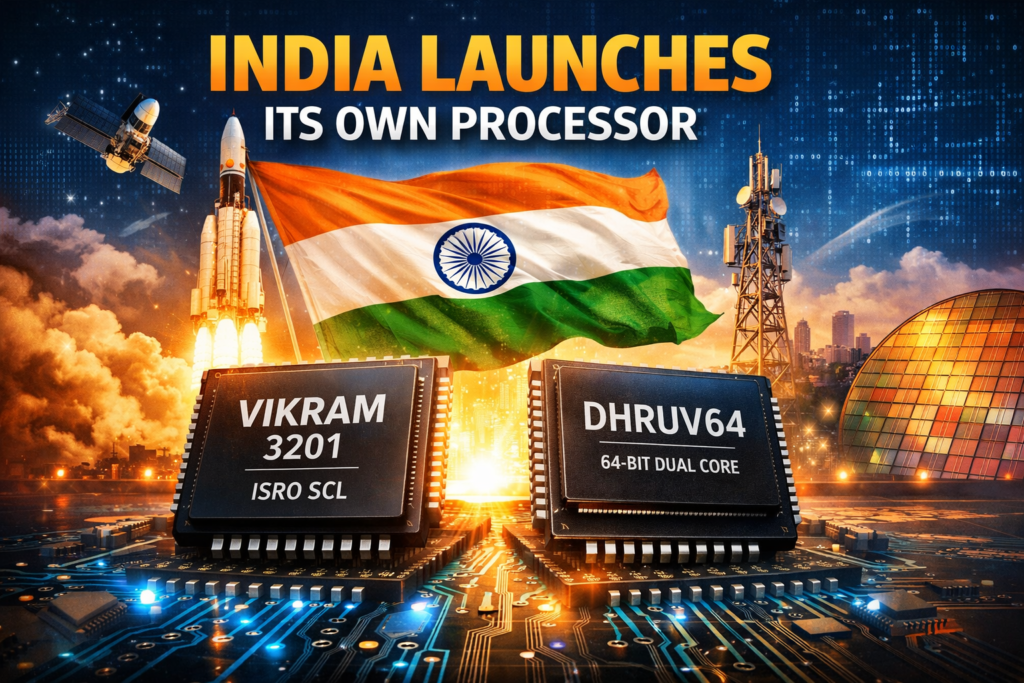
The Vikram 3201, also known as Vikram-32, is India’s first fully indigenous 32-bit microprocessor. It has been developed by ISRO in collaboration with the Semiconductor Laboratory.
This processor is designed specifically for space and mission-critical applications. Unlike commercial chips, space processors must survive extreme temperatures, radiation, and long mission durations.
Key highlights:
- 32-bit architecture
- Designed, fabricated, and tested in India
- Built for reliability rather than raw performance
- Intended for satellites and space systems
Vikram 3201 proves that India can design and manufacture processors for highly sensitive environments where failure is not an option.
DHRUV64: India’s Most Advanced Homegrown Processor So Far
Taking a bigger leap forward, India introduced DHRUV64, a 64-bit dual-core processor developed under the Microprocessor Development Programme.
This processor represents a significant jump in capability compared to earlier Indian chips.
What makes DHRUV64 important:
- 64-bit architecture
- Dual-core design
- Clock speeds suitable for real-world applications
- Designed for scalability beyond research use
DHRUV64 is aimed at sectors like embedded systems, automotive electronics, industrial control, and secure computing. It is a strong signal that India is moving from experimental chips toward usable, deployable processors.
The Role of SHAKTI and RISC-V in India’s Chip Journey
India’s processor story did not begin overnight. One of the most important contributors has been the SHAKTI processor family developed by IIT Madras.
SHAKTI processors are based on the open-source RISC-V architecture, which allows countries to design chips without paying expensive licensing fees.
Why this matters:
- Open architecture reduces dependency
- Encourages innovation and customization
- Builds academic and industry collaboration
- Trains future semiconductor engineers
SHAKTI laid the groundwork that made projects like Vikram 3201 and DHRUV64 possible.
India Semiconductor Mission: The Bigger Picture
These processors are part of the larger India Semiconductor Mission, which focuses on:
- Chip design and fabrication
- Semiconductor manufacturing plants
- Talent development
- Long-term ecosystem growth
Instead of chasing short-term wins, India is building a full semiconductor value chain, from design to deployment.
A Hard Truth: Where India Stands Today
Let’s be brutally honest.
India’s processors do not yet compete with high-performance consumer CPUs used in smartphones, laptops, or data centers. That gap will take years to close.
But that is not the point.
Every major chip-making nation started exactly like this—by mastering basic architectures, building confidence, and gradually scaling complexity. India has crossed the hardest barrier: designing working silicon independently.
That’s the real victory.
What Comes Next
Over the next decade, expect India to:
- Improve performance and efficiency
- Expand use cases beyond space and defense
- Encourage private chip startups
- Reduce reliance on imported processors
- Become a serious player in global chip design
This is a slow game. But it’s a decisive one.
Final Thoughts
India launching its own processors is not just a technological milestone—it’s a strategic statement. Vikram 3201 and DHRUV64 prove that India is no longer content being just a software powerhouse. The country is now laying the silicon beneath the software.
This is how real digital sovereignty begins.