|
Getting your Trinity Audio player ready...
|

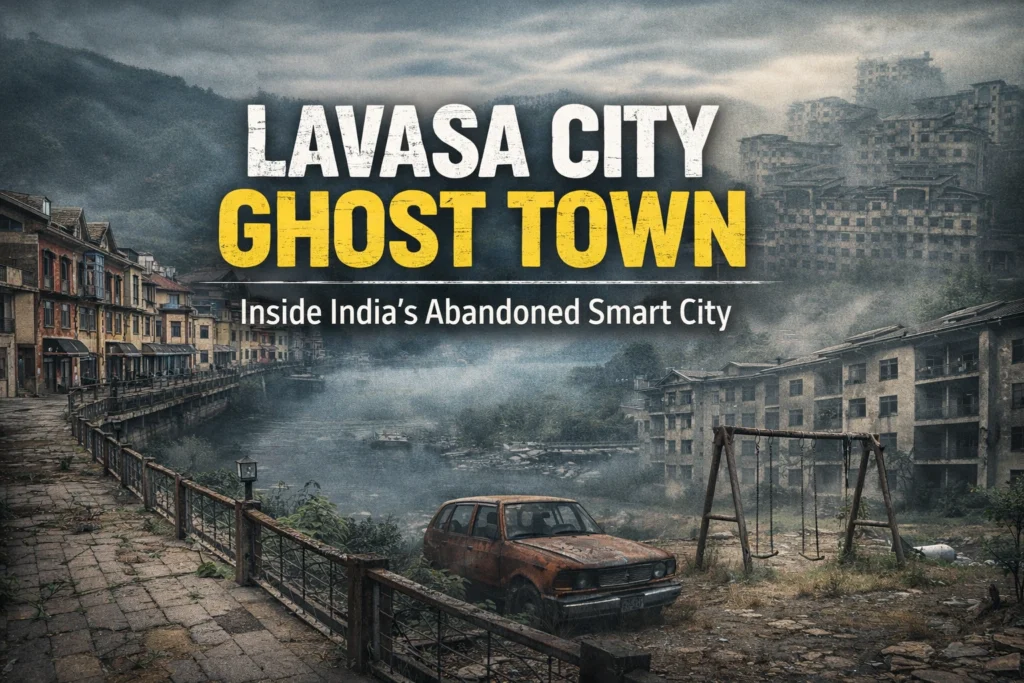
Lavasa City was once projected as India’s most futuristic hill city, a luxury smart urban paradise near Pune. Today, it stands eerily silent. Empty promenades, deserted apartment blocks, locked villas, and abandoned infrastructure now define what was supposed to be a thriving smart city. Instead of becoming India’s urban success story, Lavasa slowly transformed into a modern ghost town — a chilling reminder of overhyped ambition colliding with harsh ground realities.
- From Dream City to Dead Silence
From Dream City to Dead Silence
When Lavasa launched, it was marketed as a revolutionary private smart city with world-class infrastructure, European-style architecture, and premium lifestyle living. Buyers rushed to invest, tourists flooded the scenic lakefront, and media outlets glorified it as the future of urban India.
However, that momentum did not last long. Legal battles, environmental violations, funding breakdowns, and regulatory roadblocks gradually suffocated the project. As construction slowed, residents stopped moving in. Businesses hesitated to open. Investors lost confidence. Slowly but surely, Lavasa’s vibrant energy faded into unsettling silence.

Today, walking through Lavasa feels like entering a paused city — not fully dead, yet not truly alive either.
The Eerie Reality on Ground
Lavasa is not completely empty, but it feels abandoned in spirit. Large sections of residential towers remain unsold or unoccupied. Streets that were designed for bustling cafes and tourists now echo with emptiness on most weekdays. Some luxury homes stand locked for years, waiting for owners who never returned.
Moreover, several commercial spaces that once promised malls, offices, and entertainment zones remain half-built or shut down. Hotels operate at limited capacity, and tourism flows only during occasional weekends. The rest of the time, the city gives off a haunting vibe — polished infrastructure without real life inside it.
This strange half-developed environment makes Lavasa look like a movie set frozen after shooting ended.
Why Lavasa Turned Into a Ghost City
Lavasa’s downfall did not happen overnight. Instead, multiple failures stacked up and slowly killed the city’s growth momentum.
1. Regulatory and Legal Battles
Authorities raised serious concerns regarding environmental clearances and land acquisition practices. Construction activities were halted multiple times, which disrupted timelines and scared investors. Continuous legal uncertainty meant developers could not expand confidently, and buyers hesitated to commit long-term.
2. Financial Collapse
Massive debt and funding shortages crippled Lavasa’s development engine. Without consistent capital flow, new infrastructure projects stalled midway. As delays stretched for years, the city lost credibility in the real estate market.
3. Lack of Employment Ecosystem
A city cannot survive on scenic beauty alone. Lavasa promised IT parks, corporate hubs, and education campuses, yet most of these never materialized fully. Without jobs, residents had no reason to settle permanently. Consequently, Lavasa became more of a weekend getaway than a living city.
4. Overhyped Vision vs Ground Reality
Developers marketed Lavasa as India’s smartest private city, but execution never matched the scale of promises. This gap between vision and delivery ultimately damaged trust beyond repair.
Abandoned Infrastructure: A Symbol of Over-Ambition
Lavasa’s biggest tragedy is not incomplete buildings but incomplete purpose. Roads exist, streetlights function, waterfront promenades shine, yet the absence of daily life makes everything feel artificial. You see perfectly planned infrastructure, but you do not see the chaos, traffic, noise, and human rush that make a city feel alive.
Instead, you witness empty parking lots, silent corridors, and closed retail outlets. It feels like the city was built first and people were expected to come later. Unfortunately, they never truly did.
This reversed planning model exposed a harsh truth — infrastructure without organic demand creates ghost cities, not smart ones.
Psychological Impact: The Haunted Smart City Feeling
Many visitors describe Lavasa as beautiful but unsettling. The clean streets and colorful buildings look visually stunning, yet the emptiness creates a sense of discomfort. Unlike typical hill stations filled with crowds, Lavasa often feels staged and artificially quiet.
Such environments psychologically resemble abandoned global mega-projects where ambition exceeded practicality. Lavasa unknowingly joined that list, becoming India’s most sophisticated unfinished urban experiment.
Is Lavasa Completely Abandoned?
Technically, no. Lavasa still has operational hotels, limited residents, and occasional tourist activity. However, the scale of occupancy is nowhere close to what a planned city requires. Entire residential clusters remain unused, and multiple phases of development were never completed.
So, Lavasa is not a dead city in administrative terms, but emotionally and economically, it behaves like a ghost town most of the year.
Could Lavasa Ever Come Back to Life?
Reviving Lavasa is possible, but only if stakeholders accept brutal truths instead of repeating old marketing fantasies. First, the city needs a strong employment ecosystem. Without corporate hubs, startups, universities, or remote-work infrastructure, permanent population growth will never happen.
Second, authorities must resolve legal and environmental compliance issues permanently. Investors will only return when regulatory clarity becomes stable and transparent.
Third, Lavasa should reposition itself realistically. Instead of selling itself as a luxury residential dream city again, it should evolve into a hybrid tourism, education, and remote-working hub. With hybrid work culture rising, scenic organized cities can attract digital professionals — but only if high-speed connectivity and essential services function consistently.
The Bigger Lesson for India’s Smart City Dream
Lavasa’s ghost town transformation is a warning sign for India’s smart city mission. Grand masterplans look impressive on paper, but cities survive on employment, governance stability, and organic population growth. Ignoring these fundamentals turns even the most beautiful infrastructure into empty monuments of failed ambition.
Future smart city planners must remember one thing clearly: people create cities, not buildings. Without sustainable job ecosystems and regulatory stability, even the most luxurious smart city will struggle to attract long-term residents.
Lavasa’s silent streets are proof of this brutal reality.
Conclusion
Lavasa City is not just an abandoned project; it is a powerful symbol of India’s ambitious yet flawed urban experimentation. The city looks stunning, organized, and futuristic, yet its emptiness reveals the cost of mismanaged vision and policy conflicts. It is a ghost city not because construction stopped, but because life never fully arrived.
Still, the story is not entirely over. With strong policy reforms, fresh investment strategy, and realistic repositioning, Lavasa could transform from a ghost town into a niche smart tourism and remote-working destination. However, revival will only happen if planners stop selling dreams and start solving real structural problems.
Until then, Lavasa remains India’s most luxurious abandoned city — a silent skyline waiting for people who may or may not ever return.
FAQs
Why is Lavasa City called a ghost town?
Lavasa is called a ghost town because many residential buildings, commercial spaces, and infrastructure remain empty or underused despite being fully constructed.
Is Lavasa City completely abandoned?
No, some hotels, residents, and tourist activities still exist, but the overall occupancy is extremely low compared to a functional city.
What caused Lavasa’s decline?
Legal issues, environmental concerns, financial debt, and lack of employment opportunities collectively stalled the city’s growth.
Can Lavasa City be revived?
Yes, revival is possible if legal hurdles are cleared, jobs are created, and the city is repositioned as a realistic tourism and remote-work hub.
What lesson does Lavasa offer for future smart cities?
Lavasa proves that infrastructure alone cannot build cities. Sustainable jobs, stable governance, and organic population growth are essential for long-term urban success.