|
Getting your Trinity Audio player ready...
|

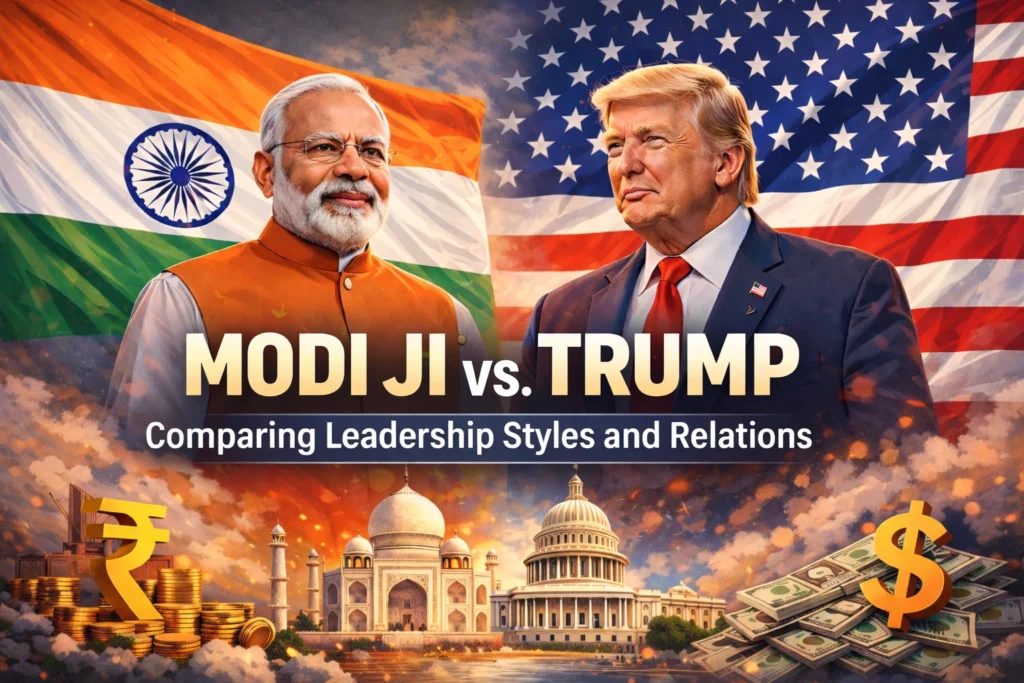
Narendra Modi and Donald Trump are two of the most influential political leaders of the 21st century. Although they come from different countries and political systems, both leaders reshaped national politics with strong personalities, bold decision-making, and powerful public communication strategies. Their leadership styles, policy approaches, and global impact reveal both striking similarities and clear differences.
This blog provides a comprehensive comparison between Modi and Trump, focusing on leadership style, economic policies, communication methods, and their influence on global politics.
- Leadership Style: Strong Personalities with Distinct Approaches
- Political Ideology and Nationalism
- Economic Policies: Growth vs Protectionism
- Communication Strategy: Discipline vs Disruption
- Global Diplomacy and Foreign Policy
- Media Image and Public Perception
- Public Support and Electoral Strategy
- Key Similarities Between Modi and Trump
- Key Differences Between Modi and Trump
Leadership Style: Strong Personalities with Distinct Approaches
Both Modi and Trump project strong, decisive leadership. However, their approaches differ significantly in tone and execution.

Modi adopts a disciplined, strategic, and structured leadership style. He emphasizes long-term national development, institutional governance, and cultural identity. His speeches often highlight nationalism, economic growth, and global partnerships. As a result, his leadership appears methodical and policy-driven.
In contrast, Trump follows a more aggressive, unconventional, and confrontational leadership style. He thrives on disruption, challenges political norms, and frequently uses bold statements to dominate public attention. Consequently, his leadership relies heavily on personal charisma and direct communication with supporters.
While Modi focuses on systematic governance and gradual reforms, Trump prioritizes immediate impact and bold policy moves. Therefore, Modi appears as a strategic reformer, whereas Trump positions himself as a disruptive political force.
Political Ideology and Nationalism
Nationalism plays a central role in both leaders’ political ideologies. However, the context and execution differ based on their countries’ priorities.
Modi promotes cultural nationalism rooted in India’s heritage and civilizational identity. He emphasizes “Make in India,” self-reliance, and strengthening domestic industries. His nationalism aligns with economic development and global cooperation.
On the other hand, Trump’s nationalism revolves around the “America First” doctrine. He focuses on reducing trade deficits, bringing jobs back to the United States, and limiting foreign dependence. His policies often prioritize domestic economic protection over international collaboration.
Therefore, while both leaders promote national pride, Modi integrates nationalism with global diplomacy, whereas Trump often links nationalism with economic protectionism.
Economic Policies: Growth vs Protectionism
Economic strategy marks one of the most important differences between Modi and Trump.
Modi’s Economic Approach
Modi’s economic policies emphasize structural reforms, digital transformation, and infrastructure development. Initiatives such as Digital India, Startup India, and Make in India aim to boost entrepreneurship, manufacturing, and technological innovation. Moreover, large-scale infrastructure projects and financial inclusion schemes support long-term economic expansion.
Additionally, Modi promotes global investment in India while simultaneously strengthening domestic industries. This balanced approach positions India as both a global investment hub and a self-reliant economy.
Trump’s Economic Approach
Trump’s economic strategy focuses heavily on protectionism and tax reforms. His administration implemented corporate tax cuts to stimulate business growth and encouraged domestic manufacturing through tariff policies. Furthermore, he pursued trade wars, particularly with China, to reduce dependence on foreign imports.
While these policies boosted certain US industries, they also created global trade tensions. Therefore, Trump’s economic model prioritizes national industrial strength even at the cost of international trade harmony.
Communication Strategy: Discipline vs Disruption
Communication style defines how both leaders connect with the public.
Modi uses a disciplined and inspirational communication strategy. His speeches often include long-term visions, cultural references, and developmental goals. He addresses citizens through radio programs, public rallies, and digital platforms with carefully structured messaging. As a result, his communication reinforces stability and national unity.
Trump, however, revolutionized political communication by using social media aggressively. He posts direct, unfiltered opinions and responds instantly to political events. This disruptive communication style keeps him constantly in headlines and ensures his narrative dominates media discussions.
Thus, Modi builds trust through structured messaging and inspirational tone, while Trump commands attention through speed, controversy, and direct engagement.
Global Diplomacy and Foreign Policy
Foreign policy highlights another key contrast between Modi and Trump.
Modi adopts a balanced diplomatic strategy. He strengthens ties with major global powers including the United States, Russia, and European nations while maintaining strong regional partnerships in Asia. His diplomacy focuses on strategic alliances, economic cooperation, and global leadership positioning for India.
Trump, in contrast, follows a transactional foreign policy approach. He prioritizes deals that directly benefit the United States and often challenges traditional alliances like NATO. His strategy seeks to renegotiate global agreements to ensure maximum advantage for America.
Consequently, Modi’s diplomacy builds long-term partnerships, whereas Trump’s diplomacy focuses on immediate strategic gains.
Media Image and Public Perception
Both leaders maintain powerful media presence, yet their public perception varies globally.
Modi enjoys an image of a development-focused reformer who promotes economic growth and cultural pride. His international visits, global summits, and investment initiatives strengthen his reputation as a global statesman.
Trump’s media image is more polarizing. Supporters view him as a bold leader who challenges political elites and defends national interests. Critics, however, see his communication style as divisive and confrontational. Despite this polarization, his ability to dominate media narratives remains unmatched.
Therefore, Modi projects a stable and visionary image, while Trump projects a bold and disruptive persona.
Public Support and Electoral Strategy
Both leaders command strong and loyal voter bases, which is crucial to their political success.
Modi’s support base stems from his focus on development, welfare schemes, and national identity. Programs related to housing, sanitation, and financial inclusion have significantly expanded his grassroots popularity.
Trump’s support base primarily includes working-class voters, small business owners, and nationalist conservatives. His messaging on job protection, immigration control, and economic nationalism resonates strongly with these groups.
Although their voter demographics differ, both leaders maintain high emotional connection with their supporters through powerful narrative building.
Key Similarities Between Modi and Trump
Despite their differences, several similarities define both leaders:
- Strong nationalist vision and focus on domestic growth
- Charismatic leadership with massive public rallies
- Direct communication with supporters using digital platforms
- Emphasis on economic development and job creation
- Ability to dominate political narratives and media attention
These similarities explain why both leaders maintain strong influence in their respective political landscapes.
Key Differences Between Modi and Trump
However, their differences are equally significant:
- Modi follows structured governance; Trump prefers disruptive decision-making
- Modi balances global cooperation; Trump emphasizes economic protectionism
- Modi uses disciplined messaging; Trump relies on controversial and rapid communication
- Modi promotes long-term policy reforms; Trump focuses on immediate economic and political impact
These distinctions highlight how different leadership philosophies can achieve strong political dominance.
Conclusion
Narendra Modi and Donald Trump represent two powerful yet contrasting leadership models in modern politics. Modi embodies strategic governance, developmental reforms, and balanced diplomacy, while Trump represents disruptive leadership, economic nationalism, and direct narrative control.
Although both leaders prioritize national interest and command massive public support, their methods reveal different approaches to power and governance. Modi builds influence through structured policies and long-term planning, whereas Trump thrives on bold actions and media-driven narrative dominance.
Ultimately, comparing Modi and Trump provides valuable insights into how leadership style, communication strategy, and economic priorities shape national and global political dynamics. Their contrasting approaches demonstrate that there is no single formula for political success, yet strong vision and decisive leadership remain essential in shaping the future of nations.