|
Getting your Trinity Audio player ready...
|
India has celebrated countless sporting heroes over the decades, but every generation witnesses a few athletes whose achievements redefine history. Sharmila Dhankar has now joined that elite list. At the 2026 Commonwealth Games in Glasgow, she became the first Indian para-athlete to win a gold medal in para athletics at the Commonwealth Games, creating a landmark moment not only for herself but for Indian sports as a whole.
Her victory in the Women’s Shot Put F57 event was much more than another medal added to India’s tally. It was the culmination of years of perseverance, discipline, and courage in the face of personal and professional challenges. Overnight, Sharmila Dhankar became one of the most searched names in India as millions of people wanted to know the inspiring story behind the woman who had created history.
For those unfamiliar with her journey, Sharmila’s success did not come overnight. Behind the gold medal is a story of resilience, sacrifice, and determination that proves extraordinary achievements are possible even in the toughest circumstances. Her rise also reflects the remarkable progress Indian para sports have made over the last decade, with athletes consistently proving that disability is never a barrier to excellence.
In this article, we take a detailed look at who Sharmila Dhankar is, her early life, her journey into para athletics, the challenges she overcame, her historic Commonwealth Games gold medal, and why her achievement is one of the defining moments in Indian sporting history.
Sharmila Dhankar Creates History at the Commonwealth Games 2026
The 2026 Commonwealth Games, held in Glasgow, Scotland, showcased some of the world’s finest athletes across multiple sporting disciplines, including para athletics. For India, the event became especially memorable when Sharmila Dhankar stepped into the throwing arena to compete in the Women’s Shot Put F57 event.
Competing against experienced international athletes, Sharmila displayed exceptional composure, strength, and technical precision throughout the competition. Her best throw proved enough to secure the gold medal, making her the first Indian athlete ever to win a Commonwealth Games gold medal in para athletics. The achievement immediately became one of the biggest highlights of India’s campaign in Glasgow and was celebrated across the country by sports fans, fellow athletes, and government leaders.
The significance of this victory extends far beyond the medal itself. While India has enjoyed tremendous success at the Paralympic Games in recent years, a Commonwealth Games para athletics gold had remained out of reach until Sharmila delivered her historic performance. Her achievement now stands as another milestone in India’s rapidly growing reputation as a global force in para sports.
Who Is Sharmila Dhankar?
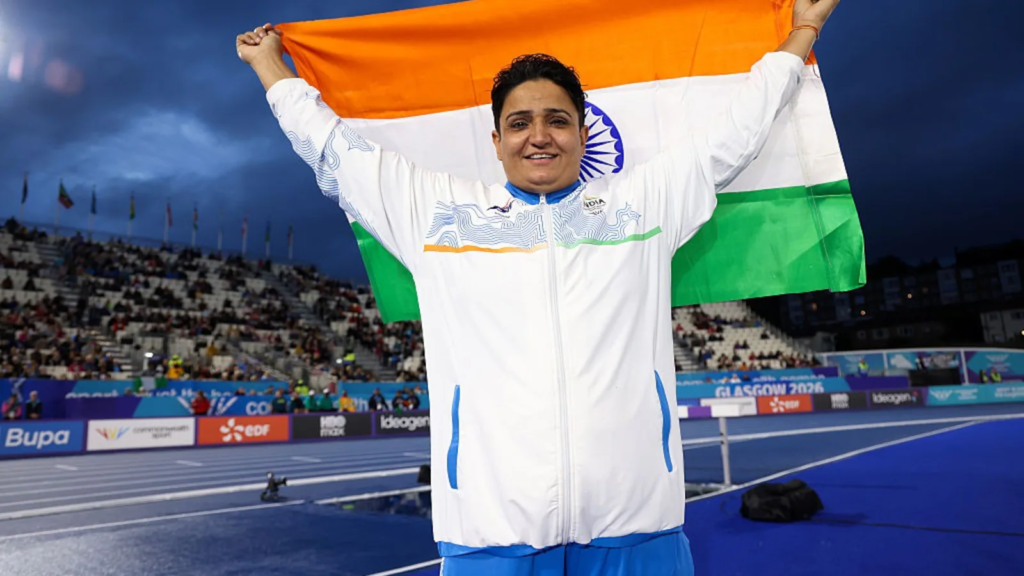
Sharmila Dhankar is an Indian para-athlete who specializes in the shot put event and represents India in international competitions under the F57 classification. Known for her exceptional upper-body strength, technical excellence, and unwavering determination, she has established herself as one of India’s leading para throwers.
Unlike many athletes who receive widespread recognition early in their careers, Sharmila quietly built her reputation through years of relentless hard work. She consistently improved her performances at national competitions before earning opportunities to compete on the international stage. Her journey reflects patience, persistence, and a relentless commitment to excellence.
Today, Sharmila is recognized not only as a Commonwealth Games champion but also as an inspiration for aspiring athletes across India. Her story demonstrates that success is achieved through dedication, resilience, and the courage to keep moving forward despite life’s challenges.
Early Life and Background
Sharmila Dhankar’s journey began in India, where she grew up facing challenges that many athletes can relate to. Access to world-class sporting infrastructure, advanced coaching, and financial support was limited, making the road to international success far from easy.
Despite these obstacles, she developed an unwavering passion for sports. Rather than allowing difficult circumstances to discourage her, Sharmila chose to focus on improving herself every single day. Her determination became one of her greatest strengths and eventually laid the foundation for an extraordinary athletic career.
As opportunities gradually emerged, she dedicated herself to training and embraced every competition as a chance to learn and improve. Those early years of persistence helped shape the champion who would later stand on top of the Commonwealth Games podium.
Overcoming Personal Struggles
One of the most inspiring aspects of Sharmila Dhankar’s story is her resilience in overcoming personal hardships. Following her Commonwealth Games victory, reports revealed that she had endured years of domestic abuse and emotional trauma before rebuilding her life through sport.
Instead of allowing those experiences to define her future, she transformed her pain into motivation. Athletics became more than just a competitive pursuit—it became a source of confidence, independence, and hope.
Every training session represented another step toward a brighter future. Every competition became an opportunity to prove not only to the world but also to herself that she was capable of achieving greatness.
Her journey reminds us that true champions are not created solely through physical training. They are also shaped by the ability to overcome adversity, rebuild confidence, and continue pursuing their dreams despite overwhelming challenges.
How Sharmila Dhankar Found Para Athletics
For Sharmila, para athletics was more than a sport—it was a life-changing opportunity. She discovered that shot put perfectly matched her determination, discipline, and physical capabilities.
The event demands explosive upper-body power, flawless technique, precise timing, and exceptional mental focus. Success cannot be achieved through strength alone; every movement must be perfected through years of dedicated practice.
Sharmila embraced this demanding process with complete commitment. She spent countless hours refining her throwing technique, building strength, and improving consistency. Rather than searching for shortcuts, she believed in steady progress through disciplined training.
Her performances gradually improved at national competitions, eventually earning her the chance to represent India at prestigious international events. Those years of dedication ultimately paved the way for her historic Commonwealth Games appearance.
Understanding the Women’s Shot Put F57 Event
Many people hearing about Sharmila Dhankar’s victory for the first time may wonder what the F57 classification represents.
The F57 category is designed for athletes with lower-limb impairments who compete in seated throwing events. Instead of relying on lower-body momentum, athletes generate power almost entirely through their upper body, shoulders, arms, chest, and core muscles.
Competitors perform their throws while securely positioned on specially designed throwing frames that provide stability during competition. Because the legs contribute very little to the throwing motion, technique becomes even more important than in conventional shot put.
Every movement—from grip and body positioning to release angle and timing—must be executed with exceptional precision. Even the smallest technical mistake can significantly reduce throwing distance.
Winning an international championship in this category requires years of disciplined training, physical conditioning, technical refinement, and mental resilience. Sharmila Dhankar’s gold medal reflects mastery of all these elements, making her achievement one of the most significant moments in Indian para athletics history.
Road to the Commonwealth Games 2026
Reaching the Commonwealth Games podium was not an overnight achievement for Sharmila Dhankar. Behind her historic gold medal were years of disciplined training, countless hours in the gym, and relentless determination to improve with every competition. Like many elite para-athletes, she faced challenges that extended far beyond the sporting arena. Limited access to specialized training facilities, financial constraints, and the lack of widespread recognition for para sports meant that every step of her journey demanded extraordinary commitment.
Despite these obstacles, Sharmila remained focused on her goal of representing India at the highest level. She competed in national championships, continuously refined her technique, and worked tirelessly to improve her strength and consistency. Every tournament became an opportunity to gain experience and prepare for bigger international competitions.
Her dedication eventually earned her a place in the Indian contingent for the 2026 Commonwealth Games in Glasgow, one of the biggest sporting events in the Commonwealth. While qualifying itself was a remarkable achievement, Sharmila had much bigger ambitions. She arrived in Glasgow determined to compete for the podium and prove that Indian para-athletes could dominate on the international stage.
The Historic Gold Medal Performance
The Women’s Shot Put F57 event featured some of the strongest para-athletes from across the Commonwealth. With experienced competitors from several nations aiming for the top spot, the contest promised to be highly competitive.
From the beginning of the event, Sharmila Dhankar looked confident. She maintained her composure while delivering technically sound throws that kept her among the leading competitors throughout the competition. As the event progressed, the pressure increased, with every athlete trying to produce their best performance in the final rounds.
When Sharmila delivered her winning throw, it became clear that history was about to be created. Her effort secured the gold medal and confirmed her position as the first Indian athlete to win a Commonwealth Games gold medal in para athletics.
The moment the final results were announced, celebrations erupted among the Indian contingent. Coaches, teammates, and officials embraced each other as the significance of the achievement became clear. Across India, sports fans took to social media to congratulate the new champion, while television channels highlighted her inspiring journey from adversity to international success.
Standing on the podium with the Indian flag behind her and the national anthem playing was a moment that symbolized years of sacrifice finally being rewarded.
Why This Gold Medal Is Historic
India has produced several world-class para-athletes who have won medals at the Paralympic Games, World Championships, and Asian Para Games. However, until Sharmila Dhankar’s victory, the country had never won a Commonwealth Games gold medal in para athletics.
That is what makes this achievement truly historic.
Her victory has added a completely new chapter to Indian sporting history. It demonstrates how far Indian para sports have progressed over the past decade and highlights the growing investment in coaching, athlete development, and international exposure.
More importantly, her success sends a powerful message to aspiring athletes with disabilities across the country. It proves that with the right determination, support, and opportunities, they too can compete with the world’s best and bring glory to India.
The medal is expected to inspire greater participation in para athletics and encourage sports authorities to continue strengthening infrastructure and funding for para-athletes.
Reactions Across India
Soon after Sharmila Dhankar’s historic victory, congratulatory messages poured in from across the country. Sports lovers, fellow athletes, coaches, and public figures praised her remarkable achievement and recognized the importance of her gold medal.
The Indian sporting community celebrated the victory as a proud moment that reflected the country’s growing strength in para sports. Social media platforms were flooded with messages applauding her determination, resilience, and inspiring journey.
Many people also highlighted the personal struggles she had overcome before reaching the international stage. Her story resonated with millions because it represented far more than sporting excellence—it became a symbol of courage, hope, and perseverance.
For young athletes, especially those competing in para sports, Sharmila’s achievement serves as motivation to dream bigger and believe that no obstacle is too great to overcome.
India’s Growing Success in Para Sports
Over the last decade, India has emerged as one of the strongest nations in international para sports. Indian athletes have consistently delivered outstanding performances at the Paralympic Games, Asian Para Games, World Championships, and now the Commonwealth Games.
The success of athletes like Avani Lekhara, Sumit Antil, Pramod Bhagat, Manish Narwal, and many others has transformed public perception of para sports in India. Their achievements have demonstrated that Indian para-athletes are capable of competing with—and defeating—the world’s very best.
Sharmila Dhankar’s Commonwealth Games gold is another significant milestone in this remarkable journey.
Her victory highlights the depth of talent that exists within Indian para athletics and reinforces the importance of continued investment in athlete development, coaching, sports science, and international competition.
With every international medal, Indian para sports continue to gain greater recognition, inspiring a new generation of athletes to pursue excellence regardless of the challenges they face.
The Importance of Representation
Sport has the power to inspire society, break stereotypes, and create opportunities for future generations. Sharmila Dhankar’s achievement goes far beyond the athletics field because it challenges long-held perceptions about disability and sporting excellence.
Her gold medal represents visibility for thousands of aspiring para-athletes who dream of representing India on the international stage. It reminds society that talent is not defined by physical limitations but by determination, hard work, and the willingness to keep striving for success.
As more para-athletes achieve global recognition, public awareness continues to grow, encouraging greater inclusivity in schools, sports academies, and communities across the country.
Sharmila’s victory is therefore not only a personal triumph but also an important step toward creating a more inclusive sporting culture in India, where every athlete receives the recognition and opportunities they deserve.
Sharmila Dhankar’s Training, Discipline, and Winning Mindset
Every international champion has a story that begins long before the spotlight arrives. For Sharmila Dhankar, success is the result of years of disciplined training, mental toughness, and an unwavering commitment to improving every aspect of her performance.
Shot put in the F57 category is an event where strength alone is never enough. Athletes must combine explosive power with perfect technique, body control, and precise timing. Every training session focuses on developing upper-body strength, improving throwing mechanics, increasing flexibility, and maintaining physical endurance. Since athletes compete from a seated position, core stability and balance become even more important than in conventional shot put.
Sharmila’s preparation involved spending countless hours perfecting every phase of her throw. Small technical improvements often translated into significant gains in distance during competition. Her coaching team worked closely with her to ensure consistency, while strength and conditioning programs helped build the power required to compete against the world’s best.
Mental preparation also played a crucial role. International competitions bring enormous pressure, especially when representing a country like India on one of the biggest sporting stages. Remaining calm, maintaining confidence, and executing a technically perfect throw under pressure requires years of experience and psychological preparation. Sharmila demonstrated all these qualities during her Commonwealth Games campaign.
Her journey shows that becoming a champion is not about one perfect performance but about thousands of disciplined training sessions that eventually lead to a historic moment.
Career Achievements Beyond the Commonwealth Games
Although the Commonwealth Games gold medal introduced Sharmila Dhankar to millions of people, her sporting journey had already included years of dedication and competitive success. She steadily progressed through national championships and earned recognition within India’s para-athletics community through consistent performances.
Representing India at international competitions is itself a significant accomplishment. Athletes must first prove themselves at domestic events, meet qualification standards, and maintain consistent performances over several seasons before earning a place in the national team.
Sharmila’s selection for the Commonwealth Games reflected the confidence that coaches and selectors had in her abilities. Her gold medal has now elevated her status among India’s leading para-athletes and is likely to open new opportunities for international competitions, sponsorships, and professional recognition.
The victory also strengthens her credentials as one of India’s medal prospects for future global events, including the Asian Para Games, World Championships, and future Paralympic competitions.
Inspiring the Next Generation
The true impact of sporting greatness extends beyond medals. It lies in the ability to inspire future generations, and Sharmila Dhankar has already begun doing exactly that.
Across India, thousands of young athletes with disabilities dream of representing the country but often face challenges such as limited facilities, financial constraints, and lack of awareness about para sports. Stories like Sharmila’s provide hope that those dreams are achievable.
Her success encourages parents to support children interested in para sports, motivates coaches to identify new talent, and reminds policymakers of the importance of investing in accessible sporting infrastructure.
Many aspiring athletes will now see Sharmila Dhankar as proof that international success is possible regardless of background or personal circumstances. Her journey demonstrates that resilience, determination, and hard work can overcome obstacles that once seemed impossible.
In many ways, her gold medal may inspire future champions who will carry India’s flag at the Paralympic Games and other international competitions for years to come.
The Growing Recognition of Para Athletics in India
Indian para sports have undergone a remarkable transformation over the past decade. Athletes who once struggled for recognition are now receiving national attention, government support, corporate sponsorships, and improved training facilities.
Major successes at the Paralympic Games have significantly changed public perception. Athletes such as Sumit Antil, Avani Lekhara, Devendra Jhajharia, Pramod Bhagat, Krishna Nagar, and several others have shown that Indian para-athletes can consistently compete among the world’s elite.
Sharmila Dhankar’s Commonwealth Games gold adds another important chapter to this remarkable journey.
As awareness continues to grow, more schools, colleges, sports academies, and state associations are actively encouraging participation in para sports. Improved coaching programs, sports science support, and international exposure are helping Indian athletes perform at increasingly higher levels.
This positive momentum is expected to continue as more success stories inspire greater participation and stronger institutional support.
What’s Next for Sharmila Dhankar?
Winning a Commonwealth Games gold medal is a defining achievement, but it is unlikely to be the final chapter of Sharmila Dhankar’s career.
Elite athletes constantly set new goals after achieving major milestones. Following her historic victory, Sharmila is expected to focus on upcoming international competitions where she can continue representing India and competing against the world’s best.
Future editions of the Asian Para Games, World Para Athletics Championships, and the Paralympic Games present exciting opportunities for her to add more medals to an already inspiring career.
With increased recognition comes greater responsibility. As one of India’s leading para-athletes, she is now in a position to mentor young athletes, promote para sports, and encourage greater inclusivity within Indian athletics.
Whether through competition or mentorship, Sharmila’s contribution to Indian sports is likely to extend far beyond her Commonwealth Games triumph.
Lesser-Known Facts About Sharmila Dhankar
There are several interesting facts that make Sharmila Dhankar’s story even more inspiring.
She became the first Indian para-athlete to win a Commonwealth Games gold medal in para athletics, creating a milestone that had never previously been achieved by an Indian competitor.
Her event, the Women’s Shot Put F57, demands exceptional upper-body strength and technical precision because athletes compete from a seated position.
Before becoming a national sporting icon, Sharmila quietly built her career through years of consistent performances with relatively little public attention.
Her inspiring comeback from personal hardships has become one of the defining aspects of her story, making her victory meaningful far beyond the sporting arena.
Today, she is widely regarded as one of the faces of India’s growing success in international para athletics.
Conclusion
Sharmila Dhankar’s journey is one of the most inspiring stories to emerge from the 2026 Commonwealth Games. Her historic gold medal in the Women’s Shot Put F57 event represents far more than a sporting achievement—it is a story of resilience, courage, determination, and hope.
From overcoming personal hardships to standing proudly on the Commonwealth Games podium with a gold medal around her neck, Sharmila has shown that true champions are defined not by the obstacles they face but by their determination to overcome them.
Her victory has rewritten Indian sporting history, bringing the country’s first-ever Commonwealth Games para athletics gold medal and inspiring millions across the nation. More importantly, it has strengthened the growing movement for para sports in India and encouraged countless young athletes to believe that no dream is beyond reach.
As Indian sport continues to evolve, Sharmila Dhankar’s name will forever be remembered among the athletes who changed history. Her success serves as a reminder that perseverance, discipline, and self-belief can transform even the most difficult circumstances into extraordinary achievements.
FAQs
Who is Sharmila Dhankar?
Sharmila Dhankar is an Indian para-athlete who competes in the Women’s Shot Put F57 category. She made history by becoming India’s first-ever Commonwealth Games para athletics gold medallist at the 2026 Commonwealth Games in Glasgow.
Why is Sharmila Dhankar’s gold medal historic?
Her victory is historic because she became the first Indian athlete to win a gold medal in para athletics at the Commonwealth Games, marking a major milestone for Indian para sports.
What is the F57 category in para athletics?
The F57 classification is for athletes with lower-limb impairments who compete in seated throwing events such as shot put, discus throw, and javelin.
Where did Sharmila Dhankar win her historic gold medal?
She won the Women’s Shot Put F57 gold medal at the 2026 Commonwealth Games held in Glasgow, Scotland.
Why is Sharmila Dhankar an inspiration?
Sharmila Dhankar’s journey from overcoming personal hardships to becoming a Commonwealth Games champion inspires millions by demonstrating that resilience, dedication, and determination can overcome even the greatest challenges.