|
Getting your Trinity Audio player ready...
|
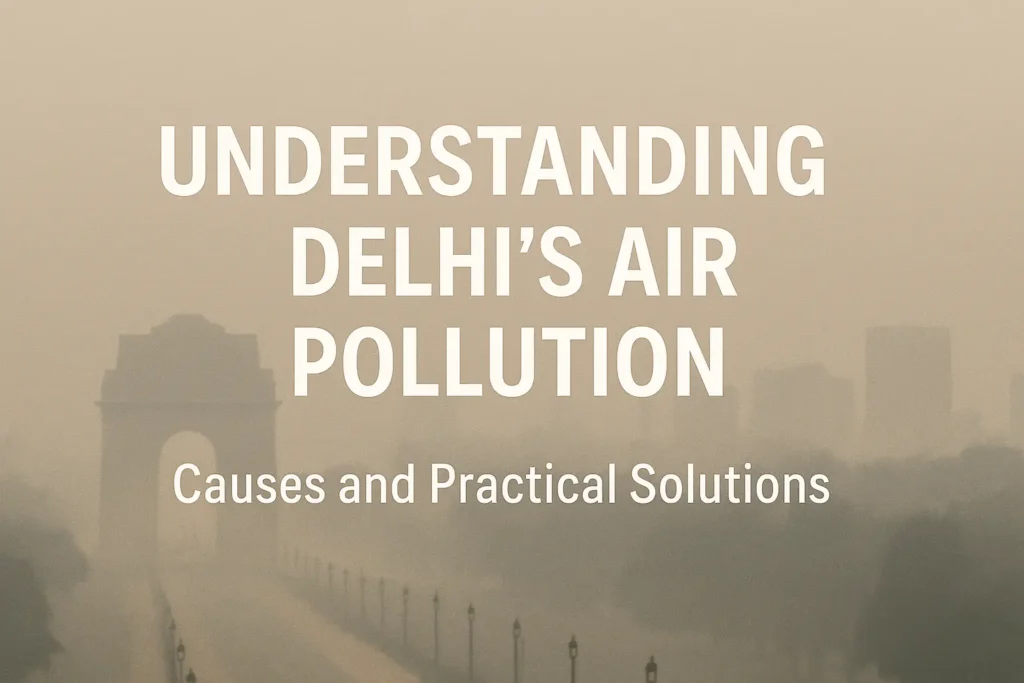
Delhi’s air pollution has become a major concern, especially as the winter months approach and the air quality begins to decline sharply. The haze, the burning eyes, the lingering smell of smoke in the air—these are not just inconveniences. They affect public health, everyday lifestyle, and even long-term development. Understanding the causes is the first step toward finding meaningful solutions.
Possible Reasons for Air Pollution in Delhi
One major factor is vehicular emissions. Delhi’s roads are packed with cars, bikes, buses, and trucks. Many vehicles are old and emit pollutants like nitrogen oxides and particulate matter, which accumulate in the air, creating smog.
Another contributor is industrial activity in and around Delhi. Factories and power plants release harmful gases. Even though there are regulations, enforcement can be uneven, leading to continuous emissions.
Seasonal stubble burning in neighboring states is also a significant reason. Farmers burn leftover crop residue after harvest to quickly clear fields for the next crop cycle. When the wind carries this smoke toward Delhi, the city becomes enveloped in a thick blanket of pollution.
Construction and dust pollution add to the problem as well. Ongoing building projects release fine dust particles into the atmosphere, which stay suspended and further reduce air quality.
Weather conditions make the situation worse. In winter, cold air traps pollutants close to the ground, preventing them from dispersing. This phenomenon creates the dense smog the city is known to experience every year.
Possible Solutions
A multi-layered issue like Delhi’s air pollution needs a multi-layered response.
Improving public transportation can reduce personal vehicle use. If buses, metros, and shared transit options become more reliable and convenient, fewer people will need to drive every day.
Stricter industrial regulations and better enforcement practices can ensure factories and power plants control emissions. Cleaner technology and monitoring systems can also help reduce harmful output.
Addressing stubble burning requires alternatives for farmers. Providing affordable machinery to handle crop residue or creating government-supported recycling systems could significantly cut down on seasonal smoke.
Reducing construction dust means using dust-control methods such as covering materials, installing barriers, and enforcing waste management rules at construction sites.
On an individual level, small steps such as carpooling, using energy efficiently, planting more greenery, and supporting clean-energy initiatives make a difference when adopted widely.
Here are live AQI readings for some common Delhi/NCR-area locations (as of latest available timestamp). These will fluctuate, so treat them as snapshots:
| Area | Approx. AQI | Timestamp (Local Time) | Category |
|---|---|---|---|
| Anand Vihar (Delhi) | ~ 425 | 11:22 AM, Nov 3 2025 | Hazardous |
| New Delhi (central) | ~ 147 | 05:07 PM, Nov 4 2025 | Poor |
| Gurugram (Haryana) | ~ 142 | ~15:30, Nov 4 2025 | Unhealthy |
| Noida (Uttar Pradesh) | ~ 115 | 05:17 PM, Nov 4 2025 | Poor |
Conclusion
Delhi’s air pollution is not an unsolvable problem. It is the result of multiple overlapping factors, but that also means several areas can be improved. With coordinated action from the government, industries, communities, and individuals, cleaner air is possible. The goal is not just to manage pollution when it becomes unbearable, but to build habits and systems that ensure healthier air throughout the year.