|
Getting your Trinity Audio player ready...
|
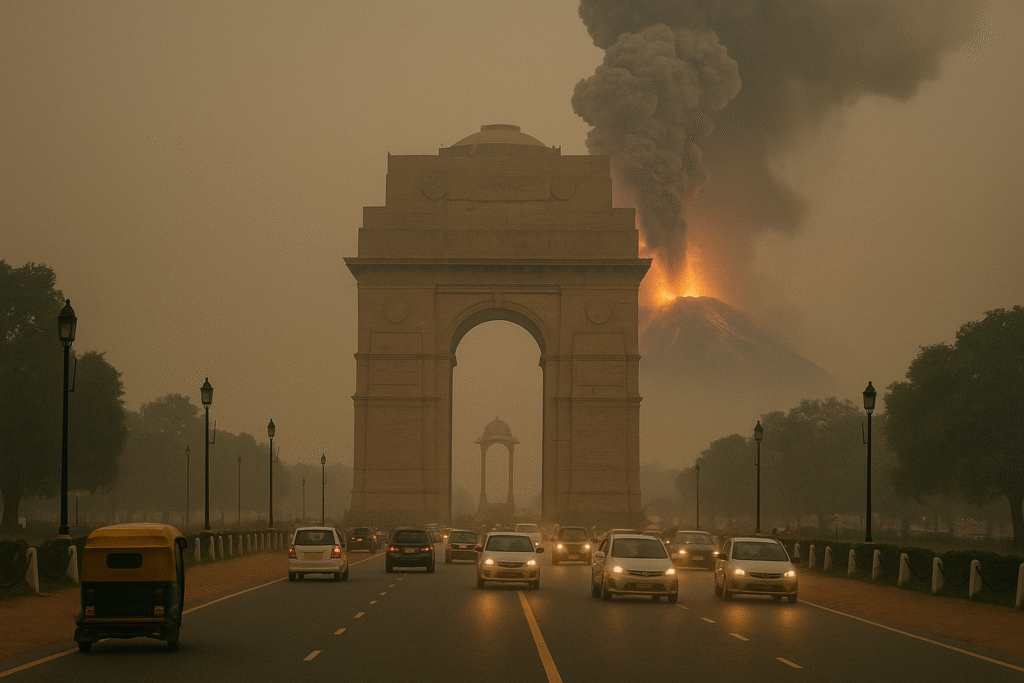
When the Hayli Gubbi volcano in Ethiopia erupted for the first time in thousands of years, no one expected that its ash would travel all the way to India. Yet within hours, upper-air winds carried the plume across the Arabian Sea, bringing it into the skies of Gujarat, Rajasthan, Haryana, Punjab, and eventually Delhi-NCR. For a region already suffocating under toxic winter pollution, this was an unexpected twist — and it set off immediate concerns for aviation, air-quality monitoring, and public health.
This blog breaks down the entire event in clear, Indian English, without exaggeration and without external links — only a factual, easy-to-understand account of what happened, why it matters, and what citizens should know.
What Exactly Happened in Ethiopia?
Hayli Gubbi, a shield volcano located in Ethiopia’s Afar region, erupted suddenly after lying dormant for nearly 12,000 years. The eruption was unusual in scale and style: instead of slow lava flows common to shield volcanoes, it blasted a massive ash column straight into the upper atmosphere. The ash plume reached around 14 kilometres in height — which is precisely the altitude where aircraft normally cruise.
Once ash enters high-altitude jet streams, it can travel astonishing distances. In this case, strong upper-air winds carried the ash northeast across the Red Sea, moved it over the Arabian Peninsula, and then pushed it toward India. Within 24–48 hours of the eruption, parts of western and northern India saw the effects in the sky.
How Did the Ash Reach India?
Many people assume volcanic ash must fall locally, but that’s not always how it works. The ash didn’t settle thickly on the ground in India. Instead, it travelled in a thin but widespread plume at high altitudes.
Here’s the sequence in simple terms:
- Eruption in Ethiopia → massive ash plume rises vertically.
- Jet stream picks it up → the plume enters powerful high-level winds.
- Ash travels eastward → across Yemen, Oman, and the Arabian Sea.
- Plume reaches India → first hitting western states, then drifting toward Delhi-NCR.
This movement is similar to how wildfire smoke from Canada once reached Europe — when particles enter high-altitude winds, distance stops mattering.
Why Did India See Immediate Impact?
1. Aviation Disruptions
This was the first and most visible impact.
Volcanic ash is deadly for aircraft engines. The fine particles can melt inside engines, cause abrasion to windshields, interfere with sensors, and reduce visibility. Because of this, aviation authorities issued an immediate alert.
- Airlines were instructed to avoid ash-affected flight paths.
- Some routes were temporarily diverted.
- Multiple flights were delayed or cancelled as a precaution.
- Airlines had to review fuel planning and rerouting options.
Even if the ash concentration is low, flying through it is risky. Hence, the aviation sector did not take chances.
2. Air-Quality Concerns in Delhi
Delhi does not need more pollution — and certainly not volcanic ash.
Even though the ash plume stayed mostly at high altitude, the possibility of mixing downward raised concerns. Delhi was already experiencing “poor” to “very poor” air-quality levels, and any additional soot, fine particulate matter, or sulphur-based gases would worsen the situation.
Meteorologists said that the ash cloud’s main layer stayed above typical breathing levels, so it was unlikely to cause a dramatic immediate spike in pollution. Still, the situation needed monitoring because weather systems can shift quickly.
3. Reduced Visibility and Changed Sky Colour
People in some regions reported hazy skies and unusual light conditions.
Volcanic ash scatters sunlight differently, sometimes producing:
- reddish or orange-tinted sunrises and sunsets,
- a mild haze even during the day,
- a diffused glow due to fine airborne particles.
Such visual effects are common after major eruptions — even far from the source.
How Serious Is This for India?
To be blunt: the impact is disruptive, not disastrous.
Here’s the realistic assessment:
- The ash plume passing over India is thin and mostly elevated, meaning it’s not dumping large amounts of ash on the ground.
- The primary risk is to aircraft, not the general population.
- Air-quality agencies are tracking it, but so far, the ash is not expected to dramatically worsen pollution at ground level.
- Delhi and NCR still face bigger problems from local pollution, not volcanic ash.
However, even if the direct threat is limited, India must take such events seriously. With climate patterns changing and global monitoring systems improving, cross-continental atmospheric events like this may become more noticeable.
Should People in Delhi and NCR Be Worried?
Not excessively — but they should stay informed.
Who may feel mild effects?
- People with asthma or chronic bronchitis
- Heart patients
- Children and elderly individuals
- Those who work outdoors for long hours
If any haze or particulate levels rise, these groups might experience irritation or breathing discomfort.
Simple Precautions
- Avoid strenuous outdoor activities during hazy hours.
- Use masks if you’re sensitive to dust.
- Keep windows closed if air quality seems worse than usual.
- Monitor official weather and AQI updates.
Again, the expected impact is mild — but staying aware is sensible.
Broader Implications for India
This unusual event teaches India a few important lessons:
1. Atmosphere Knows No Borders
A volcanic eruption in Africa influenced flight paths in India. That alone shows how interconnected global weather systems are.
2. Indian Aviation Needs Rapid Response Mechanisms
Quick rerouting and communication helped avoid risks. In the future, real-time volcanic monitoring must be integrated into domestic aviation protocols.
3. Better Public Communication Is Crucial
Events like these often cause confusion. Authorities must consistently share verified, understandable updates so that people don’t panic or spread misinformation.
4. Delhi’s Air-Quality Crisis Is So Severe That Even Natural Events Add Pressure
The fact that volcanic ash became a concern shows how vulnerable Delhi’s air-quality ecosystem already is.
How Long Will the Ash Stay Over India?
Meteorologists estimate that the ash plume will continue drifting and is likely to move eastward within a short timeframe. Upper-air winds are dynamic; such plumes rarely stay over one region for long unless the eruption continues.
As of now, the eruption intensity appears to be reducing, meaning the cloud will gradually dilute and move out of Indian airspace.
Final Thoughts
The Hayli Gubbi eruption is a rare geological event that unexpectedly touched India’s skies. While it caused flight disruptions and added pressure to already polluted regions like Delhi, the larger impact remains manageable.
Still, the episode highlights how global natural events can ripple across borders. It’s a reminder that India must keep strengthening its environmental monitoring, aviation preparedness, and public-information systems.
Nature doesn’t send invitations before dramatic events — it just happens.
And when it does, being informed and prepared is the only smart response.