|
Getting your Trinity Audio player ready...
|
In today’s digital payment era, debit cards and credit cards have become essential financial tools. While both cards look similar and can be used for online and offline transactions, they function very differently. Choosing the right card can directly impact your financial discipline, credit score, and overall spending habits.
Understanding the difference between debit and credit cards helps you make smarter financial decisions, avoid unnecessary debt, and manage expenses efficiently. In this blog, we will explore debit cards vs credit cards in depth, including how they work, their advantages, disadvantages, and a complete comparison table to simplify the decision-making process.
- What is a Debit Card?
- What is a Credit Card?
- Key Difference Between Debit Card and Credit Card
- Debit Card vs Credit Card Comparison Table
- Advantages of Using a Debit Card
- Advantages of Using a Credit Card
- Risks and Disadvantages of Debit Cards
- Risks and Disadvantages of Credit Cards
- Which One Should You Choose?
- FAQs
- 1. Which is safer: debit card or credit card?
- 2. Does using a debit card build credit score?
- 3. Can a credit card be used without paying interest?
- 4. Is it good to have both debit and credit cards?
- 5. What happens if I miss a credit card payment?
- 6. Are debit cards better for beginners?
- 7. Which card is better for online shopping?
What is a Debit Card?
A debit card is directly linked to your bank account. Whenever you make a payment using a debit card, the money is instantly deducted from your available bank balance. This means you can only spend the amount you already have in your account.
Debit cards are ideal for individuals who want strict control over their spending. Since the transaction uses your own money, there is no risk of debt accumulation. These cards are commonly used for ATM withdrawals, online purchases, bill payments, and in-store payments.
What is a Credit Card?
A credit card allows you to borrow money from the bank up to a pre-approved credit limit. Instead of deducting funds immediately, the bank pays on your behalf, and you repay the amount later within a billing cycle.
If the full amount is not paid within the due date, interest charges apply on the outstanding balance. Credit cards are powerful financial tools when used responsibly because they help build a credit score, provide reward points, and offer emergency financial support.
Key Difference Between Debit Card and Credit Card
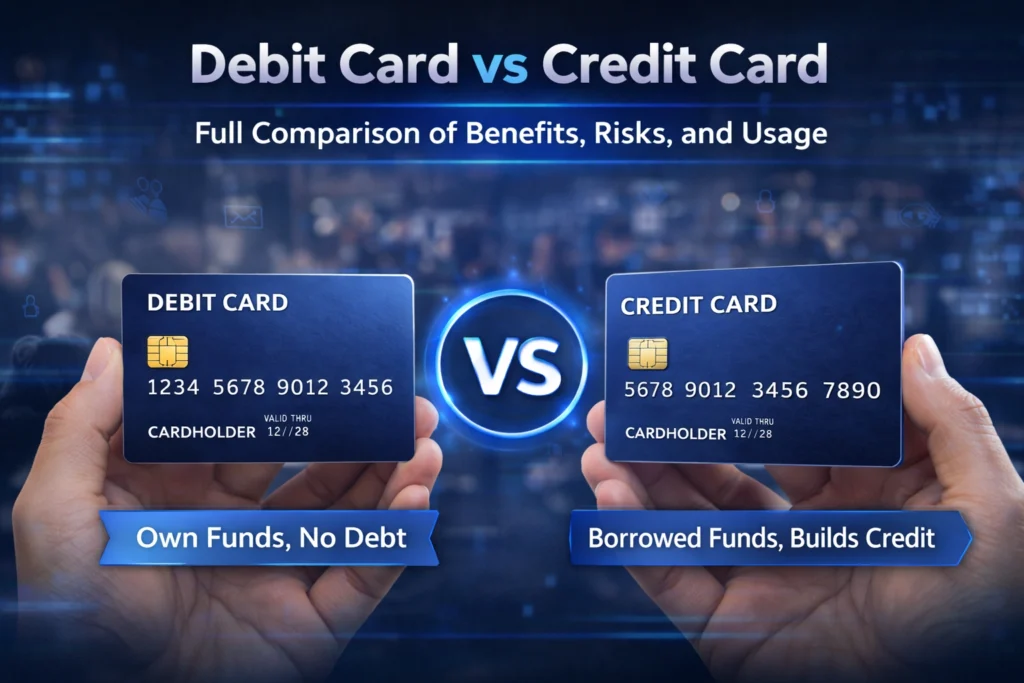
The fundamental difference lies in the source of funds. Debit cards use your own money, whereas credit cards use borrowed money that must be repaid later. This difference affects spending behavior, risk level, and financial flexibility.
Debit Card vs Credit Card Comparison Table
| Feature | Debit Card | Credit Card |
|---|---|---|
| Source of Funds | Directly from bank account | Borrowed money from bank |
| Spending Limit | Limited to account balance | Pre-approved credit limit |
| Interest Charges | No interest | Interest applies if unpaid |
| Credit Score Impact | Does not affect credit score | Helps build credit history |
| Risk of Debt | No debt risk | High if misused |
| Rewards & Cashback | Limited rewards | Attractive rewards and cashback |
| Approval Requirement | Easy to obtain | Requires credit eligibility |
| Fraud Protection | Basic protection | Stronger purchase protection |
| Usage in Emergencies | Limited to available funds | Useful for emergencies |
| Annual Fees | Usually minimal or none | Often includes annual fees |
This table clearly shows that debit cards focus on financial discipline, while credit cards offer financial flexibility and additional benefits.
Advantages of Using a Debit Card
Debit cards promote responsible spending since you can only use the money available in your account. This prevents overspending and keeps your budget under control. They are also easy to obtain because they do not require credit history or eligibility checks.
Another advantage is that debit cards do not involve interest payments. You are not borrowing money, so there is no risk of accumulating debt. For beginners and students, debit cards are often the safest and most practical payment option.
Advantages of Using a Credit Card
Credit cards provide financial flexibility and convenience. They allow you to make large purchases even when you do not have immediate funds available. This makes them extremely useful during emergencies or sudden expenses.
Additionally, credit cards help build a strong credit score when bills are paid on time. A good credit score improves eligibility for loans, better interest rates, and premium financial services. Many credit cards also offer reward points, travel benefits, cashback, and exclusive discounts, which add extra value to spending.
Risks and Disadvantages of Debit Cards
Although debit cards are safe for budgeting, they lack financial backup in emergencies. If your account balance is low, transactions may fail. They also provide fewer rewards and limited purchase protection compared to credit cards.
Another drawback is that debit card fraud can directly affect your bank balance, and recovering funds may sometimes take time depending on bank policies.
Risks and Disadvantages of Credit Cards
Credit cards come with a major risk of overspending. Since you are using borrowed money, it becomes easy to lose track of expenses. If the bill is not paid on time, high interest charges apply, which can quickly lead to debt accumulation.
Annual fees, late payment charges, and penalties can also increase financial burden if the card is not managed responsibly. Therefore, discipline and timely repayment are essential for credit card users.
Which One Should You Choose?
The choice between a debit card and a credit card depends on your financial habits and goals. If you prefer strict budgeting and want to avoid debt, a debit card is the better option. It ensures you only spend what you already have.
However, if you want financial flexibility, reward benefits, and an opportunity to build a strong credit profile, a credit card is more suitable. The key is to use it wisely and always pay the full bill before the due date to avoid interest charges.
For most individuals, using both cards strategically offers the best balance between financial control and flexibility.
Final Thoughts
Debit cards and credit cards serve different purposes in personal finance. A debit card helps maintain spending discipline and eliminates the risk of debt, while a credit card provides purchasing power, reward benefits, and credit score growth.
Instead of choosing one over the other blindly, understanding how each card works allows you to use them smartly according to your financial needs. When managed properly, both debit and credit cards can become powerful tools for financial stability and long-term planning.
FAQs
1. Which is safer: debit card or credit card?
Credit cards are generally safer due to stronger fraud protection and dispute resolution policies offered by banks.
2. Does using a debit card build credit score?
No, debit card usage does not impact your credit score because it does not involve borrowing money.
3. Can a credit card be used without paying interest?
Yes, if you pay the full outstanding bill before the due date, no interest is charged.
4. Is it good to have both debit and credit cards?
Yes, using both cards strategically provides better financial flexibility and spending control.
5. What happens if I miss a credit card payment?
Missing a payment results in late fees, interest charges, and a negative impact on your credit score.
6. Are debit cards better for beginners?
Yes, debit cards are ideal for beginners because they help control spending and avoid debt risks.
7. Which card is better for online shopping?
Credit cards are often better for online shopping due to rewards, cashback offers, and stronger purchase protection.