|
Getting your Trinity Audio player ready...
|
Over the past few days, a mobile application called BAT BMS has become one of the most discussed topics in India’s electric vehicle community. Videos circulating across Instagram, YouTube, X, and other social media platforms show users allegedly connecting to nearby e-rickshaws and remotely disabling them, leaving drivers stranded and confused.
The trend, often referred to online as “Tirri Control,” has sparked concerns among e-rickshaw drivers, EV owners, battery manufacturers, and government authorities. What began as a viral prank has now evolved into a serious conversation about electric vehicle cybersecurity and the safety of connected battery systems.
So what exactly is the BAT BMS App, how does it work, and why are thousands of e-rickshaw drivers worried about it?
What Is BAT BMS App?
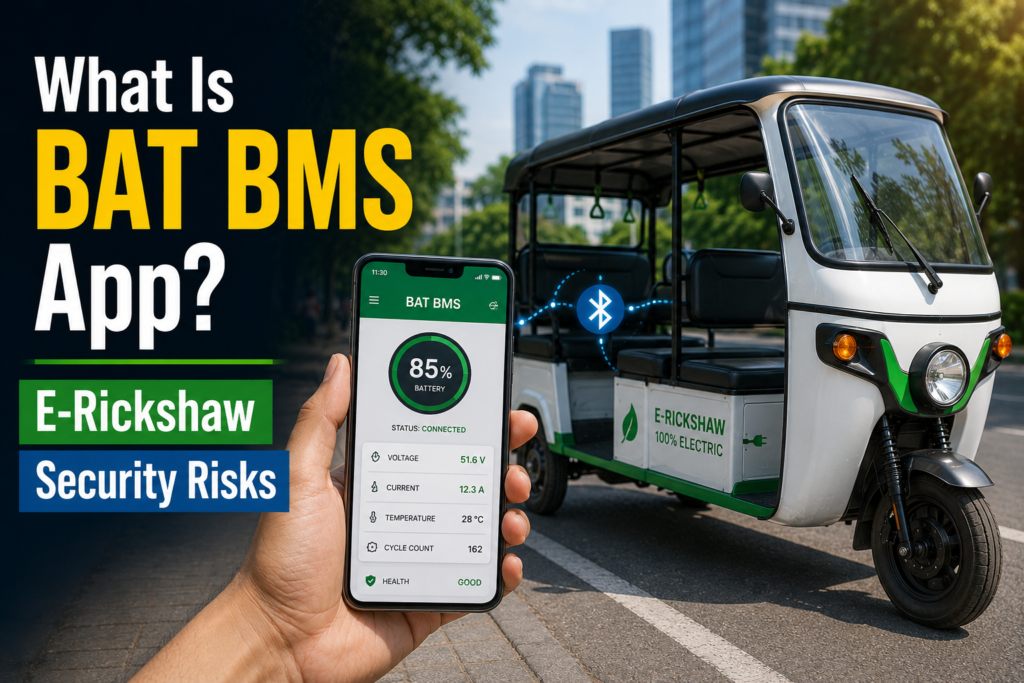
BAT BMS is a battery management application designed for monitoring and controlling compatible lithium battery systems. The app connects to batteries through Bluetooth and provides real-time information such as battery percentage, voltage, current, temperature, charging status, cycle count, and cell health. The application is available for both Android and iOS devices and was originally developed as a battery monitoring tool rather than a vehicle control platform.
Battery Management Systems, commonly known as BMS, are critical components inside modern lithium-ion batteries. They help regulate charging and discharging, monitor battery health, prevent overheating, and ensure safe operation.
The BAT BMS App was designed to make this monitoring process easier by allowing users to access battery information directly from their smartphones. However, recent viral videos suggest that some users have discovered ways to connect to nearby battery systems that lack adequate security protections.
Why Is BAT BMS Trending in India?
The app gained nationwide attention after videos emerged showing individuals approaching e-rickshaws and allegedly switching off their battery systems through Bluetooth connections.
These videos have attracted millions of views online and triggered widespread debate. In many clips, the e-rickshaw suddenly stops moving while the driver appears unaware of what has happened. The trend quickly became known as “Tirri Control” on social media.
As the videos spread, many users began questioning whether electric vehicles could actually be controlled remotely and whether the app represented a major security threat.
How Does the BAT BMS App Work?
The BAT BMS App uses Bluetooth Low Energy (BLE) technology to connect with compatible battery management systems. According to the application’s official description, it can operate within a range of approximately 15 metres and display various battery parameters.
When a battery’s Bluetooth interface is left unsecured, nearby devices may be able to detect and connect to it. If the battery management system lacks proper authentication or password protection, unauthorized users could potentially gain access to controls that were intended only for the owner.
Experts suggest that the issue is not necessarily with the BAT BMS App itself but with certain battery systems that fail to implement adequate security measures.
Why Are E-Rickshaw Drivers Worried?
For thousands of e-rickshaw drivers, their vehicle is their primary source of income. Any unexpected disruption can directly affect daily earnings.
Drivers are worried for several reasons:
Loss of Income
If a vehicle suddenly stops working during a trip, drivers may lose customers and valuable working hours. Even short interruptions can impact daily earnings, especially for drivers operating on tight margins.
Passenger Safety
One of the biggest concerns is road safety. If an e-rickshaw stops unexpectedly in traffic, it could create dangerous situations for passengers, pedestrians, and other road users. Social media users and experts have highlighted the risks associated with disabling vehicles while they are moving.
Lack of Awareness
Many drivers may not even know that their battery systems have Bluetooth connectivity. As a result, they may be unaware of potential security vulnerabilities or available protective measures.
Trust Issues
The viral trend has created uncertainty among EV users. Some drivers now question whether their battery systems are secure and whether similar incidents could happen to them.
Is Every Electric Vehicle at Risk?
No.
The BAT BMS controversy does not affect every electric vehicle. Most modern EV manufacturers implement stronger cybersecurity measures, encrypted communications, password-protected systems, and advanced software protections.
The reported issue appears to be limited primarily to certain Bluetooth-enabled battery management systems that may not have sufficient authentication controls. Premium electric cars, branded electric scooters, and vehicles with secure battery architectures are generally far less vulnerable.
Government and Industry Response
The growing controversy has attracted attention from authorities. Reports indicate that the Delhi government has asked its transport department to investigate claims surrounding the BAT BMS App and determine the authenticity of the reported vulnerabilities. Officials are examining whether the app can genuinely disable vehicles and whether additional regulatory action may be necessary.
Industry experts believe the incident highlights the need for stronger cybersecurity standards in connected EV systems, particularly in the rapidly growing e-rickshaw sector.
What This Means for the Future of EV Security
The BAT BMS controversy serves as a reminder that electric vehicles are becoming increasingly digital. Modern batteries, charging systems, mobile apps, and connected technologies offer convenience and efficiency, but they also introduce new security challenges.
Manufacturers may need to strengthen:
- Bluetooth authentication
- Password protection
- Data encryption
- Firmware security
- Access controls
- Remote monitoring safeguards
As India’s EV market continues to expand, cybersecurity will become just as important as battery range, charging speed, and vehicle performance.
How E-Rickshaw Owners Can Protect Themselves
Drivers and battery owners can take several precautions:
- Use batteries from reputable manufacturers.
- Change default passwords whenever possible.
- Disable Bluetooth when not required.
- Update battery firmware regularly.
- Consult battery suppliers regarding security settings.
- Avoid sharing battery access credentials.
These simple measures can reduce the risk of unauthorized access and improve overall vehicle security.
Conclusion
The BAT BMS App was originally created as a battery monitoring and management tool. However, viral videos showing users allegedly disabling e-rickshaws through Bluetooth connections have brought the app into the national spotlight.
While the issue does not affect all electric vehicles, it has exposed potential weaknesses in some battery management systems. For e-rickshaw drivers whose livelihoods depend on their vehicles, the possibility of unauthorized interference is understandably concerning.
The controversy highlights an important lesson for India’s growing EV industry: cybersecurity must become a core part of vehicle safety. As electric mobility continues to evolve, secure battery systems, stronger authentication protocols, and better industry standards will be essential to maintaining trust and protecting users.
FAQs
What is the BAT BMS App?
BAT BMS is a battery management application used to monitor lithium battery systems through Bluetooth connections. It displays battery health, voltage, temperature, charge levels, and other important information.
Why is BAT BMS trending?
The app became viral after social media videos claimed that it could connect to certain e-rickshaw battery systems and disable them remotely.
Can BAT BMS stop all electric vehicles?
No. The issue appears to affect only certain battery systems that lack adequate security protections. Most modern EVs use stronger cybersecurity measures.
Is BAT BMS a hacking app?
No. BAT BMS was designed as a legitimate battery monitoring tool. The controversy relates to how some users may be exploiting weaknesses in certain battery systems.
Has the government taken action?
Authorities have reportedly begun investigating claims surrounding the app and the reported vulnerabilities in affected e-rickshaw battery systems.