|
Getting your Trinity Audio player ready...
|
When people talk about ancient cities swallowed by the sea, one name instantly comes to mind in India—Dwarka. Believed to be the legendary kingdom of Lord Krishna, Dwarka has fascinated historians, archaeologists, and devotees for decades. Underwater explorations off the coast of Gujarat have uncovered stone structures, anchors, and artefacts that suggest an ancient settlement once existed beneath the Arabian Sea.
But what if Dwarka isn’t the only mysterious city lost beneath the waves?
Thousands of kilometres away from India’s western coast lies another legendary city that has captivated the imagination of people for over 2,000 years—Atlantis. Unlike Dwarka, whose existence is supported by archaeological discoveries, Atlantis remains one of history’s greatest unsolved mysteries. Was it an advanced civilisation destroyed by a natural disaster? Was it merely a philosophical story invented by the ancient Greek philosopher Plato? Or does the truth lie somewhere in between?
The mystery of Atlantis has inspired countless books, documentaries, films, scientific expeditions, and conspiracy theories. Even today, researchers continue searching for evidence that could finally answer one of humanity’s oldest questions: Did Atlantis really exist?
This article explores the fascinating history of Atlantis, compares it with Dwarka, examines archaeological discoveries, separates myths from facts, and explains why both lost cities continue to intrigue the world.
What Is Atlantis?
Atlantis is a legendary island civilisation first described by the ancient Greek philosopher Plato around 360 BCE in his dialogues Timaeus and Critias. According to Plato, Atlantis was a powerful island nation located beyond the “Pillars of Hercules,” widely believed to refer to the Strait of Gibraltar.
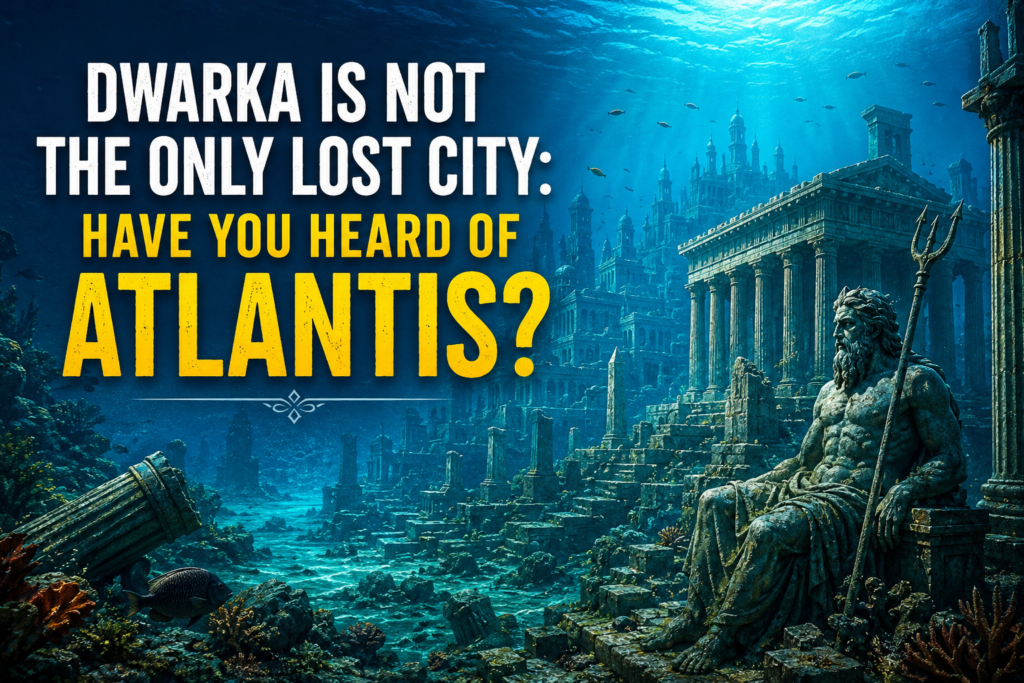
Plato described Atlantis as an incredibly wealthy and technologically advanced civilisation. The island supposedly featured magnificent temples, enormous palaces, sophisticated irrigation systems, harbours filled with ships, and concentric rings of land and water surrounding its capital.
Its people were said to possess extraordinary engineering skills, vast military power, and abundant natural resources, including gold, silver, precious stones, fertile farmland, and exotic wildlife.
However, Plato also claimed that the Atlanteans became arrogant and morally corrupt. According to his account, the gods punished Atlantis by causing catastrophic earthquakes and floods, sinking the entire island beneath the ocean “in a single day and night of misfortune.”
Since then, Atlantis has become one of the world’s greatest historical mysteries.
The Story Behind Atlantis
Plato claimed he learned the story through Egyptian priests, who allegedly preserved records dating back approximately 9,000 years before his own lifetime.
According to these accounts, Atlantis once ruled a vast maritime empire stretching across large parts of the Atlantic Ocean.
The Atlanteans attempted to conquer neighbouring lands, including ancient Athens, but were ultimately defeated.
Shortly afterward, devastating earthquakes and floods destroyed Atlantis, causing the island to disappear beneath the sea forever.
Although Plato presented Atlantis within philosophical writings rather than historical records, many readers over the centuries interpreted his descriptions literally.
This single story has inspired generations of explorers searching for the lost civilisation.
Is Atlantis Real?
This remains one of archaeology’s biggest unanswered questions.
There is currently no universally accepted archaeological evidence proving Atlantis existed exactly as Plato described.
Most historians believe Plato created Atlantis as a moral and political allegory illustrating how even the most powerful societies can collapse due to pride and corruption.
However, others argue that Plato may have based his story on real historical events.
Several natural disasters in the ancient Mediterranean, particularly volcanic eruptions and tsunamis, destroyed thriving civilisations thousands of years ago.
Some researchers suggest these disasters may have inspired the Atlantis legend.
While definitive proof remains absent, the possibility that Atlantis contains elements of historical truth continues attracting scientific interest.
The 2011–2012 Atlantis Discovery Claims
Interest in Atlantis surged again during 2011 and 2012 after a documentary suggested researchers had identified possible ruins in the marshlands of Doñana National Park in southern Spain.
Using satellite imagery, radar technology, and ground surveys, investigators identified circular formations beneath marshland that resembled Plato’s description of Atlantis.
The documentary proposed that survivors of Atlantis may have escaped after a massive tsunami destroyed their civilisation.
Around the same period, internet users also widely shared satellite images from Google Earth showing unusual underwater formations near the Canary Islands and other parts of the Atlantic Ocean.
Many people claimed these images revealed the streets of Atlantis.
Scientists quickly explained that the formations were actually artefacts created during sonar mapping of the ocean floor rather than ancient ruins.
Similarly, the Spanish research attracted public attention but did not produce conclusive archaeological evidence confirming Atlantis.
While fascinating, the 2012 discoveries remain speculative rather than definitive proof.
Possible Locations of Atlantis
Over the past century, researchers have proposed dozens of possible locations for Atlantis.
Some believe it existed near southern Spain.
Others suggest the island of Santorini in Greece, where a massive volcanic eruption devastated the Minoan civilisation around 1600 BCE.
Additional theories place Atlantis near the Azores Islands, Malta, the Caribbean, Antarctica, and even beneath the Sahara Desert.
Despite extensive investigations, no location has been universally accepted by archaeologists.
Dwarka: India’s Lost Underwater City
Unlike Atlantis, Dwarka has genuine archaeological evidence supporting the existence of an ancient settlement beneath the sea.
Marine archaeologists have discovered stone walls, anchors, pottery fragments, and structural remains off the coast of modern Dwarka in Gujarat.
These discoveries indicate that ancient coastal settlements were gradually submerged as sea levels changed over thousands of years.
Although researchers continue debating whether these remains correspond exactly to the Dwarka described in the Mahabharata, there is little doubt that an important ancient city once flourished in the region.
This makes Dwarka fundamentally different from Atlantis.
Dwarka’s underwater remains are supported by archaeology, whereas Atlantis remains primarily a legendary civilisation.
Dwarka vs Atlantis
Although both cities are associated with myths and underwater mysteries, important differences exist.
Dwarka is deeply connected to Hindu traditions and the life of Lord Krishna. Archaeological surveys have confirmed submerged structures near the present-day city.
Atlantis originates from Greek philosophy. Despite centuries of exploration, no universally accepted archaeological site has been identified.
Dwarka represents a blend of history, religion, and archaeology.
Atlantis remains largely within the realms of mythology, speculation, and philosophical interpretation.
What Makes Dwarka and Atlantis Similar?
At first glance, Dwarka and Atlantis appear to belong to completely different worlds—one rooted in Hindu scriptures and Indian history, the other emerging from ancient Greek philosophy. Yet, despite their different origins, the two legendary cities share remarkable similarities that have fascinated historians, archaeologists, marine explorers, and mythology enthusiasts for centuries. Both are described as prosperous coastal civilizations with extraordinary architecture, advanced planning, thriving maritime trade, and immense cultural significance. Ancient texts suggest that each city flourished during its peak before disappearing beneath the sea following catastrophic natural events, giving rise to legends that have endured for thousands of years.
Another striking similarity is the mystery surrounding their existence. Both Dwarka and Atlantis have inspired numerous underwater expeditions, scientific studies, documentaries, and archaeological investigations aimed at uncovering evidence hidden beneath the ocean floor. Modern technologies such as sonar mapping, satellite imagery, remotely operated underwater vehicles (ROVs), and marine archaeology have been used to search for clues about these submerged worlds. While underwater excavations near Gujarat have revealed structures, anchors, stone blocks, and artefacts linked to an ancient settlement at Dwarka, Atlantis continues to remain elusive, with no universally accepted archaeological evidence confirming its exact location.
Why Are Lost Cities So Fascinating?
Lost cities capture human imagination because they combine history, mystery, adventure, and unanswered questions.
They remind us that great civilisations can disappear through natural disasters, climate change, wars, or economic collapse.
Modern technology continues revealing forgotten settlements beneath deserts, forests, lakes, and oceans.
Every new discovery encourages archaeologists to continue searching for clues about humanity’s past.
Whether Atlantis existed exactly as Plato described or not, its story continues inspiring exploration and scientific curiosity.
Other Famous Lost Cities Around the World
Atlantis and Dwarka are not alone.
Many remarkable ancient cities remained hidden for centuries before being rediscovered.
Machu Picchu in Peru remained largely unknown to the outside world until the early twentieth century.
Petra in Jordan was hidden within narrow desert canyons for centuries.
Pavlopetri in Greece is one of the world’s oldest submerged cities and provides important evidence about Bronze Age civilisation.
Heracleion, once one of ancient Egypt’s busiest ports, lay underwater for more than a thousand years before being rediscovered in the Mediterranean Sea.
These discoveries demonstrate that history still holds countless secrets waiting to be uncovered.
What Does Modern Science Say?
Today’s archaeologists rely on advanced technologies such as satellite imagery, sonar mapping, underwater robotics, carbon dating, LiDAR scanning, and artificial intelligence to investigate ancient settlements.
These techniques have transformed archaeology by allowing researchers to explore locations previously considered inaccessible.
While none of these technologies has confirmed Atlantis, they continue uncovering remarkable ancient sites across the globe.
Future discoveries may eventually provide new clues about the origins of the Atlantis legend.
Why Atlantis Continues to Inspire the World
The enduring appeal of Atlantis extends beyond archaeology.
The lost city has become part of global popular culture, inspiring novels, films, television series, documentaries, video games, and scientific debates.
Its story represents humanity’s fascination with forgotten knowledge, advanced civilisations, and unexplained mysteries.
Whether viewed as history, mythology, or philosophy, Atlantis continues encouraging people to ask questions about the past and explore the unknown.
Final Thoughts
Dwarka may be India’s most famous lost city, but it is certainly not the only one to capture humanity’s imagination. Across the world, the legend of Atlantis has endured for more than two millennia, inspiring explorers, historians, scientists, and storytellers alike.
The key difference lies in the evidence. Dwarka has tangible archaeological remains that confirm an ancient submerged settlement existed off Gujarat’s coast. Atlantis, on the other hand, remains an unsolved mystery rooted in Plato’s writings, with no universally accepted archaeological proof despite centuries of exploration and the widely discussed 2012 discovery claims.
Perhaps that is why Atlantis continues to fascinate people. It sits at the crossroads of history, mythology, science, and imagination. Until conclusive evidence emerges, the Lost City of Atlantis will remain one of the world’s greatest mysteries, reminding us that Earth’s oceans still hold countless secrets waiting to be discovered.