|
Getting your Trinity Audio player ready...
|
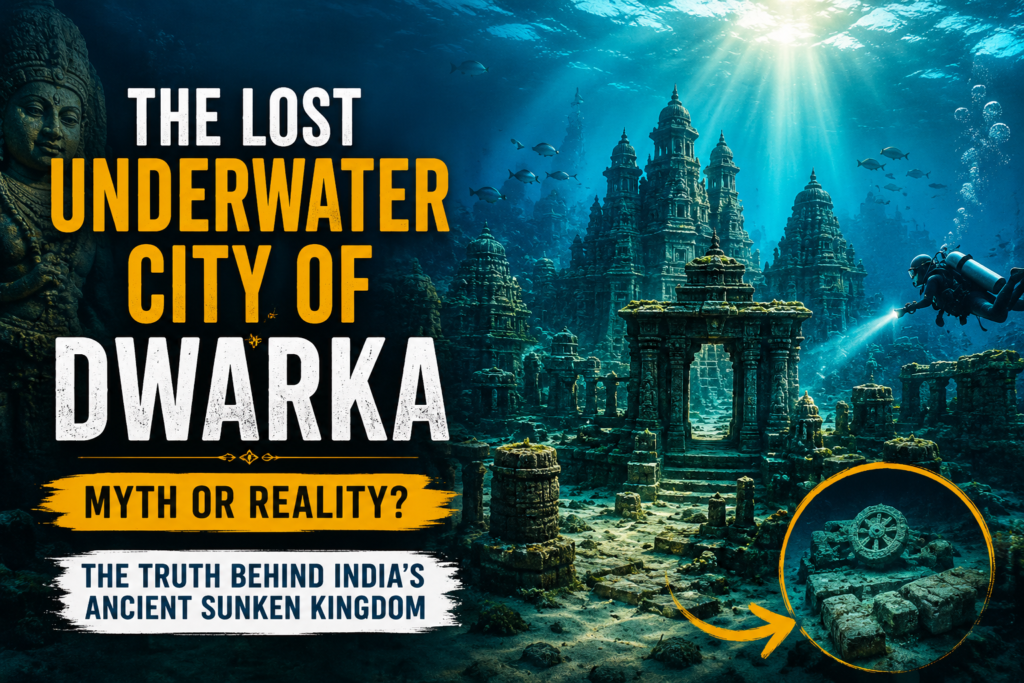
The story of Dwarka has fascinated historians, archaeologists, spiritual believers, and researchers for decades. Known as the legendary kingdom of Lord Krishna, Dwarka occupies a unique place in Indian mythology and ancient history. What makes the story even more intriguing is the claim that an ancient city now lies submerged beneath the waters of the Arabian Sea near modern-day Gujarat.
For many people, Dwarka is not just mythology. Archaeological discoveries, underwater explorations, ancient scriptures, and historical references have all contributed to ongoing debates about whether Dwarka was a real ancient city that disappeared beneath the sea thousands of years ago.
The mystery surrounding Dwarka continues to attract global attention because it combines religion, history, science, and archaeology into one of the most fascinating unsolved mysteries in India.
The Historical Importance of Dwarka
Dwarka is believed to have been the kingdom of Lord Krishna according to ancient Hindu texts, especially the Mahabharata and the Bhagavata Purana. These scriptures describe Dwarka as a magnificent city filled with palaces, ports, grand roads, and advanced architecture.
According to mythology, Lord Krishna established Dwarka after leaving Mathura to protect his people from repeated invasions. The city was said to be highly prosperous and strategically built near the sea.
Ancient texts describe Dwarka as a city made with extraordinary planning and engineering. It was considered one of the most beautiful and advanced cities of its time.
However, the most mysterious part of the story is the belief that after Krishna’s death, the city submerged into the sea.
This single claim transformed Dwarka from mythology into one of India’s greatest archaeological mysteries.
Underwater Discoveries Near Dwarka
The mystery deepened during the late twentieth century when marine archaeologists began underwater explorations near the coast of Gujarat.
Researchers discovered several submerged structures, stone blocks, walls, anchors, and other artifacts beneath the sea near present-day Dwarka and Bet Dwarka. These discoveries immediately attracted national and international attention.
Some underwater structures appeared to resemble ancient urban settlements. Archaeologists also found evidence of ancient maritime activity, suggesting that the region may once have been a significant port city.
The discoveries raised an important question.
Could these ruins actually belong to the legendary city mentioned in ancient Hindu scriptures?
Several artifacts recovered from the seabed were estimated to be thousands of years old. Stone anchors found in the region indicated advanced trade and navigation systems. Some experts argued that these findings proved the existence of an ancient civilization near Dwarka.
However, the debate remains unresolved because dating underwater structures accurately is extremely difficult.
Scientific Debate Around Dwarka
The Dwarka mystery continues because scientists and historians remain divided on the interpretation of the evidence.
One group believes the underwater discoveries strongly support ancient textual references. They argue that the alignment between mythology and archaeological findings cannot be ignored.
Another group remains skeptical.
Some historians believe the structures found underwater may belong to later historical settlements rather than the original city described in mythology. Others argue that natural geological formations can sometimes resemble man-made structures.
Marine archaeology itself is a highly complex field. Ocean currents, sediment movement, and changing sea levels can alter underwater sites over thousands of years.
Despite these challenges, the Dwarka discoveries remain among the most important underwater archaeological findings in India.
Could Dwarka Be One of the Oldest Cities in India?
If future evidence conclusively proves that the submerged structures belong to Krishna’s Dwarka, it could significantly reshape our understanding of ancient Indian civilization.
Some researchers suggest that the settlement may date back several thousand years, potentially placing it among the oldest known urban settlements in the region.
Ancient India already possesses a rich archaeological legacy through civilizations like the Indus Valley Civilization. The possibility of another advanced coastal city existing thousands of years ago adds even greater importance to the Dwarka mystery.
This is one reason why Dwarka continues to attract historians from around the world.
The Connection Between Mythology and Archaeology
One of the most fascinating aspects of Dwarka is how mythology and archaeology intersect.
Usually, myths are considered symbolic stories passed down through generations. However, throughout history, several legendary cities once thought fictional were later discovered through archaeology.
This raises an important possibility.
Could ancient scriptures contain historical truths hidden within symbolic narratives?
The Mahabharata’s detailed descriptions of Dwarka, combined with underwater discoveries near Gujarat, have encouraged many researchers to reconsider the relationship between mythology and historical reality.
Even today, scientists continue studying ancient texts alongside archaeological findings to uncover possible connections.
Tourism and Cultural Significance
Dwarka today remains one of the most important pilgrimage destinations in India. Thousands of devotees visit the Dwarkadhish Temple every year believing it stands near the original kingdom of Lord Krishna.
The city’s spiritual significance continues to grow because of the underwater mystery. Tourists, historians, and researchers from around the world visit Dwarka to explore the legendary story firsthand.
The underwater city theory has also boosted marine archaeology tourism and cultural interest in Gujarat.
For many believers, Dwarka represents more than history. It symbolizes faith, heritage, and the deep connection between India’s ancient traditions and modern discoveries.
Why the Dwarka Mystery Continues to Fascinate the World
The Dwarka mystery remains powerful because it exists at the intersection of science, spirituality, mythology, and history.
People are naturally drawn toward lost civilizations and ancient mysteries. Stories about submerged cities have fascinated humanity for centuries. Dwarka represents India’s own legendary underwater city, often compared to the mythical Atlantis.
Unlike many myths, however, Dwarka also has real archaeological investigations supporting parts of the story.
This combination of faith and scientific exploration continues to keep public interest alive.
As underwater exploration technologies improve in the future, researchers may uncover more evidence hidden beneath the Arabian Sea. Until then, the mystery of Dwarka remains one of India’s greatest historical questions.
Conclusion
The story of Dwarka is far more than a mythological tale. It is a mystery that has challenged historians, archaeologists, scientists, and spiritual thinkers for generations.
While definitive proof about the original city’s existence remains uncertain, underwater discoveries near Gujarat have added remarkable credibility to ancient legends. The possibility that a sophisticated ancient city once existed beneath the sea continues to inspire research and debate worldwide.
Whether viewed through the lens of faith, history, or science, Dwarka remains one of the most fascinating subjects in Indian civilization. The search for the truth behind the lost underwater city is still ongoing, and future discoveries may one day reveal whether the legendary kingdom of Lord Krishna truly disappeared beneath the waves thousands of years ago.