|
Getting your Trinity Audio player ready...
|
On 7th May 2025, India launched one of its most talked-about military operations in recent history — Operation Sindoor. The operation became a defining moment in India’s national security strategy and quickly dominated global headlines.
The mission was launched after the deadly Pahalgam terror attack, which shocked the nation and led to strong public demand for action against terrorist groups operating across the border. India responded with precision strikes targeting terror infrastructure in Pakistan and Pakistan-occupied Kashmir (PoK).
Operation Sindoor was not just another military action. It represented a major shift in India’s defense posture, military coordination, and geopolitical messaging.
- What Was Operation Sindoor?
- Why Was Operation Sindoor Launched?
- Meaning Behind the Name “Sindoor”
- How Operation Sindoor Was Executed
- India-Pakistan Tensions After the Operation
- Global Reaction to Operation Sindoor
- How Operation Sindoor Changed India’s Defense Strategy
- PM Narendra Modi’s Strong Message After Operation Sindoor
- Public Reaction in India
- Operation Sindoor and Media Coverage
- Key Facts About Operation Sindoor
What Was Operation Sindoor?
Operation Sindoor was a coordinated military operation carried out by the Indian Armed Forces on 7 May 2025. According to Indian government statements, the operation targeted terror camps, launch pads, weapons storage facilities, and militant training infrastructure linked to anti-India terror groups.
The operation involved:
- Indian Army
- Indian Air Force
- Indian Navy
- Advanced surveillance systems
- Precision-guided strike capabilities
India described the mission as a “measured and focused anti-terror operation” rather than an act of war against Pakistan itself.
The strikes reportedly avoided civilian areas and focused specifically on militant infrastructure.
Why Was Operation Sindoor Launched?
The operation came after the Pahalgam terror attack, where several civilians and security personnel lost their lives. The attack triggered widespread outrage across India.
Public sentiment was extremely strong after the incident. Citizens demanded strict action against terror groups and their support systems.
The Indian government stated that intelligence agencies had identified multiple terror launch sites preparing future infiltration attempts. Operation Sindoor was launched to destroy those networks before additional attacks could occur.
Meaning Behind the Name “Sindoor”
The word “Sindoor” carries deep emotional and cultural significance in India.
Sindoor is the red vermillion traditionally worn by married Hindu women. Reports and analysts connected the operation’s codename to the emotional impact of the terror attack on families, especially women who lost husbands and loved ones.
The codename gave the operation a symbolic and emotional dimension that resonated strongly across the country.
How Operation Sindoor Was Executed
According to reports and defense experts, the operation used:
- Precision missiles
- Drone surveillance
- Satellite intelligence
- Airstrike coordination
- Electronic warfare systems
Military analysts noted that the strikes demonstrated India’s increasing technological capabilities in modern warfare.
Several strategic terror locations were reportedly hit within a short operational window. The mission was designed for speed, surprise, and minimal collateral damage.
India’s military communication during the operation was also highly coordinated, showing a more modern and controlled information strategy compared to previous conflicts.
India-Pakistan Tensions After the Operation
Following the strikes, tensions between India and Pakistan escalated rapidly.
Pakistan strongly condemned the operation and claimed violations of its sovereignty. Military movements increased on both sides of the border, and fears of a larger conflict began rising globally.
For a brief period:
- Border regions were placed on high alert
- Air defense systems were activated
- Diplomatic channels became highly active
- Global powers called for restraint
However, the situation did not turn into a full-scale war. After intense diplomatic pressure and military signaling from both sides, tensions gradually reduced.
Global Reaction to Operation Sindoor
The international community closely monitored the operation.
Countries including the United States, Russia, France, and the United Kingdom urged both nations to avoid escalation.
At the same time, several global security experts acknowledged India’s growing ability to conduct precision anti-terror operations with advanced military coordination.
International media described Operation Sindoor as:
- A major geopolitical signal
- A demonstration of India’s military modernization
- A turning point in South Asian strategic policy
The operation also reignited global discussions around cross-border terrorism and regional stability.
How Operation Sindoor Changed India’s Defense Strategy
Defense analysts believe Operation Sindoor marked a significant evolution in India’s military doctrine.
Key changes observed include:
1. Faster Military Response
India showed it could respond rapidly after a terror attack without long delays.
2. Precision Warfare
The operation focused heavily on targeted strikes instead of broad military action.
3. Technology-Driven Operations
The use of drones, surveillance systems, and advanced intelligence played a major role.
4. Joint Force Coordination
All three branches of the armed forces worked together in a synchronized manner.
5. Strong Global Messaging
India demonstrated that future terror attacks could invite direct military consequences.
PM Narendra Modi’s Strong Message After Operation Sindoor
During speeches and public addresses after Operation Sindoor, Prime Minister Narendra Modi delivered several strong statements regarding terrorism and national security.
One line that gained massive attention across India was:
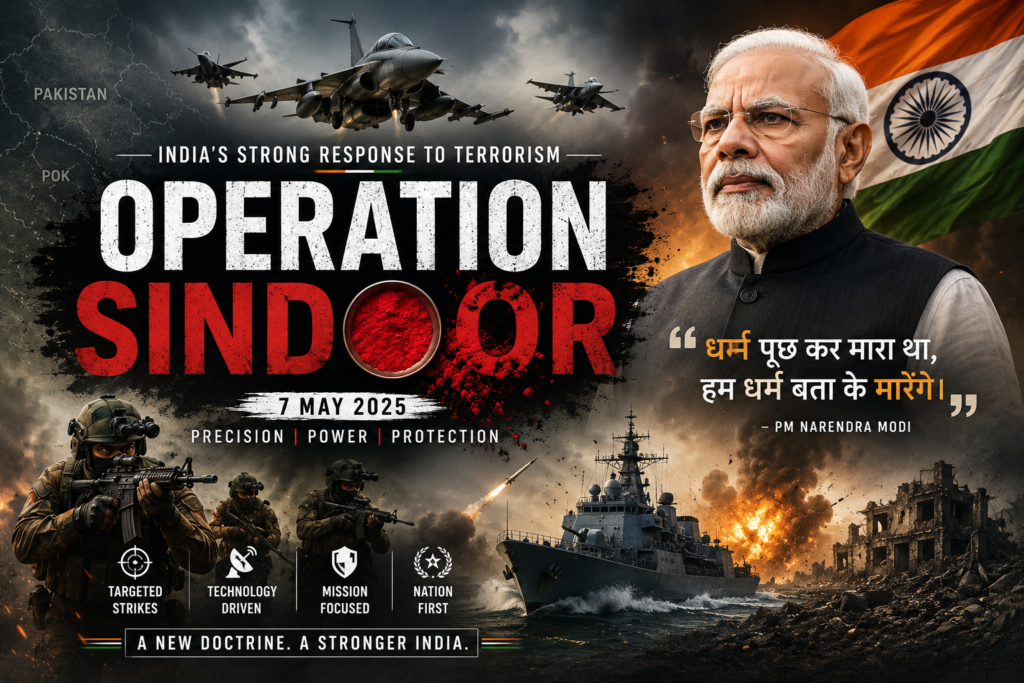
“धर्म पूछ कर मारा था, हम धर्म बता के मारेंगे।”
The statement quickly went viral on social media and became one of the most discussed political lines connected to Operation Sindoor. Supporters described it as a powerful response to the brutal nature of the terror attack that triggered the operation.
The remark also intensified political and national security debates across the country, with supporters calling it a symbol of decisive leadership while critics discussed its broader implications in public discourse.
Regardless of differing opinions, the statement became one of the defining political moments associated with Operation Sindoor and reflected the emotional atmosphere in India after the attack.
Public Reaction in India
Operation Sindoor received massive public attention across India.
Social media platforms were flooded with:
- Tributes to the armed forces
- Patriotic messages
- Support for military personnel
- Discussions about national security
Political leaders across multiple parties praised the courage and professionalism of the Indian military.
One year later, the operation continues to be remembered as a defining security event of 2025.
Operation Sindoor and Media Coverage
Indian news channels extensively covered the operation for weeks.
Television debates, defense analysis programs, documentaries, and social media campaigns kept the topic trending nationwide.
The operation also became one of the most searched defense-related topics online in India during 2025.
This intense coverage helped shape public perception about modern warfare, military readiness, and India’s strategic posture.
Key Facts About Operation Sindoor
| Detail | Information |
|---|---|
| Operation Name | Operation Sindoor |
| Date | 7 May 2025 |
| Trigger | Pahalgam terror attack |
| Conducted By | Indian Armed Forces |
| Main Objective | Destroy terror infrastructure |
| Regions Targeted | Pakistan & Pakistan-occupied Kashmir |
| Nature of Strike | Precision anti-terror operation |
| Global Impact | Increased India-Pakistan tensions |
Final Thoughts
Operation Sindoor became much more than a military mission. It evolved into a symbol of India’s changing security approach and determination to respond strongly against terrorism.
The operation highlighted how warfare is changing in the modern era — with technology, precision strikes, intelligence systems, and global diplomacy all playing critical roles.
Even a year later, Operation Sindoor remains one of the most important defense and geopolitical events in South Asia’s recent history. Its impact continues to influence discussions around military strategy, national security, and regional stability.
For India, the operation marked a moment that many believe redefined the country’s response framework against cross-border terrorism.