|
Getting your Trinity Audio player ready...
|
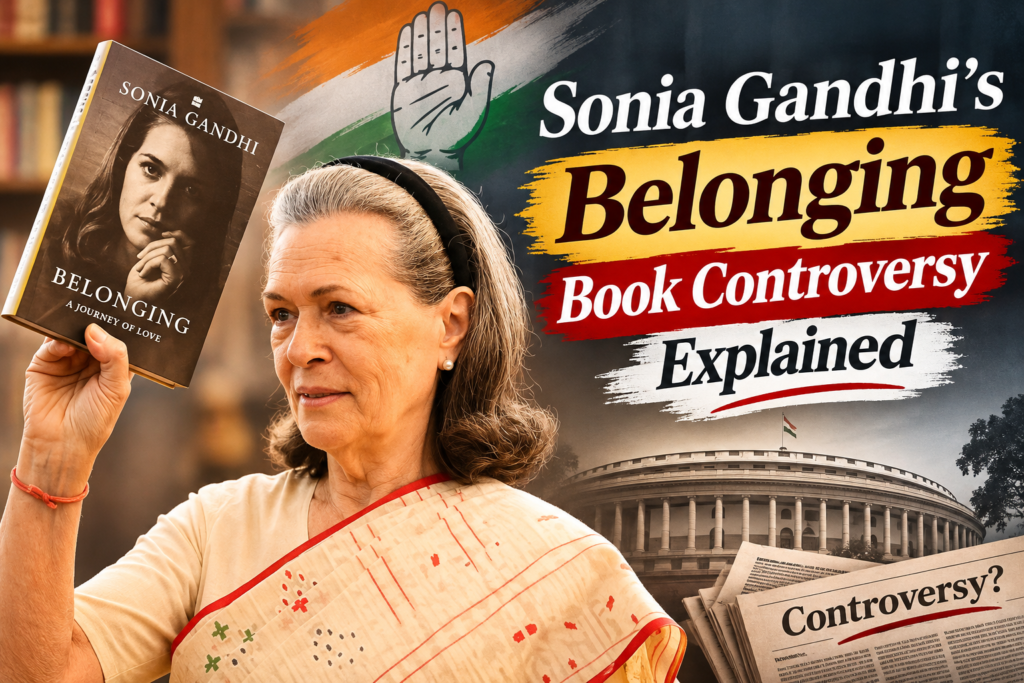
Congress leader Sonia Gandhi’s new memoir, Belonging: A Journey of Love, has become a major subject of political discussion following its release on November 10, 2026. The book, which explores her personal life, family history and decades-long association with Indian politics, has attracted attention not only for its contents but also for the controversy surrounding its publication.
The memoir was initially expected to be published in India by Penguin Random House India. However, the publishing arrangement fell through following disagreements between the publisher and Sonia Gandhi’s representatives over proposed editorial changes. Reports suggested that some of the disputed sections involved references to Prime Minister Narendra Modi, the Rashtriya Swayamsevak Sangh (RSS), China’s activities along the Indian border, communal tensions and minority rights.
The controversy quickly developed into a political debate, with Congress leaders raising questions about editorial independence and freedom of expression. Penguin Random House India, however, denied allegations of external pressure and maintained that the disagreement was part of the normal publishing process.
After Penguin’s exit, HarperCollins India acquired the Indian publishing rights and released the memoir on November 10. However, the controversy did not end with the book’s publication. The BJP criticised Sonia Gandhi’s account of several historical events, particularly the 1984 anti-Sikh riots and the Emergency imposed by Indira Gandhi. Families of victims of the 1984 violence also protested against the book.
So, what is the Sonia Gandhi book controversy all about? Why did Penguin Random House India withdraw from the publishing arrangement? What does the memoir reveal about her family, political career and India’s history? Here is a detailed look at the developments surrounding Belonging: A Journey of Love.
What Is Sonia Gandhi’s New Book ‘Belonging: A Journey of Love’ About?
Belonging: A Journey of Love is a personal and political memoir written by Sonia Gandhi, the former president of the Indian National Congress and one of India’s most prominent political figures.
The book traces her journey from her childhood in Italy to her life in India after marrying Rajiv Gandhi. It explores her experiences within the Nehru-Gandhi family, her relationship with former Prime Minister Indira Gandhi, the personal tragedies that shaped her life and her eventual entry into Indian politics.
For many years, Sonia Gandhi maintained a relatively private personal life despite being closely associated with one of India’s most influential political families. However, her responsibilities within the Congress party eventually placed her at the centre of national politics.
The memoir revisits important moments from her life, including the assassination of Indira Gandhi in 1984, the assassination of Rajiv Gandhi in 1991, her decision to enter politics, her leadership of the Congress party and her decision to decline the Prime Minister’s position after the 2004 general election.
It also discusses her observations about India’s political and social transformation, including developments during the governments led by the Congress and the BJP.
The book is particularly significant because it presents these experiences from Sonia Gandhi’s own perspective rather than through a conventional biography written by another author.
Why Is Sonia Gandhi’s Book Facing Controversy?
The controversy surrounding Belonging began before its official release.
Penguin Random House India was initially expected to publish the Indian edition of Sonia Gandhi’s memoir. However, reports in August 2026 indicated that the publishing arrangement had fallen through following disagreements over certain editorial changes and deletions suggested during the manuscript review process.
According to reports, the disagreements involved passages discussing Prime Minister Narendra Modi, the RSS, India’s relationship with China, communal tensions and the condition of religious minorities.
The discussions reportedly continued for around two months. The author’s representatives were reportedly uncomfortable with extensive changes that could make the Indian edition different from the international version.
One of the concerns was that readers might receive different versions of the same memoir depending on where they purchased it. This raised questions about the consistency of the author’s account and the extent to which a publisher should be able to modify politically sensitive material.
However, Penguin Random House India rejected the suggestion that it withdrew because Sonia Gandhi refused editorial changes. The publisher stated that fact-checking and editorial recommendations were part of its normal responsibilities and that discussions between both sides ultimately failed to produce an agreement on a particular issue.
The publisher also denied that external pressure influenced its position.
The disagreement became politically sensitive because Sonia Gandhi is a senior opposition leader who has frequently criticised the BJP-led government. Consequently, the publishing dispute attracted attention beyond the book industry and became part of the wider political debate.
Penguin Random House India vs Sonia Gandhi: What Happened?
The disagreement between Sonia Gandhi and Penguin Random House India became public in August 2026.
According to reports published by The Indian Express and Hindustan Times, the publisher’s editorial and legal representatives had raised concerns about certain passages in the manuscript. These reportedly included Sonia Gandhi’s observations about Narendra Modi, the RSS and China’s activities along India’s border.
The reports also suggested that some passages concerning communal tensions and minority rights were part of the discussions.
Sonia Gandhi’s representatives reportedly opposed several proposed changes, arguing that the memoir should reflect her experiences and observations without substantial alterations.
The matter eventually reached a deadlock, and Penguin Random House India did not proceed with the Indian publishing arrangement.
However, the publisher presented a different explanation. It said that some proposed changes were accepted by the author’s representatives, while in other instances the publisher accepted the author’s position. The disagreement ultimately concerned one particular issue on which both parties could not reach an understanding.
This difference between the reported editorial disagreements and Penguin’s official explanation became an important part of the controversy.
Sonia Gandhi subsequently expressed disappointment with the publishing development and suggested that the publisher was uncomfortable with criticism of the government.
The disagreement raised an important question for the publishing industry: where should the boundary between editorial responsibility and an author’s freedom to present personal political experiences be drawn?
HarperCollins India Takes Over Sonia Gandhi’s Memoir
After Penguin Random House India did not proceed with the Indian edition, the future of Sonia Gandhi’s memoir remained uncertain for a short period.
The situation changed on September 4, 2026, when HarperCollins India officially announced that it would publish Belonging: A Journey of Love in India.
The announcement brought an end to speculation about the book’s Indian publisher. HarperCollins described the memoir as a deeply personal account of love, identity, duty and belonging, offering readers an insider’s perspective on India’s political and social journey.
The Indian edition was scheduled for release on November 10, 2026. The international edition was also released on the same date through Alfred A. Knopf, an imprint of Penguin Random House in the United States.
The development was particularly interesting because Penguin Random House India did not proceed with the Indian publishing arrangement, while its international publishing network continued to be associated with the memoir through Knopf.
The book was subsequently released in India through HarperCollins, bringing the long-running publishing controversy into the public spotlight once again.
What Does Sonia Gandhi Reveal About Her Personal Life?
One of the most important aspects of Belonging: A Journey of Love is its personal account of Sonia Gandhi’s life.
The memoir begins with her early years in Italy and explores how her meeting with Rajiv Gandhi changed the direction of her life.
Childhood in Italy and Marriage to Rajiv Gandhi
Sonia Gandhi was born as Sonia Maino in Italy. She spent her early years there before moving to India following her relationship and marriage with Rajiv Gandhi.
She first met Rajiv Gandhi in Cambridge, England, in 1965, when she was a young student. Their relationship eventually developed into marriage, bringing her into the Nehru-Gandhi family.
Her transition into Indian society involved adapting to a different culture, language, traditions and family environment.
The memoir discusses her relationship with Rajiv Gandhi and her experiences with Indira Gandhi. It also explores how her personal life gradually became connected with India’s political establishment.
The Assassination of Indira Gandhi
The assassination of Indira Gandhi on October 31, 1984, was one of the most traumatic events in the family’s history.
Indira Gandhi was assassinated by two of her Sikh bodyguards following Operation Blue Star, the military operation conducted at the Golden Temple in June 1984.
The memoir revisits the atmosphere surrounding the assassination and the security concerns that affected the family.
It also explores the emotional consequences of the incident and the challenges faced by Sonia Gandhi and her children during this period.
Rajiv Gandhi’s Assassination in 1991
Another major part of the memoir concerns the assassination of former Prime Minister Rajiv Gandhi.
Rajiv Gandhi was killed on May 21, 1991, during an election campaign in Sriperumbudur, Tamil Nadu. The attack was carried out by a suicide bomber associated with the Liberation Tigers of Tamil Eelam (LTTE).
His death changed Sonia Gandhi’s personal life permanently and created a major turning point in the family’s political journey.
The memoir revisits the emotional impact of his assassination and the challenges of raising Rahul Gandhi and Priyanka Gandhi Vadra after losing her husband.
It also helps explain why Sonia Gandhi initially remained away from active politics before eventually accepting a leadership role within the Congress party.
Why Did Sonia Gandhi Refuse to Become Prime Minister in 2004?
One of the most important political events discussed in the memoir is Sonia Gandhi’s decision not to become Prime Minister after the Congress-led United Progressive Alliance won the 2004 Lok Sabha election.
The Congress emerged as the largest party in the election and formed the UPA government with support from several political parties.
As Congress president and the leader of the alliance, Sonia Gandhi was widely expected to become the next Prime Minister.
However, she decided not to accept the position and instead supported Manmohan Singh for the post.
Manmohan Singh became Prime Minister on May 22, 2004, beginning the first of his two terms in office.
The decision attracted significant political attention at the time and remains one of the most discussed moments in Sonia Gandhi’s career.
In her memoir, she revisits the circumstances surrounding the decision and the personal and political considerations involved.
The episode is particularly important because it demonstrates the relationship between Sonia Gandhi’s leadership within the Congress party and the government’s functioning during the UPA years.
What Does the Book Say About the Emergency and Indira Gandhi?
The Emergency imposed by Indira Gandhi in June 1975 remains one of the most controversial periods in India’s democratic history.
During the Emergency, civil liberties were restricted, opposition leaders were arrested, press freedom was curtailed and several government actions attracted widespread criticism.
The Emergency continued until March 1977, when elections were announced and the Congress suffered a major defeat.
Sonia Gandhi’s memoir revisits this period and discusses Indira Gandhi’s political decisions and the circumstances surrounding her leadership.
It also addresses the influence of Sanjay Gandhi, whose political activities during the Emergency became a subject of considerable criticism.
The book presents Sonia Gandhi’s perspective on the family and political circumstances during this period.
However, the Emergency remains a sensitive political subject, and the memoir’s treatment of the period has attracted criticism from the BJP.
The controversy reflects the continuing disagreement between the Congress and BJP over the historical legacy of Indira Gandhi’s government.
1984 Anti-Sikh Riots: Why Is This Section Attracting Attention?
The 1984 anti-Sikh riots are among the most sensitive historical events discussed in Belonging: A Journey of Love.
Following the assassination of Indira Gandhi on October 31, 1984, widespread violence against members of the Sikh community took place in Delhi and other parts of India.
Thousands of people were killed, homes were destroyed and several families lost their livelihoods.
The violence remains one of the most painful chapters in independent India’s history.
In her memoir, Sonia Gandhi describes the violence as a tragic and shameful chapter. She discusses the failure of the administration to control the situation and acknowledges that justice was delayed for many victims.
The book also revisits the controversy surrounding Rajiv Gandhi’s response to the violence and the allegations against Congress leaders.
The BJP has questioned whether the memoir adequately addresses the political responsibility associated with the riots. Families of victims have also expressed dissatisfaction with the way the subject has been discussed.
For many survivors, the issue is not simply about a political disagreement. It is about accountability, justice and recognition of the suffering experienced by thousands of families.
The discussion has therefore become one of the biggest reasons behind the political reaction to the memoir.
Babri Masjid Demolition and Sonia Gandhi’s Account
The demolition of the Babri Masjid in Ayodhya on December 6, 1992, is another important event discussed in the memoir.
The demolition took place when a large gathering of kar sevaks assembled at the disputed religious site. The incident triggered communal violence in several parts of India and significantly changed the country’s political environment.
Sonia Gandhi recalls the demolition and describes her reaction to the destruction of the structure.
The issue remains politically sensitive because it is connected to decades of religious and political disagreements involving the Congress, BJP and several other organisations.
Her account has attracted attention because the Babri Masjid demolition remains a major subject in discussions about India’s political history and communal relations.
Why Is the BJP Criticising Sonia Gandhi’s Book?
The release of Belonging triggered a fresh political confrontation between the BJP and Congress.
BJP leaders accused Sonia Gandhi of presenting a selective interpretation of historical events and attempting to defend the political legacy of the Nehru-Gandhi family.
BJP spokesperson C.R. Kesavan criticised the memoir’s treatment of the 1984 anti-Sikh riots and the Emergency imposed by Indira Gandhi.
The BJP argued that the book did not adequately address the historical responsibility of the Congress party and its leadership.
The ruling party also questioned Sonia Gandhi’s account of several political developments, arguing that her personal recollections should not be treated as a complete historical record.
Congress leaders rejected these allegations and defended Sonia Gandhi’s right to present her personal experiences and political observations.
The Congress also accused the BJP of using the memoir to create another political confrontation rather than discussing its actual contents.
The disagreement demonstrates how political memoirs can become part of larger ideological debates, particularly when they involve influential political families and controversial historical events.
Why Did Families of 1984 Riot Victims Protest Against the Book?
The controversy extended beyond political parties after families of victims of the 1984 anti-Sikh riots reportedly protested against the memoir in Delhi on November 12, 2026.
The protesters gathered near the Wall of Truth and burned copies of the book while raising slogans against Sonia Gandhi.
Their objection focused on the memoir’s discussion of the 1984 violence and the responsibility of political leaders during that period.
For many families, the events of 1984 remain unresolved despite decades of investigations, legal proceedings and demands for accountability.
The protesters argued that the suffering of victims and their families should not be overshadowed by political explanations or personal recollections.
The demonstration added another dimension to the controversy because the criticism was not limited to the BJP or its political supporters.
It also showed that the memoir’s treatment of historical events continues to attract reactions from people directly affected by those events.
What Is the Price of Sonia Gandhi’s Book?
Sonia Gandhi’s Belonging: A Journey of Love was released in India through HarperCollins on November 10, 2026.
- The memoir is approximately 544 pages long and has a reported Indian price of ₹1,299.
- The book is available through major online book retailers and physical bookstores.
- The international edition is published by Alfred A. Knopf, while HarperCollins India handles the Indian edition.
The memoir has attracted considerable interest among readers interested in Indian politics, modern history, political biographies and the Nehru-Gandhi family.
Sonia Gandhi’s Book Controversy: Important Dates and Timeline
The controversy developed over several months, beginning with the disagreement involving Penguin Random House India and continuing after the memoir’s release.
- August 28, 2026: Reports emerge that Penguin Random House India will not proceed with publishing Sonia Gandhi’s memoir following disagreements over editorial changes.
- August 28, 2026: Penguin Random House India issues a clarification, denying that the decision was simply because the author refused editorial changes.
- September 4, 2026: HarperCollins India officially announces that it will publish Belonging: A Journey of Love in India.
- November 7, 2026: Sonia Gandhi publicly discusses the publishing controversy and expresses her views about Penguin’s decision.
- November 10, 2026: Belonging: A Journey of Love is officially released in India and internationally.
- November 11, 2026: BJP leaders criticise the memoir, particularly its treatment of the Emergency and the 1984 anti-Sikh riots.
- November 12, 2026: Families of victims of the 1984 anti-Sikh riots reportedly protest against the book in Delhi.
- November 17, 2026: Political criticism and discussion surrounding the memoir continue.
Why Is ‘Belonging: A Journey of Love’ Important for Indian Politics?
Sonia Gandhi’s memoir has become important because it combines personal memories with political observations about several decades of Indian history.
- For Congress supporters, the book provides an opportunity to understand the experiences of a leader who spent years managing the party and influencing national politics.
- For BJP leaders and critics, the memoir raises questions about how the Congress leadership remembers controversial historical events and whether its account adequately addresses political responsibility.
- For the publishing industry, the disagreement between Penguin Random House India and Sonia Gandhi has highlighted the challenges of handling politically sensitive nonfiction.
The controversy also raises a broader question about the relationship between authors and publishers. Publishers have a responsibility to fact-check manuscripts, identify legal risks and maintain editorial standards. At the same time, authors have a legitimate interest in ensuring that their personal accounts are not substantially altered without their agreement.
Ultimately, readers must evaluate political memoirs with an understanding that personal recollections represent an individual perspective. Historical events should also be examined through official records, independent reporting and accounts from other people involved.
FAQs
What is Sonia Gandhi’s new book called?
Sonia Gandhi’s new book is titled Belonging: A Journey of Love. It is a memoir covering her childhood in Italy, marriage to Rajiv Gandhi, family experiences, political career and observations about India’s history.
Why is Sonia Gandhi’s book controversial?
The book became controversial after Penguin Random House India did not proceed with the Indian publishing arrangement following disagreements over proposed editorial changes. The controversy later expanded following BJP criticism of the memoir’s account of historical events, particularly the Emergency and the 1984 anti-Sikh riots.
Why did Penguin Random House India withdraw from publishing Sonia Gandhi’s memoir?
According to the publisher, discussions with the author’s representatives ended without an agreement on a particular issue. Reports suggested that disagreements involved proposed changes to passages concerning Narendra Modi, the RSS, China and communal issues. Penguin denied that external pressure influenced its decision.
Who published Sonia Gandhi’s book in India?
HarperCollins India published Belonging: A Journey of Love in India on November 10, 2026.
What does Sonia Gandhi reveal about Rajiv Gandhi?
The memoir discusses her relationship with Rajiv Gandhi, their family life, his political journey, his assassination in 1991 and the personal consequences of his death.
What does Sonia Gandhi say about the 1984 anti-Sikh riots?
Sonia Gandhi describes the violence as a tragic and shameful chapter in India’s history. She discusses administrative failures and delayed justice, while her account of the events has attracted criticism from political opponents and victims’ families.
Why is the BJP criticising Sonia Gandhi’s book?
The BJP has accused Sonia Gandhi of selectively presenting historical events and defending the Congress party’s political legacy. Its criticism has particularly focused on the 1984 anti-Sikh riots, the Emergency and the Babri Masjid demolition.
How much does Sonia Gandhi’s book cost?
The reported Indian price of Belonging: A Journey of Love is ₹1,299.
Conclusion
Sonia Gandhi’s Belonging: A Journey of Love has become one of the most discussed political memoirs of 2026. What began as a disagreement between an author and a publisher eventually developed into a wider debate involving political parties, historical accountability, editorial independence and freedom of expression.
The exit of Penguin Random House India, the subsequent involvement of HarperCollins and the political reactions following the book’s release have all contributed to its public attention.
While the memoir offers Sonia Gandhi’s personal account of her family, political journey and experiences in India, its treatment of controversial historical events has generated strong reactions from both supporters and critics.
The debate is likely to continue as readers examine the memoir and compare its recollections with other historical accounts. Beyond the political arguments, the book has reopened important discussions about India’s past, the responsibilities of political leaders and the role of publishing in presenting difficult historical subjects.