|
Getting your Trinity Audio player ready...
|
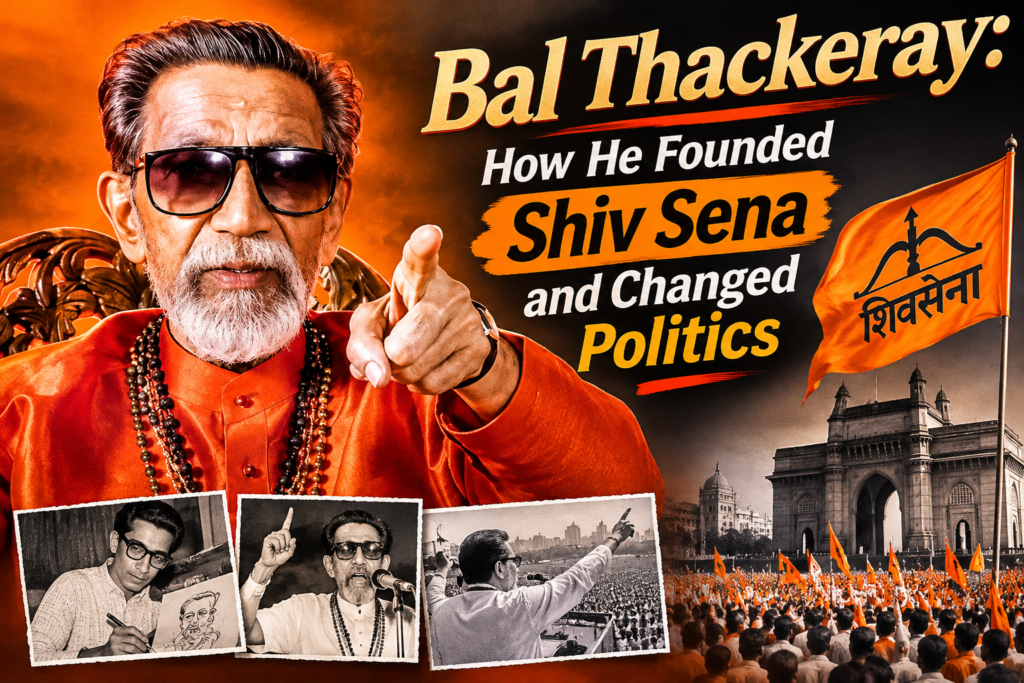
Indian politics has witnessed several powerful leaders who have influenced the country’s political, social and cultural development. Among them, Bal Thackeray holds a distinctive place, particularly in the political history of Maharashtra. Popularly known as Balasaheb Thackeray, he was a political leader, newspaper cartoonist and the founder of Shiv Sena, a regional political party that significantly changed Maharashtra’s political landscape.
Bal Thackeray did not enter politics through traditional political organisations or government positions. Instead, he began his professional journey as a cartoonist and gradually developed an influential public voice through journalism. His cartoons and political commentary highlighted issues related to employment, regional identity and the representation of Marathi-speaking people in Mumbai.
On June 19, 1966, Bal Thackeray founded Shiv Sena in Mumbai, creating a political platform to raise concerns about the rights, opportunities and identity of local Marathi-speaking communities. What began as a regional movement eventually developed into one of Maharashtra’s most influential political organisations.
Under his leadership, Shiv Sena expanded its political activities, established a strong grassroots network and became an important force in state politics. The organisation also experienced a significant ideological transformation, moving from its original emphasis on Marathi regional identity towards Hindutva and broader national political issues.
Bal Thackeray’s political career was marked by strong leadership, considerable public support and numerous controversies. While his supporters considered him a powerful voice for Maharashtra, critics questioned his political methods and ideological positions.
Understanding how Bal Thackeray founded Shiv Sena, built its political influence and changed Maharashtra politics provides an important perspective on the development of regional political movements in India.
Who Was Bal Thackeray?
Bal Keshav Thackeray, popularly known as Balasaheb Thackeray, was born on January 23, 1926, in Pune, Maharashtra, during British rule in India. He became one of the most influential political personalities in Maharashtra and remained an important figure in Indian politics for several decades.
He was the son of Keshav Sitaram Thackeray, popularly known as Prabodhankar Thackeray. His father was a social reformer, writer and activist who worked on social and cultural issues. Growing up in an environment influenced by social reform and regional identity played an important role in shaping Bal Thackeray’s political outlook.
Before entering politics, Bal Thackeray worked as a cartoonist. He was associated with The Free Press Journal, an English-language newspaper published in Mumbai. Through political cartoons, he expressed his views on government policies, political leaders and social developments.
His cartoons became popular among readers because of their direct style, humour and political criticism. However, his ambitions extended beyond journalism. He wanted to create a stronger public platform for discussing the concerns of Marathi-speaking people.
In 1960, he launched Marmik, a Marathi-language weekly magazine with his brother Shrikant Thackeray. The publication highlighted issues involving employment opportunities and the representation of Marathi-speaking people in Mumbai’s growing business and professional sectors.
Marmik gradually became more than a magazine. It developed into a platform for political awareness and helped Bal Thackeray connect with people who believed that local communities needed greater representation.
His growing public influence eventually provided the foundation for the formation of Shiv Sena in 1966.
Why Did Bal Thackeray Found Shiv Sena?
To understand why Bal Thackeray founded Shiv Sena, it is important to examine the economic and social conditions of Mumbai during the 1950s and 1960s.
At that time, Mumbai was developing into one of India’s most important commercial, financial and industrial centres. The city attracted people from different parts of the country because of its employment opportunities in manufacturing, banking, business, government services and entertainment.
However, sections of the Marathi-speaking population felt that they were not receiving sufficient opportunities in the city’s growing economy. Concerns about employment, language, cultural identity and political representation gradually became important public issues.
Bal Thackeray used his magazine Marmik to highlight these concerns. He regularly discussed the representation of Marathi-speaking people in private companies, offices and professional establishments. His publication encouraged discussions about whether local residents were receiving a fair share of the opportunities available in Mumbai.
Thackeray believed that newspaper articles and political cartoons alone could not address these concerns. He wanted to establish an organisation that could mobilise people, organise public campaigns and represent regional interests through political activities.
This idea eventually led to the creation of Shiv Sena.
The organisation initially focused on Marathi identity, regional pride and employment opportunities for local residents. Its political message was strongly connected with the concept of sons of the soil, which argued that local communities should receive priority in employment and opportunities within their home region.
This approach attracted support among sections of Mumbai’s Marathi-speaking population and helped Bal Thackeray develop a political movement that extended beyond journalism.
How Bal Thackeray Founded Shiv Sena in 1966
Bal Thackeray founded Shiv Sena on June 19, 1966, in Mumbai. The organisation was established to represent the concerns of Marathi-speaking people and strengthen their political influence in Maharashtra.
The name Shiv Sena was inspired by Chhatrapati Shivaji Maharaj, the 17th-century Maratha ruler who remains one of the most respected historical figures in Maharashtra. The name reflected the organisation’s emphasis on Marathi pride, regional identity and the cultural history of the state.
In its early years, Shiv Sena focused primarily on Mumbai. Bal Thackeray and his supporters worked to build local networks, organise public meetings and attract young people who wanted stronger representation for Marathi-speaking communities.
Unlike traditional political organisations that depended heavily on established political structures, Shiv Sena developed a direct connection with local neighbourhoods. Its workers interacted with residents, discussed employment concerns and organised activities around regional issues.
Bal Thackeray’s leadership style played an important role in the organisation’s growth. His speeches were direct, powerful and often controversial. He communicated with supporters through public gatherings, newspaper publications and political campaigns.
His ability to attract attention and build a strong personal connection with supporters helped Shiv Sena establish its identity in Maharashtra.
The party gradually expanded its influence from local neighbourhoods to larger political platforms. Its activities increasingly focused on employment, trade unions, local administration and regional representation.
The formation of Shiv Sena in 1966 marked the beginning of a new phase in Maharashtra politics, as a regional movement began developing into an organised political force.
The First Major Shiv Sena Rally at Shivaji Park
The first major public rally of Shiv Sena became an important moment in the organisation’s early history.
On October 30, 1966, Shiv Sena organised a large public meeting at Shivaji Park in Dadar, Mumbai. The rally attracted significant public attention and demonstrated the growing popularity of Bal Thackeray’s political movement.
Shivaji Park gradually became closely associated with Shiv Sena’s political activities and Bal Thackeray’s public appearances. It remained an important location for major party gatherings and political events for decades.
The rally helped the organisation establish its presence beyond newspaper discussions and local meetings. It also demonstrated that the movement was attracting supporters who wanted to participate in regional political activities.
One of the most important organisational features of Shiv Sena was its local branch system, known as Shakhas. These branches became centres where party workers interacted with residents, discussed neighbourhood issues and organised political campaigns.
The Shakha system helped Shiv Sena establish a strong grassroots network, particularly in Mumbai and nearby areas. It also allowed the organisation to maintain direct contact with local communities between elections.
This organisational model later became one of Shiv Sena’s major political strengths and contributed significantly to its expansion across Maharashtra.
How Shiv Sena Expanded Its Political Influence in Maharashtra
After establishing its presence in Mumbai, Shiv Sena gradually expanded its activities across Maharashtra. The organisation focused on strengthening its local networks and attracting supporters who believed that regional concerns required stronger political representation.
During its early years, Shiv Sena concentrated on Mumbai, Thane and surrounding areas. Its campaigns focused on employment opportunities, Marathi identity and the position of local communities in the state’s economic development.
The party also became involved in labour politics. Mumbai had a large industrial workforce, and trade unions played an important role in the city’s economic and political environment. Shiv Sena attempted to challenge the influence of established left-wing trade unions by building its own labour organisations.
This helped the party establish connections with workers and expand its political presence in industrial areas.
Over time, Shiv Sena developed a more aggressive political style. Its campaigns attracted considerable public attention, but they also generated criticism from political opponents and civil society groups.
The organisation gradually moved beyond its original regional agenda and began participating in wider political discussions involving religion, nationalism and cultural identity.
This expansion allowed Shiv Sena to become a major political organisation rather than remaining limited to a regional employment movement.
Shiv Sena’s Shift Towards Hindutva
One of the most significant developments in Shiv Sena’s political history was its gradual shift towards Hindutva during the 1980s.
When Bal Thackeray founded the organisation in 1966, its primary focus was Marathi identity and the interests of local residents. However, as the party expanded its political ambitions, it increasingly adopted Hindu nationalist positions.
This ideological transformation helped Shiv Sena connect with voters beyond the Marathi-speaking population.
The party began emphasising Hindu identity, cultural nationalism and religious issues alongside its existing regional political agenda. These developments also created opportunities for closer political cooperation with the Bharatiya Janata Party (BJP).
The relationship between Shiv Sena and the BJP became increasingly important during the late 1980s and 1990s. Both organisations found common ground on Hindutva and several political issues, although they maintained separate political identities.
Their partnership eventually developed into one of Maharashtra’s most influential political alliances.
The shift towards Hindutva represented an important transformation in Shiv Sena’s political journey. It demonstrated how a regional political movement could expand its support base by adapting its ideological positions to changing political circumstances.
However, Marathi regional identity remained an important part of the organisation’s political messaging.
Bal Thackeray and the BJP Alliance
The political relationship between Shiv Sena and the BJP became one of the defining features of Maharashtra politics.
During the late 1980s, both organisations increasingly cooperated on electoral and ideological issues. Their partnership helped Shiv Sena strengthen its position in Maharashtra, while the BJP benefited from the regional party’s established organisational network.
The alliance became particularly successful during the 1990s.
In the 1995 Maharashtra Assembly election, the Shiv Sena-BJP alliance secured a majority and formed the state government. This was a historic achievement for Shiv Sena, which had spent nearly three decades building its political influence.
Manohar Joshi of Shiv Sena became the Chief Minister of Maharashtra, while Gopinath Munde of the BJP served as Deputy Chief Minister.
Although Bal Thackeray never held the position of Chief Minister, he remained the central figure within Shiv Sena. His political influence was considerable, and his opinions carried significant weight within the party.
The 1995 victory established Shiv Sena as a major governing force in Maharashtra. It also demonstrated that a regional political organisation could successfully challenge established parties and become part of the state’s government through electoral alliances.
The victory marked a major milestone in Bal Thackeray’s political journey and strengthened his position as one of the most influential political leaders in Maharashtra.
How Bal Thackeray Changed Mumbai and Maharashtra Politics
Bal Thackeray’s influence extended beyond the establishment of Shiv Sena. His leadership changed the way regional identity, political communication and grassroots organisation influenced Maharashtra’s political environment.
Several aspects of his political journey continue to be discussed when examining the development of regional politics in India.
1. He Made Marathi Identity a Major Political Issue
Bal Thackeray brought Marathi identity and regional employment concerns into mainstream political discussions.
His campaigns focused on the position of Marathi-speaking people in Mumbai’s economic and professional sectors. These issues became important subjects in political debates and helped create a strong regional identity movement.
Shiv Sena’s rise demonstrated how language, culture and local employment could become central themes in state politics.
2. He Built a Strong Grassroots Political Network
The Shakha system played a major role in Shiv Sena’s expansion.
Local branches allowed party workers to interact directly with residents, discuss neighbourhood problems and organise political activities. This approach helped the organisation develop a strong presence in residential areas and working-class communities.
The system also allowed Shiv Sena to remain connected with supporters beyond election campaigns.
3. He Changed Political Communication
Bal Thackeray developed a distinctive style of political communication through cartoons, newspapers, speeches and public gatherings.
His direct language and ability to attract media attention helped him build a strong public identity. He understood that political influence depended not only on elections but also on communication, public perception and organisational strength.
His approach influenced the way regional political movements communicated with their supporters.
4. He Challenged Established Political Organisations
Shiv Sena’s rise changed the political competition in Maharashtra.
The organisation challenged established political parties and trade unions, gradually developing into an important force in Mumbai’s local politics and the state’s electoral system.
Its victory in the 1995 Maharashtra Assembly election demonstrated that regional parties could play a major role in government formation.
5. He Strengthened Regional Parties in National Politics
Through its alliance with the BJP, Shiv Sena became part of larger national political developments.
The partnership helped demonstrate how regional political organisations could influence national alliances while maintaining their own identity and political priorities.
Bal Thackeray’s leadership therefore contributed to the wider evolution of coalition politics in India.
Bal Thackeray’s Role in Mumbai Municipal Politics
Mumbai’s municipal administration was another important area where Shiv Sena developed considerable political influence.
The Brihanmumbai Municipal Corporation, commonly known as BMC, is one of India’s most important municipal organisations because of Mumbai’s economic significance and large population.
Shiv Sena gradually developed a strong political presence in Mumbai’s civic administration. Its grassroots network, local leadership and neighbourhood-level campaigns helped the party build support among sections of the city’s population.
The organisation eventually became a dominant force in Mumbai municipal politics and maintained a long association with the city’s civic administration.
Control over municipal institutions gave Shiv Sena opportunities to influence local infrastructure, public services and civic development discussions.
Mumbai’s civic politics became an important part of the organisation’s identity, complementing its growing influence in Maharashtra’s state government.
Bal Thackeray’s Newspaper Saamana and Political Influence
Bal Thackeray understood the importance of newspapers and regional-language media in shaping public opinion.
His early experience with The Free Press Journal and the launch of Marmik helped him establish a reputation as a political cartoonist and commentator.
In 1989, he launched Saamana, a Marathi-language newspaper that became closely associated with Shiv Sena’s political views.
Saamana provided a platform for communicating the party’s positions, discussing political developments and criticising opponents. It also helped the organisation maintain a direct connection with Marathi-speaking readers.
The newspaper became an important part of Shiv Sena’s political communication strategy.
Bal Thackeray’s use of print media demonstrates how regional publications can influence public discussions and help political movements establish a recognisable identity.
His journey from cartoonist to newspaper publisher and political leader remains an unusual example of how journalism and political activism can intersect.
Bal Thackeray’s Controversies and Political Criticism
Bal Thackeray remains one of the most debated personalities in Indian political history. His supporters remember him as a strong regional leader who raised the concerns of Marathi-speaking people, while critics associate his political career with aggressive regionalism, religious polarisation and confrontational political methods.
During the early years of Shiv Sena, the organisation’s campaigns against migrants from other parts of India, particularly South Indian communities, attracted considerable criticism. Later, its opposition to migrants from northern India also became a major subject of political debate.
His speeches and the activities of party workers frequently generated controversy and intensified political disagreements.
The 1992–93 Bombay riots represented another significant and sensitive chapter in Maharashtra’s political history. The Srikrishna Commission investigated the violence and discussed the role of political organisations, including Shiv Sena, in its findings.
Bal Thackeray’s political statements and the organisation’s activities during this period continue to be examined by historians, journalists and political commentators.
His political legacy cannot be understood through only one perspective. While his supporters credit him with giving Marathi-speaking communities a stronger political voice, critics question the social consequences of his political ideology and methods.
A balanced understanding of Bal Thackeray requires examining both his organisational achievements and the controversies associated with his leadership.
Bal Thackeray’s Personal Life and Family
Bal Thackeray was married to Meena Thackeray, and the couple had three sons: Bindumadhav, Jaidev and Uddhav Thackeray.
His youngest son, Uddhav Thackeray, eventually became an important figure in Shiv Sena and continued his father’s political legacy.
In 2003, Bal Thackeray appointed Uddhav as the party’s working president, giving him a more prominent position within the organisation.
However, the Thackeray family’s political journey also experienced internal disagreements. Raj Thackeray, Bal Thackeray’s nephew, separated from Shiv Sena and founded the Maharashtra Navnirman Sena (MNS) in 2006.
The development introduced another regional political organisation into Maharashtra’s political environment and created new competition for Shiv Sena.
Despite these internal developments, Bal Thackeray remained the most influential figure in the organisation until his death in 2012.
When Did Bal Thackeray Die?
Bal Thackeray passed away on November 17, 2012, at the age of 86 in Mumbai, Maharashtra.
His death marked the end of an important chapter in the state’s political history. Thousands of supporters gathered in Mumbai to pay their final respects, and his funeral at Shivaji Park witnessed an enormous public gathering.
Political leaders from different parties expressed condolences, recognising his influence on Maharashtra’s political development.
His death also raised questions about the future of Shiv Sena and the continuation of the political legacy he had built over several decades.
Uddhav Thackeray subsequently became the central leader of the organisation, although Shiv Sena’s political journey experienced significant changes in the years that followed.
In 2022, the party split into two major factions following a political crisis in Maharashtra. The Eknath Shinde-led faction continued under the Shiv Sena name and received recognition as the party by the Election Commission of India, while Uddhav Thackeray led a separate faction under the Shiv Sena (Uddhav Balasaheb Thackeray) name.
The split represented a major development in the political organisation Bal Thackeray had founded in 1966.
Bal Thackeray’s Legacy: Why He Remains Important in Indian Politics
Bal Thackeray’s legacy is closely connected with the rise of regional political movements in India.
He transformed a movement focused on Marathi identity and employment concerns into a powerful political organisation that influenced municipal administration, state elections and national political alliances.
His leadership demonstrated the importance of grassroots organisation, regional-language media and strong political communication in building a mass movement.
For his supporters, Balasaheb represented regional pride, confidence and strong leadership. For his critics, his political career raised serious questions about regionalism, communal relations and aggressive political mobilisation.
His influence can be seen in the history of Shiv Sena, the development of Mumbai’s civic politics and the changing nature of Maharashtra’s political alliances.
Even years after his death, Bal Thackeray remains a significant personality in discussions about Indian regional politics.
Understanding his journey is essential to understanding how Shiv Sena emerged, how Maharashtra’s political landscape changed and how regional parties became influential participants in India’s democratic system.
FAQs
Who was Bal Thackeray?
Bal Thackeray was an Indian political leader, cartoonist and the founder of Shiv Sena. He was popularly known as Balasaheb Thackeray and became one of the most influential political personalities in Maharashtra.
When did Bal Thackeray found Shiv Sena?
Bal Thackeray founded Shiv Sena on June 19, 1966, in Mumbai. The organisation initially focused on Marathi identity, regional pride and employment opportunities for local residents.
Why did Bal Thackeray establish Shiv Sena?
He established Shiv Sena to represent the concerns of Marathi-speaking people, particularly regarding employment opportunities, regional identity and political representation in Mumbai and Maharashtra.
What was the original ideology of Shiv Sena?
Shiv Sena initially focused on Marathi regional identity and the interests of local residents. During the 1980s, the organisation increasingly adopted Hindutva and Hindu nationalist positions.
Did Bal Thackeray ever become the Chief Minister of Maharashtra?
No. Bal Thackeray never served as Maharashtra’s Chief Minister. However, Shiv Sena formed the state government with the BJP alliance in 1995, and Manohar Joshi became Chief Minister.
When did Bal Thackeray die?
Bal Thackeray died on November 17, 2012, in Mumbai, Maharashtra, at the age of 86.
Who succeeded Bal Thackeray as the leader of Shiv Sena?
Uddhav Thackeray, his youngest son, became the party’s working president in 2003 and continued leading the organisation after his father’s death.
What was Bal Thackeray’s contribution to Maharashtra politics?
His biggest contribution was establishing Shiv Sena as a major regional political organisation, making Marathi identity an important political issue and influencing Maharashtra’s electoral and civic politics for several decades.
Conclusion
Bal Thackeray’s journey from a newspaper cartoonist to the founder of one of Maharashtra’s most influential political organisations represents an important chapter in Indian political history.
Through Shiv Sena, he brought Marathi identity, regional employment concerns and local political representation into mainstream discussions. His organisational abilities, powerful speeches and distinctive leadership style helped transform a regional movement into a major political force.
At the same time, his political career was marked by controversies and criticism that continue to influence discussions about regionalism, nationalism and identity-based politics in India.
Whether remembered as a strong regional leader or a controversial political personality, Bal Thackeray changed Maharashtra politics in ways that continue to shape the state’s political discussions.
His story remains essential to understanding the rise of Shiv Sena, the political history of Mumbai and the evolution of regional political movements in India.