|
Getting your Trinity Audio player ready...
|
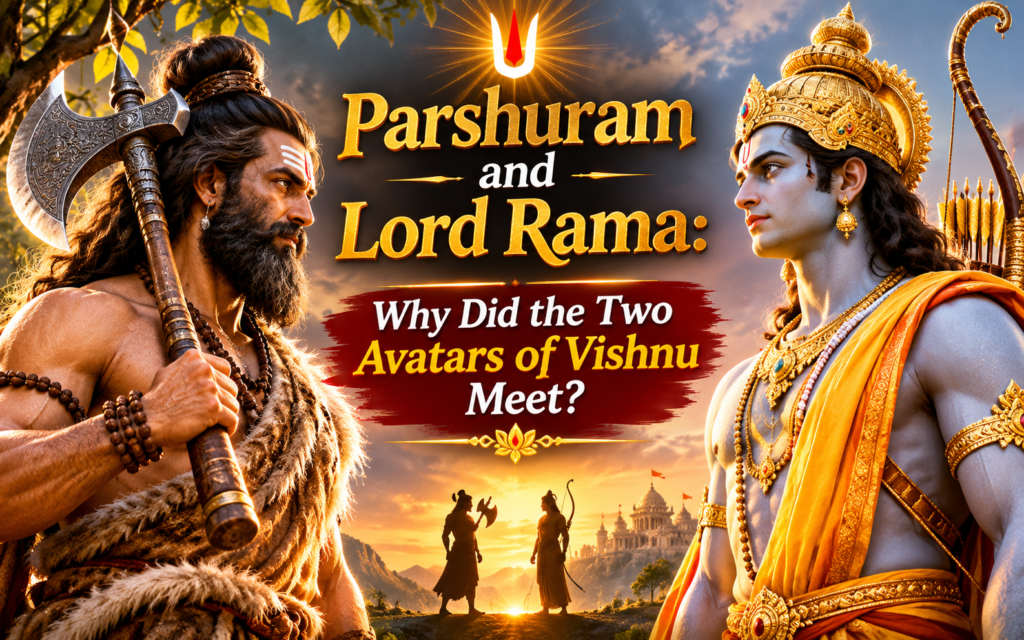
The meeting between Lord Parshuram and Lord Rama is one of the most fascinating episodes in Hindu mythology. Both are considered incarnations of Lord Vishnu, yet they represent different approaches to protecting dharma. Parshuram is remembered as a powerful warrior-sage who fought against injustice, while Lord Rama is worshipped as Maryada Purushottam — the ideal man who followed duty, discipline and righteousness.
Their encounter takes place after Rama breaks Lord Shiva’s mighty bow at Sita’s swayamvara. As Rama and Sita begin their journey towards Ayodhya after their wedding, Parshuram appears and challenges Rama. What follows is not simply a contest between two extraordinary warriors. It is a story about divine identity, humility, the responsibility of power and the transition from one form of Vishnu’s mission to another.
The episode raises an interesting question: if both Parshuram and Rama were avatars of Vishnu, why did they meet, and why did Parshuram challenge Rama? The story becomes clearer when we understand their backgrounds, the significance of Shiva’s bow and the deeper meaning of their encounter.
Who Was Lord Parshuram?
Lord Parshuram, also written as Parashurama, is traditionally regarded as the sixth avatar of Lord Vishnu in the Dashavatara, the ten principal incarnations commonly recognised in Hindu traditions. His name comes from the Sanskrit words Parashu, meaning axe, and Rama, referring to his name. He is therefore widely known as Rama with the axe. Unlike Lord Rama, who is remembered as a prince and king, Parshuram is known as a warrior-sage who combined the knowledge of a Brahmin with the strength and fighting skills of a warrior.
According to Hindu tradition, Parshuram was born to sage Jamadagni and Renuka. He belonged to the Bhrigu lineage and grew up in an environment shaped by spiritual discipline, devotion and the study of sacred knowledge. He became a skilled warrior and was especially associated with the divine axe. His stories describe a personality with immense physical strength, strong devotion to his father and a fierce commitment to confronting injustice.
One of the most important episodes associated with Parshuram concerns King Kartavirya Arjuna, also known in many retellings as Sahasrabahu Arjuna. The king’s conflict with Jamadagni’s family is traditionally described as the event that led Parshuram to take up arms against oppressive rulers. Following the death of his father, Parshuram is said to have fought against unjust Kshatriya rulers. Several Hindu texts and later retellings describe him as destroying the Kshatriya warrior class twenty-one times.
This part of his story is often understood as a response to the misuse of royal power. However, it is important to recognise that different scriptures and regional traditions narrate the details differently. The broader message is that power without responsibility can become destructive, and rulers are expected to protect people rather than exploit them.
Why Is Parshuram Considered the Sixth Avatar of Vishnu?
The Dashavatara tradition describes ten major incarnations of Lord Vishnu, who appears in different forms to restore balance and protect dharma. Parshuram is commonly placed as the sixth avatar, followed by Lord Rama as the seventh. The sequence is significant because their stories are closely connected in the Ramayana.
Parshuram’s incarnation is associated with confronting rulers who have abandoned righteousness and used their authority for oppression. His character represents the forceful removal of injustice when ordinary methods fail. He is a warrior who also practises austerity and spiritual discipline, making him different from a conventional king or fighter.
Lord Rama’s incarnation, on the other hand, is associated with establishing the ideals of righteous conduct through personal example. His life demonstrates the importance of fulfilling responsibilities as a son, husband, brother, ruler and human being. While Parshuram’s stories often focus on confronting injustice through strength, Rama’s story focuses on the practice of dharma even when it demands personal sacrifice.
This difference helps explain why their meeting is so important. It brings together two forms of divine purpose: the force that challenges injustice and the ideal of disciplined leadership that establishes righteousness.
Why Did Lord Parshuram Meet Lord Rama?
The meeting takes place after Rama wins Sita’s hand in marriage by lifting and breaking the mighty bow of Lord Shiva at King Janaka’s court in Mithila. The bow was considered extraordinarily powerful, and many kings and warriors had failed to lift it. Rama not only lifts it but breaks it while attempting to string it.
After the wedding ceremonies, King Dasharatha, Rama, Sita and the rest of the royal family begin their journey back to Ayodhya. During this journey, Parshuram appears before the wedding procession. He has heard about Rama’s extraordinary achievement and wants to test his strength.
In the Valmiki Ramayana, this encounter is narrated in the Bala Kanda, particularly in the sections describing Parshuram’s appearance, his challenge and his eventual departure. Parshuram carries another powerful bow, traditionally identified as the bow of Lord Vishnu. He challenges Rama to take the bow, string it and demonstrate his ability.
The challenge is not merely about physical strength. Parshuram wants to know whether the young prince who broke Shiva’s bow possesses the ability to handle another divine weapon. He also appears to be testing the warrior who has suddenly become famous for an extraordinary feat.
King Dasharatha becomes worried when he sees Parshuram. He knows the sage’s reputation and remembers his violent conflict with Kshatriya rulers. Dasharatha requests Parshuram not to harm his son, but the challenge continues. Rama, however, remains calm and accepts the bow.
The Story of the Two Divine Bows
A major part of the encounter concerns two extraordinary bows associated with Lord Shiva and Lord Vishnu. Parshuram explains that both bows were created by the divine architect Vishvakarma. One was given to Lord Shiva, while the other was associated with Lord Vishnu.
The bow that Rama broke at Janaka’s court was the bow of Shiva. The other bow, which Parshuram brings before Rama, is associated with Vishnu and has been passed down through Parshuram’s family tradition.
Parshuram explains the history of these weapons and challenges Rama to prove his ability by stringing the bow of Vishnu. This moment makes the encounter much more significant than a simple argument about who is stronger. The two bows represent divine power, and the challenge brings Rama face to face with a weapon associated with his own divine identity.
Rama accepts the bow without displaying anger or arrogance. He takes it, strings it and places an arrow on it. His effortless handling of the weapon surprises everyone present, including Parshuram.
How Did Lord Rama Defeat Parshuram?
The word “defeat” is often used when describing this episode, but the encounter does not end with Rama killing Parshuram or engaging him in a conventional physical battle. Instead, Rama demonstrates his extraordinary power by successfully stringing the divine bow and preparing to release its arrow.
Once Rama has drawn the bow, he tells Parshuram that the arrow cannot simply be released without a target. He gives Parshuram the opportunity to identify what should be struck. The conversation reveals that Rama understands the spiritual power and achievements Parshuram has gained through his penance.
Parshuram recognises that the young prince standing before him is no ordinary human being. He realises Rama’s divine identity and understands that he is facing another manifestation of Lord Vishnu. His challenge gives way to respect and recognition.
In the Valmiki Ramayana, the arrow is directed towards the spiritual realms or merit Parshuram had acquired through his austerities, rather than towards his physical body. Parshuram accepts the outcome and prepares to withdraw. He does not die in this encounter; instead, he returns to Mount Mahendra.
The important point is that Rama establishes his superiority without disrespecting the sage. His strength is evident, but so is his restraint. The episode therefore presents victory through self-control rather than uncontrolled aggression.
Did Parshuram Recognise Lord Rama as Vishnu?
Yes. One of the central moments of the story is Parshuram’s recognition of Rama’s divine nature. Before the encounter, Parshuram sees Rama as a young prince whose achievement has attracted attention. After Rama strings the bow of Vishnu, Parshuram understands that the person before him is connected to the same divine source from which his own incarnation comes.
This recognition changes the nature of their interaction. What began as a challenge becomes an act of acceptance. Parshuram understands that Rama’s appearance has a larger purpose and that his own role in the divine plan is different.
In many devotional interpretations, this moment is understood as the transfer or withdrawal of the older avatar’s active role as the next avatar begins his mission. Parshuram does not need to fight Rama because both ultimately serve the same divine purpose.
The scene also highlights an important idea in Hindu philosophy: the divine can appear in different forms to respond to the needs of different ages. These forms may have different personalities, responsibilities and methods, but they are understood as manifestations of the same ultimate divine reality.
Why Did Two Avatars of Lord Vishnu Meet?
The meeting of Parshuram and Rama has several layers of meaning. It is not included merely to create a dramatic confrontation between two powerful characters. It helps establish the relationship between two avatars and explains the changing nature of Vishnu’s mission.
1. The transition from one avatar to another
Parshuram is traditionally recognised as the sixth avatar of Vishnu, while Rama is the seventh. Their meeting can be understood as a symbolic transition between two divine missions. Parshuram’s role is associated with confronting oppressive rulers, while Rama’s life is centred on establishing dharma through ideal conduct, leadership and responsibility.
2. Recognition of divine identity
Parshuram’s challenge leads him to recognise Rama’s divine nature. The episode reminds readers that divine power is not limited to one form or personality. The two avatars may appear different, but their spiritual source is the same.
3. The importance of humility
Parshuram is a highly respected sage and a formidable warrior. Yet, when he recognises Rama, he accepts the truth rather than continuing a pointless contest. The story shows that wisdom includes the ability to recognise when one’s role has changed.
4. Strength must be guided by discipline
Both characters possess extraordinary power, but Rama demonstrates that strength does not need to be expressed through anger. He handles the challenge calmly and does not attack Parshuram simply because he has the opportunity. The episode presents restraint as an important part of true power.
5. Dharma changes according to responsibility
Parshuram’s mission and Rama’s mission are not identical. One confronts injustice through the force of a warrior-sage, while the other demonstrates the responsibilities of an ideal prince and king. Their meeting highlights that protecting dharma can require different approaches in different circumstances.
Parshuram and Rama: What Is the Difference Between the Two Avatars?
Although both are considered incarnations of Lord Vishnu, Parshuram and Rama are remembered for different qualities and responsibilities. Their stories offer two distinct ways of understanding the protection of dharma.
Parshuram is primarily associated with spiritual austerity, warrior skills and the punishment of oppressive rulers. He is often depicted carrying an axe and is remembered for his fierce response to injustice. His character combines the qualities of a sage and a warrior, and his stories frequently explore the consequences of arrogance and the misuse of authority.
Rama is associated with ideal conduct, compassion, courage and responsibility. He is known as Maryada Purushottam because his life represents the importance of following moral boundaries and fulfilling one’s duties. His story includes his exile, his relationship with Sita, his loyalty to family, his friendship with Hanuman and his battle against Ravana.
| Aspect | Lord Parshuram | Lord Rama |
|---|---|---|
| Traditional avatar sequence | Sixth avatar of Vishnu | Seventh avatar of Vishnu |
| Parents | Sage Jamadagni and Renuka | King Dasharatha and Queen Kaushalya |
| Main identity | Warrior-sage | Prince and ideal king |
| Famous weapon | Divine axe | Bow and arrows |
| Major association | Confronting oppressive rulers | Defeating Ravana and upholding dharma |
| Common title or description | Bhargava Rama | Maryada Purushottam |
| Ramayana connection | Challenges Rama after the bow episode | Breaks Shiva’s bow and later meets Parshuram |
The comparison does not mean that one avatar is more important than the other. Both are revered for their contributions to the protection of dharma. Their different characteristics show how divine purpose can take different forms.
Is the Parshuram and Rama Meeting the Same in Every Ramayana?
No. The episode is narrated differently across different Ramayana traditions, and this is important for understanding the story accurately.
In the Valmiki Ramayana, Parshuram appears on the road after Rama and Sita’s wedding, while the royal procession is travelling from Mithila towards Ayodhya. He challenges Rama to string the bow of Vishnu, and the encounter concludes with Parshuram recognising Rama’s power and returning to Mount Mahendra.
In Tulsidas’s Ramcharitmanas, the encounter is presented differently. Parshuram appears at King Janaka’s court after Rama breaks Shiva’s bow. This version is especially famous for the sharp and entertaining exchange between Parshuram and Lakshmana. Lakshmana responds fearlessly to Parshuram’s anger, creating one of the most memorable conversations in popular retellings of the Ramayana.
These differences are not necessarily contradictions that need to be forced into one single version. The Ramayana has been retold through different languages, regions, literary traditions and devotional perspectives. Each version places emphasis on particular characters and themes.
For example, the Valmiki narrative focuses on the divine bow challenge and Rama’s recognition by Parshuram. The Ramcharitmanas version gives greater attention to the dramatic conversation between Parshuram and Lakshmana. Both have become important parts of the wider cultural understanding of the Ramayana.
What Happened to Parshuram After Meeting Lord Rama?
After recognising Rama, Parshuram withdraws from the encounter and returns to Mount Mahendra. His departure marks the end of this particular episode, but it does not mean that Parshuram disappears from Hindu tradition.
Parshuram is regarded as a Chiranjeevi, or an immortal being, in several Hindu traditions. He also appears in stories connected with the Mahabharata. He is remembered as a teacher of important warriors, including Bhishma, Dronacharya and Karna, although the circumstances and details of these relationships vary across the epic’s episodes and later interpretations.
His presence in both the Ramayana and the Mahabharata makes him a distinctive figure in Hindu mythology. He belongs to a much wider narrative world than a single avatar story. His continued role in later traditions also explains why he is sometimes described as an immortal warrior-sage who remains connected to the unfolding of dharma.
Some later traditions also associate Parshuram with the future appearance of Kalki, the tenth avatar of Vishnu. In these accounts, he is expected to guide or train Kalki. Such beliefs belong to particular scriptural and devotional traditions and should not be confused with the specific account of his meeting with Rama in the Valmiki Ramayana.
The Spiritual Meaning of the Parshuram and Rama Story
The story of Parshuram and Rama offers a lesson that goes beyond the question of which warrior is stronger. It explores the relationship between power, knowledge, humility and responsibility.
Parshuram’s character demonstrates that even great strength and spiritual achievement must remain connected to a larger purpose. Rama’s response shows that genuine power does not require arrogance or unnecessary conflict. He accepts the challenge, proves his ability and still treats Parshuram with the respect due to a revered sage.
The story also encourages readers to understand that different situations may require different forms of action. There are times when injustice must be confronted firmly, and there are times when patience, discipline and responsible leadership are more effective. Both approaches can serve dharma when guided by wisdom.
Perhaps the most meaningful part of the encounter is that it ends without hatred. Parshuram recognises Rama, Rama respects Parshuram, and the conflict is resolved without a destructive battle. Their meeting becomes a reminder that the purpose of strength is not endless competition but the protection of righteousness.
Conclusion
The meeting between Lord Parshuram and Lord Rama is one of the most meaningful episodes in the Ramayana because it connects two incarnations of Lord Vishnu and highlights their different roles in protecting dharma. Parshuram, the warrior-sage, challenges Rama after hearing that he has broken Lord Shiva’s bow. Rama accepts the challenge, strings the bow of Vishnu and demonstrates a power that leads Parshuram to recognise his divine identity.
The encounter is not a story in which Rama kills Parshuram or simply defeats him in a physical fight. Instead, it is a moment of recognition, acceptance and transition. Parshuram withdraws to Mount Mahendra, while Rama continues towards the responsibilities that will define his life and his place in the Ramayana.
Ultimately, the story teaches that strength becomes meaningful when it is guided by wisdom, humility and duty. Both avatars represent different expressions of the same divine purpose, reminding devotees that the protection of dharma can take many forms.
FAQs
1. Why did Parshuram challenge Lord Rama?
Parshuram heard that Rama had broken the powerful bow of Lord Shiva at Sita’s swayamvara. He appeared before Rama and challenged him to string another divine weapon, the bow associated with Lord Vishnu, to test his strength and ability.
2. Were Parshuram and Lord Rama both avatars of Vishnu?
Yes. In the commonly followed Dashavatara tradition, Parshuram is considered the sixth avatar of Lord Vishnu, while Lord Rama is the seventh. Their meeting is therefore understood as an encounter between two incarnations of the same divine source.
3. Did Lord Rama kill Parshuram?
No. Rama does not kill Parshuram. After Rama strings Vishnu’s bow and prepares an arrow, Parshuram recognises his divine identity. The encounter ends with Parshuram withdrawing to Mount Mahendra.
4. Why did Parshuram become angry after Rama broke Shiva’s bow?
Parshuram was known for his strong warrior nature and had heard about Rama’s extraordinary achievement. He wanted to test the young prince by challenging him with the bow of Vishnu. Different Ramayana traditions present the details and emotional tone of this encounter differently.
5. Where did Parshuram meet Lord Rama?
In the Valmiki Ramayana, Parshuram meets Rama on the journey from Mithila to Ayodhya after Rama’s marriage to Sita. In Tulsidas’s Ramcharitmanas, the confrontation takes place at King Janaka’s court after the breaking of Shiva’s bow.
6. What is the difference between Parshuram and Rama?
Parshuram is remembered as a warrior-sage who confronted oppressive rulers, while Rama is remembered as Maryada Purushottam, the ideal prince and king. Both are considered incarnations of Vishnu but represent different approaches to protecting dharma.
7. Is Parshuram still alive according to Hindu belief?
Several Hindu traditions regard Parshuram as a Chiranjeevi, meaning an immortal being. He is also associated with stories from the Mahabharata and with some traditions concerning the future arrival of Kalki.
8. Which chapter of the Valmiki Ramayana describes the meeting?
The encounter is described in the Bala Kanda of the Valmiki Ramayana. The sections commonly identified as Sargas 74, 75 and 76 narrate Parshuram’s arrival, his challenge involving Vishnu’s bow and his eventual departure.