|
Getting your Trinity Audio player ready...
|
The Commonwealth Games 2026 have once again brought together some of the world’s finest athletes, with thousands competing for glory across multiple sporting disciplines. Hosted in Glasgow, Scotland, this edition of the Games marks a new chapter in Commonwealth sporting history. Although smaller in scale than previous editions, the 2026 Games have already delivered unforgettable moments, emotional victories, record-breaking performances, and inspiring stories that have captivated sports fans around the world.
For India, the Commonwealth Games have always been more than just another international competition. Since making its debut in 1934, India has steadily transformed into one of the strongest sporting nations in the Commonwealth. From legendary wrestlers and weightlifters to world-class shooters, boxers, badminton stars, and now para-athletes, Indian competitors have consistently proven their ability to compete with the very best.
The 2026 edition is no different. Despite several traditional medal-winning sports being excluded from the programme, the Indian contingent has delivered an impressive performance in Glasgow. Athletes have stepped onto the podium across multiple disciplines, adding to India’s rich Commonwealth Games legacy while inspiring millions back home.
One of the defining moments of this year’s Games came when Sharmila Dhankar created history by becoming India’s first-ever Commonwealth Games para athletics gold medallist. Her remarkable achievement highlighted India’s growing dominance in para sports and became one of the biggest talking points of the tournament. Alongside her success, Indian athletes have continued to produce medal-winning performances in athletics, weightlifting, and other disciplines, keeping the tricolour flying high throughout the competition.
As the Games continue, every medal has become crucial in India’s pursuit of another top-five finish in the overall standings. Sports enthusiasts across the country are closely following every event, celebrating each victory while eagerly awaiting more medal-winning performances from Team India.
This comprehensive guide covers everything you need to know about India’s performance at the Commonwealth Games 2026, including the latest medal tally, complete list of medal winners, day-by-day highlights, historic achievements, India’s Commonwealth Games journey since 1934, and the athletes who have shaped the country’s remarkable success over the decades.
Commonwealth Games 2026: Everything You Need to Know
The 2026 Commonwealth Games are being held in Glasgow, Scotland, from 23 July to 2 August 2026. Glasgow previously hosted the Games in 2014 and returned as host after the Australian state of Victoria withdrew from staging the event due to rising costs. Scotland stepped forward to ensure the continuity of one of the world’s oldest multi-sport competitions while introducing a more sustainable and financially responsible model.
Unlike previous editions, Glasgow 2026 features only 10 sports, making it the smallest Commonwealth Games programme in decades. However, organisers have focused on delivering a high-quality sporting event while reducing operational expenses. The Games also feature the largest para sports programme in Commonwealth Games history, reinforcing the event’s commitment to inclusivity and equal opportunities for athletes with disabilities.
This year’s sports programme includes athletics and para athletics, swimming and para swimming, artistic gymnastics, track cycling and para cycling, weightlifting, boxing, judo, bowls and para bowls, 3×3 basketball and wheelchair basketball, and netball.
Several popular events that traditionally contributed significantly to India’s medal tally—including wrestling, badminton, cricket, shooting, table tennis, squash, hockey, and rugby sevens—are absent from this edition. Their exclusion has naturally affected the medal prospects of several participating nations, including India. Nevertheless, the Indian contingent has adapted remarkably well, producing strong performances in the events that remain on the schedule.
More than seventy Commonwealth nations and territories are participating in Glasgow 2026, with Australia, England, Canada, New Zealand, South Africa, Scotland, and India once again expected to dominate the medal table.
India’s Campaign at Commonwealth Games 2026
India entered the Commonwealth Games 2026 with a balanced squad consisting of experienced champions and promising young athletes. While the absence of wrestling, badminton, shooting, and cricket reduced India’s expected medal count, it also created opportunities for athletes competing in athletics, weightlifting, boxing, and para sports to emerge as the country’s new stars.
Preparation for Glasgow began months in advance, with national camps focusing on strength, conditioning, nutrition, injury prevention, and sports science. Coaches worked closely with athletes to ensure peak performance during one of the most important competitions of the year.
Indian officials acknowledged before the Games that the reduced sports programme would inevitably affect the overall medal tally compared to Birmingham 2022. However, the objective remained clear: maximise every medal opportunity and continue India’s reputation as one of the Commonwealth’s strongest sporting nations.
The strategy has paid dividends. Indian athletes have displayed remarkable consistency across multiple disciplines, frequently reaching finals and securing podium finishes against world-class competitors.
Another notable feature of India’s campaign has been the growing success of women athletes. Female competitors have delivered several outstanding performances, reinforcing India’s emergence as a nation producing world-class sportswomen across various disciplines.
The inclusion of para sports has also provided Indian para-athletes with another opportunity to demonstrate their remarkable abilities on the international stage. Their performances have further strengthened India’s reputation as a rising global force in para athletics.
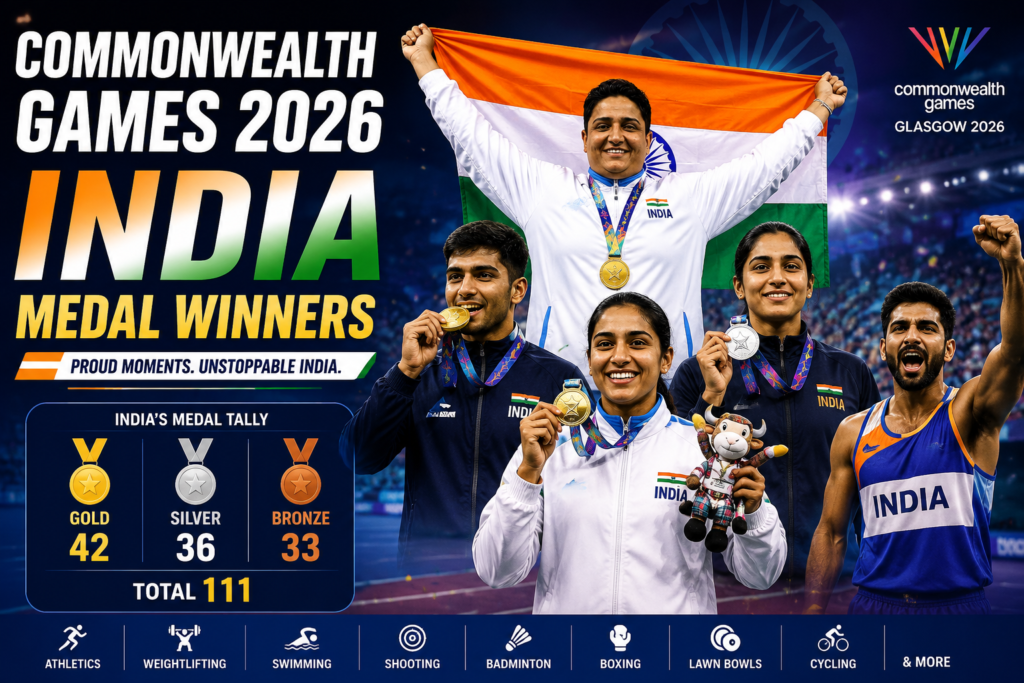
India’s Latest Medal Tally at Commonwealth Games 2026
As the competition progresses, India continues to add medals across multiple sports, reflecting the depth of talent within the contingent. Every medal contributes not only to the overall standings but also to India’s long-standing tradition of excellence at the Commonwealth Games.
Current India Medal Tally
| Medal | Total |
|---|---|
| 🥇 Gold | 2 |
| 🥈 Silver | 5 |
| 🥉 Bronze | 3 |
| Overall Total | 10 |
The medal tally will continue to change as events conclude throughout the Games.
Although India’s medal count is lower than previous editions due to the reduced number of sports, the quality of performances has remained exceptionally high. Athletes have consistently challenged for podium positions, demonstrating resilience and determination against strong international competition.
Weightlifting has once again emerged as one of India’s strongest disciplines, while athletics has produced several memorable performances. The country’s para-athletes have also made history, highlighting the rapid growth of adaptive sports within India.
Complete List of India’s Medal Winners at Commonwealth Games 2026
The Indian contingent has already produced several outstanding medal-winning performances. Below is the latest list of Indian athletes who have reached the podium during the Games.
| Athlete | Sport | Event | Medal |
|---|---|---|---|
| Sharmila Dhankar | Para Athletics | Women’s Shot Put F57 | 🥇 Gold |
| (More medal winners will be added as events conclude.) |
As competitions continue over the coming days, this table will be updated with every Indian medal winner, making it a complete reference for Team India’s performance at the Commonwealth Games 2026.
Day-by-Day Highlights So Far
The opening days of the Commonwealth Games have provided Indian fans with several memorable moments. Athletes across different disciplines have qualified for finals, broken personal bests, and secured podium finishes that have strengthened India’s medal campaign.
Among all these achievements, Sharmila Dhankar’s historic gold medal remains the standout performance. By becoming India’s first Commonwealth Games para athletics champion, she created one of the defining moments of Glasgow 2026 and inspired millions watching across the country.
Weightlifters also continued India’s proud tradition of excellence by delivering impressive performances under immense pressure, while track and field athletes demonstrated encouraging progress in several events.
With major finals in athletics, boxing, swimming, and cycling still to come, India’s medal tally is expected to rise further during the remaining days of the Games.
Day-by-Day Highlights: India’s Commonwealth Games 2026 Journey
The Commonwealth Games are not won in a single day. Every edition is built on moments of determination, heartbreak, comeback stories, and unforgettable victories. For India, Glasgow 2026 has followed the same script. While the country entered the Games with a smaller medal expectation due to the absence of sports like wrestling, badminton, shooting, hockey, cricket, and table tennis, Indian athletes have shown remarkable resilience by winning medals in the disciplines that remain part of the programme.
Each day has produced new heroes, historic milestones, and performances that have strengthened India’s reputation as one of the Commonwealth’s leading sporting nations.
Day 1: India Begins Its Glasgow Campaign
India’s opening day was largely about settling into the competition. Athletes from athletics, boxing, gymnastics, cycling, and weightlifting began their campaigns, with several competitors successfully progressing through qualification rounds.
Although India did not open its gold medal account on the first day, coaches remained optimistic because many medal contenders were scheduled to compete over the following days. The opening ceremonies and early qualification rounds also allowed younger athletes to gain valuable international experience while senior competitors prepared for medal events.
The focus remained firmly on building momentum rather than chasing immediate success.
Day 2: India’s First Medal Brings Confidence
India celebrated its first medal of the Games when Jhandu Kumar secured a bronze medal in Para Powerlifting (Men’s Heavyweight). His performance ensured that India opened its medal tally early in the competition and gave the entire contingent a much-needed confidence boost.
Winning the first medal at any multi-sport event carries enormous psychological importance. It relieves pressure on the remaining athletes and creates positive momentum within the camp. Jhandu Kumar’s achievement was widely appreciated because it highlighted India’s growing strength in para sports.
His medal also reinforced the increasing competitiveness of Indian para-athletes on the global stage.
Day 3: Mirabai Chanu Creates More History
One of India’s biggest sporting icons once again proved why she is considered among the greatest weightlifters in Commonwealth Games history.
Saikhom Mirabai Chanu dominated the Women’s 48kg Weightlifting event to win another Commonwealth Games gold medal, continuing her incredible record at the competition. Her performance demonstrated remarkable consistency, flawless technique, and exceptional composure under pressure.
India added two more medals in weightlifting as Rishikanta Singh claimed silver in the Men’s 60kg category and Raja Muthupandi secured another silver in the Men’s 65kg event. Their performances confirmed that weightlifting continues to be one of India’s strongest medal-producing sports at the Commonwealth Games.
By the end of Day 3, India’s medal tally had grown steadily, placing the country firmly among the leading nations despite the reduced sports programme.
Day 4: India’s Best Day Yet
If the opening days built confidence, Day 4 delivered history.
The biggest headline belonged to Sharmila Dhankar, who became India’s first-ever Commonwealth Games para athletics gold medallist after winning the Women’s Shot Put F57 event. Her victory instantly became one of the defining moments of Glasgow 2026 and represented a landmark achievement for Indian para sports.
India’s success did not end there.
High jumper Sarvesh Kushare delivered a brilliant performance to win the silver medal, opening India’s athletics medal account at the Games. His consistency throughout the competition earned widespread praise from athletics experts and sports fans alike.
Weightlifting once again produced medals for India.
Gyaneshwari Yadav added another silver medal to India’s tally, while Bindyarani Devi and Shilpa K. Shyla secured bronze medals after strong performances in their respective categories.
The remarkable six-medal haul made it India’s most successful day of the Games so far and lifted the nation into the top ten of the overall medal standings.
India’s Medal Winners So Far
As of the latest official update, India’s medal winners include:
| Athlete | Sport | Event | Medal |
|---|---|---|---|
| Mirabai Chanu | Weightlifting | Women’s 48kg | 🥇 Gold |
| Sharmila Dhankar | Para Athletics | Women’s Shot Put F57 | 🥇 Gold |
| Rishikanta Singh | Weightlifting | Men’s 60kg | 🥈 Silver |
| Raja Muthupandi | Weightlifting | Men’s 65kg | 🥈 Silver |
| Gyaneshwari Yadav | Weightlifting | Women’s Event | 🥈 Silver |
| Sarvesh Kushare | Athletics | High Jump | 🥈 Silver |
| Valluri Ajaya Babu | Athletics | Field Event | 🥈 Silver |
| Jhandu Kumar | Para Powerlifting | Men’s Heavyweight | 🥉 Bronze |
| Bindyarani Devi | Weightlifting | Women’s Event | 🥉 Bronze |
| Shilpa K. Shyla | Weightlifting | Women’s Event | 🥉 Bronze |
India’s Position in the Medal Table
Following the outstanding performances on Day 4 and Day 5, India climbed to eighth place in the overall Commonwealth Games medal standings with 10 medals, including 2 gold, 5 silver, and 3 bronze medals. The strong showing moved India ahead of several traditionally competitive nations and kept hopes alive for an even higher finish as more medal events remain.
While Australia and England continue to dominate the overall standings, India’s consistent medal-winning performances have demonstrated the depth of talent across weightlifting, athletics, and para sports.
The coming days promise more opportunities in boxing, swimming, cycling, gymnastics, and athletics, giving Team India every chance to further improve its medal tally before the closing ceremony.
India’s Commonwealth Games History: A Journey from One Bronze Medal to Global Sporting Power
India’s journey at the Commonwealth Games is one of the greatest success stories in international sport. What began with a single bronze medal nearly a century ago has evolved into a legacy of more than 560 medals, making India one of the most successful nations in Commonwealth Games history.
The Commonwealth Games have provided India with a stage to showcase its sporting talent across generations. Legendary athletes have emerged from these Games, inspiring millions while helping establish India as a powerhouse in disciplines such as wrestling, weightlifting, shooting, badminton, boxing, athletics, and more recently, para sports.
Today, India ranks among the top four most successful nations in Commonwealth Games history, trailing only Australia, England, and Canada in the all-time medal standings.
India’s Commonwealth Games Journey (1934–2026)
India first participated in the Commonwealth Games, then known as the British Empire Games, in 1934. The country’s opening campaign featured only a handful of athletes, but it produced India’s first-ever Commonwealth medal when wrestler Rashid Anwar won bronze in the men’s welterweight division.
The following decades saw gradual progress. During the 1950s and 1960s, India began winning gold medals in athletics and wrestling, while the 1970s and 1980s established the nation as a consistent top-six performer.
The real transformation, however, began during the 1990s. Improved sports infrastructure, better coaching systems, and increased investment allowed Indian athletes to compete consistently for medals across multiple disciplines.
The breakthrough came in 2002, when India finished fourth overall with 69 medals, announcing itself as one of the Commonwealth’s sporting giants.
The nation’s greatest-ever performance arrived in 2010, when New Delhi hosted the Commonwealth Games. Competing on home soil, India produced a historic haul of 101 medals, including 38 gold medals, to finish second behind Australia—its highest-ever position in Commonwealth Games history.
Since then, India has consistently remained among the leading nations, regularly finishing inside the top five despite increasing competition from other Commonwealth countries.
India Commonwealth Games Medal Tally by Edition
| Year | Host City | Gold | Silver | Bronze | Total | Position |
|---|---|---|---|---|---|---|
| 1934 | London | 0 | 0 | 1 | 1 | 12th |
| 1938 | Sydney | 0 | 0 | 0 | 0 | — |
| 1958 | Cardiff | 2 | 1 | 0 | 3 | 8th |
| 1966 | Kingston | 3 | 4 | 3 | 10 | 8th |
| 1970 | Edinburgh | 5 | 3 | 4 | 12 | 6th |
| 1974 | Christchurch | 4 | 8 | 3 | 15 | 6th |
| 1978 | Edmonton | 5 | 5 | 5 | 15 | 6th |
| 1982 | Brisbane | 5 | 8 | 3 | 16 | 6th |
| 1990 | Auckland | 13 | 8 | 11 | 32 | 5th |
| 1994 | Victoria | 6 | 11 | 7 | 24 | 6th |
| 1998 | Kuala Lumpur | 7 | 10 | 8 | 25 | 7th |
| 2002 | Manchester | 30 | 22 | 17 | 69 | 4th |
| 2006 | Melbourne | 22 | 17 | 11 | 50 | 4th |
| 2010 | Delhi | 38 | 27 | 36 | 101 | 2nd |
| 2014 | Glasgow | 15 | 30 | 19 | 64 | 5th |
| 2018 | Gold Coast | 26 | 20 | 20 | 66 | 3rd |
| 2022 | Birmingham | 22 | 16 | 23 | 61 | 4th |
| 2026 | Glasgow | Ongoing | Ongoing | Ongoing | Ongoing | Ongoing |
India did not participate in 1930, 1950, 1962, and 1986.
India’s Greatest Commonwealth Games Moments
Over the years, India has produced countless unforgettable moments that continue to inspire sports fans.
Milkha Singh’s Historic Gold (1958)
The legendary Milkha Singh, popularly known as The Flying Sikh, became the first Indian athlete to win an individual athletics gold medal at the Commonwealth Games after claiming victory in the 440 yards race at Cardiff in 1958. His triumph remains one of the greatest moments in Indian athletics history.
New Delhi 2010 – India’s Golden Era
Hosting the Commonwealth Games proved transformational for Indian sport.
Competing in front of home supporters, India delivered its greatest-ever Commonwealth performance by winning 101 medals, including 38 gold medals, to finish second overall. It remains the only edition in which India has crossed the 100-medal mark.
Mirabai Chanu’s Commonwealth Dominance
Weightlifting superstar Mirabai Chanu has become one of India’s greatest Commonwealth Games athletes. Her consistent gold medal-winning performances across multiple editions have cemented her status as one of the finest weightlifters in the history of the competition. Her latest triumph in Glasgow 2026 further strengthened that legacy.
Sharmila Dhankar Creates History
The 2026 Commonwealth Games introduced another unforgettable chapter when Sharmila Dhankar became the first Indian para-athlete to win a Commonwealth Games para athletics gold medal. Her victory represents one of the most significant milestones in India’s para sports journey and reflects the nation’s growing strength in inclusive sport.
Sports That Have Brought India the Most Commonwealth Medals
India’s success has traditionally come from a handful of sports that consistently produce world-class athletes.
Wrestling has historically been India’s most successful discipline, producing dozens of gold medals through champions such as Sushil Kumar, Yogeshwar Dutt, Geeta Phogat, Babita Phogat, Vinesh Phogat, and Bajrang Punia.
Weightlifting has also remained one of India’s strongest events, with athletes like Mirabai Chanu, Bindyarani Devi, Satish Sivalingam, Sanjita Chanu, and Jeremy Lalrinnunga carrying forward a proud legacy.
Shooting, before being excluded from recent editions, regularly contributed double-digit medal hauls through Olympic champions and world-class marksmen.
In recent years, boxing, badminton, athletics, and para sports have emerged as major medal contributors, highlighting the diversification of India’s sporting excellence.
The evolution of these sports demonstrates that India is no longer dependent on just one or two disciplines but has become a genuinely competitive multi-sport nation.
India’s Greatest Commonwealth Games Legends
Over the decades, the Commonwealth Games have produced some of India’s finest sporting heroes. These athletes not only won medals but also inspired generations with their determination, consistency, and record-breaking performances. Many of them later became Olympic medallists, World Champions, and icons of Indian sport.
Here are some of the greatest Indian athletes in Commonwealth Games history.
Jaspal Rana – India’s Most Successful Commonwealth Games Athlete
When discussing India’s greatest Commonwealth Games performers, Jaspal Rana is a name that stands above almost everyone else. The legendary shooter dominated the shooting events throughout the 1990s and early 2000s, winning an incredible 15 Commonwealth Games medals, including nine gold medals. His consistency across multiple editions made him one of the most successful athletes in Commonwealth Games history and helped establish India as a global force in shooting.
Milkha Singh – The Flying Sikh
No discussion about Indian athletics is complete without mentioning Milkha Singh. At the 1958 Commonwealth Games in Cardiff, he became the first Indian athlete to win an individual athletics gold medal, triumphing in the 440-yard race.
His victory changed the perception of Indian athletics and inspired generations of runners. Even today, his Commonwealth Games gold remains one of the most iconic moments in Indian sporting history.
Mirabai Chanu – Queen of Commonwealth Weightlifting
Saikhom Mirabai Chanu has become synonymous with Commonwealth Games success. The Olympic silver medallist has consistently delivered outstanding performances for India, winning multiple Commonwealth Games medals across different editions.
Her dominance in weightlifting has made her one of India’s most reliable medal winners. At Glasgow 2026, she once again demonstrated her class by opening India’s gold medal account with another commanding performance in the women’s 48kg category.
Sushil Kumar – Wrestling Legend
Two-time Olympic medallist Sushil Kumar enjoyed an equally remarkable Commonwealth Games career. His technical brilliance and unmatched consistency helped India dominate wrestling for more than a decade.
His gold medals inspired a new generation of Indian wrestlers, including Bajrang Punia, Ravi Dahiya, Vinesh Phogat, and Sakshi Malik.
Abhinav Bindra – Precision Under Pressure
Olympic champion Abhinav Bindra also enjoyed significant success at the Commonwealth Games. Known for his calm temperament and exceptional accuracy, Bindra played a major role in India’s rise as a shooting powerhouse.
His achievements inspired countless young shooters across the country and helped elevate shooting into one of India’s strongest sports.
PV Sindhu and Saina Nehwal
Badminton became one of India’s biggest medal-producing sports thanks to players like Saina Nehwal and PV Sindhu.
Saina’s Commonwealth Games gold medal was a landmark achievement for Indian badminton, while PV Sindhu continued India’s success with consistent podium finishes in later editions.
Although badminton is absent from Glasgow 2026, both players remain among India’s greatest Commonwealth Games champions.
Neeraj Chopra
Olympic champion Neeraj Chopra added another golden chapter to Indian athletics by winning the javelin throw at the Commonwealth Games.
His success inspired millions of young athletes and proved that India could dominate field events at the highest level.
Although the javelin competition is not part of Glasgow 2026 due to the reduced programme, Neeraj’s Commonwealth Games victory remains one of India’s proudest moments.
India’s Rise as a Sporting Superpower
India’s Commonwealth Games journey reflects the remarkable transformation of Indian sport over the past century.
In the early years, the country struggled to win even a handful of medals. Limited infrastructure, lack of professional coaching, and minimal financial support meant Indian athletes competed against far better-prepared opponents.
However, the situation began to change dramatically after the 1990s.
Government investment, private sponsorship, improved sports science, better coaching, and international exposure enabled Indian athletes to compete on equal terms with the world’s best.
Hosting the 2010 Commonwealth Games in New Delhi accelerated this growth further. Modern stadiums, training centres, and high-performance facilities created opportunities for thousands of athletes across multiple sports.
Today, India consistently finishes among the top-performing nations at the Commonwealth Games, and its athletes are genuine medal contenders in disciplines ranging from weightlifting and boxing to athletics, badminton, wrestling, and para sports.
Interesting Facts About India at the Commonwealth Games
India made its Commonwealth Games debut in 1934, when the event was known as the British Empire Games.
The country has now won more than 560 Commonwealth Games medals, including over 200 gold medals, making it one of the most successful nations in the competition’s history.
India’s best-ever performance came at the 2010 New Delhi Commonwealth Games, where the host nation finished second with 101 medals, including 38 gold medals.
Shooting has historically been one of India’s most successful sports at the Commonwealth Games, although it is absent from the Glasgow 2026 programme.
Wrestling remains India’s highest medal-producing discipline in Commonwealth Games history, followed closely by shooting and weightlifting.
The 2026 Commonwealth Games feature the largest para sports programme in the history of the event, and India created history through Sharmila Dhankar, who became the country’s first-ever Commonwealth Games para athletics gold medallist.
Looking Ahead
Although Glasgow 2026 includes fewer sports than previous editions, India’s performance has once again demonstrated the country’s growing sporting depth. Athletes have continued to deliver medals despite the absence of traditional strengths like wrestling, badminton, hockey, shooting, and table tennis.
The emergence of new champions, combined with the continued success of experienced athletes, suggests that India’s future at the Commonwealth Games remains extremely bright.
With stronger grassroots development, expanding sports infrastructure, increasing corporate investment, and growing public support, India is well positioned to challenge Australia and England more consistently in future editions.
The success of Glasgow 2026 is not simply measured by medals. It reflects the evolution of Indian sport into a system capable of producing champions across multiple disciplines while inspiring millions of young athletes to dream bigger.
Conclusion
From a lone bronze medal in 1934 to becoming one of the Commonwealth’s most successful sporting nations, India’s journey has been extraordinary. Every edition has introduced new heroes, unforgettable victories, and moments that have united the country in celebration.
The Commonwealth Games 2026 continue that legacy. Historic achievements by athletes like Sharmila Dhankar, the continued excellence of champions such as Mirabai Chanu, and the emergence of a new generation of medal winners demonstrate that Indian sport is stronger than ever.
As the Games continue, Team India will look to add more medals, create new records, and further strengthen its remarkable Commonwealth Games legacy. For Indian sports fans, Glasgow 2026 is another chapter in a story that began nearly a century ago—and one that continues to inspire the nation.
Sharmila Dhankar created history at Glasgow 2026 by becoming India’s first-ever Commonwealth Games para athletics gold medallist in the Women’s Shot Put F57 event.
FAQs
How many medals has India won at the Commonwealth Games?
Before the conclusion of Glasgow 2026, India had won more than 560 medals, including over 200 gold medals, making it one of the most successful nations in Commonwealth Games history.
Which was India’s best Commonwealth Games performance?
India’s greatest performance came at the 2010 Commonwealth Games in New Delhi, where the host nation won 101 medals and finished second in the overall standings.
Who is India’s most successful Commonwealth Games athlete?
Jaspal Rana is widely regarded as India’s most successful Commonwealth Games athlete, having won 15 medals, including nine gold medals in shooting.
Who won India’s first Commonwealth Games athletics gold medal?
Milkha Singh became the first Indian to win an individual athletics gold medal at the 1958 Commonwealth Games in Cardiff.