|
Getting your Trinity Audio player ready...
|

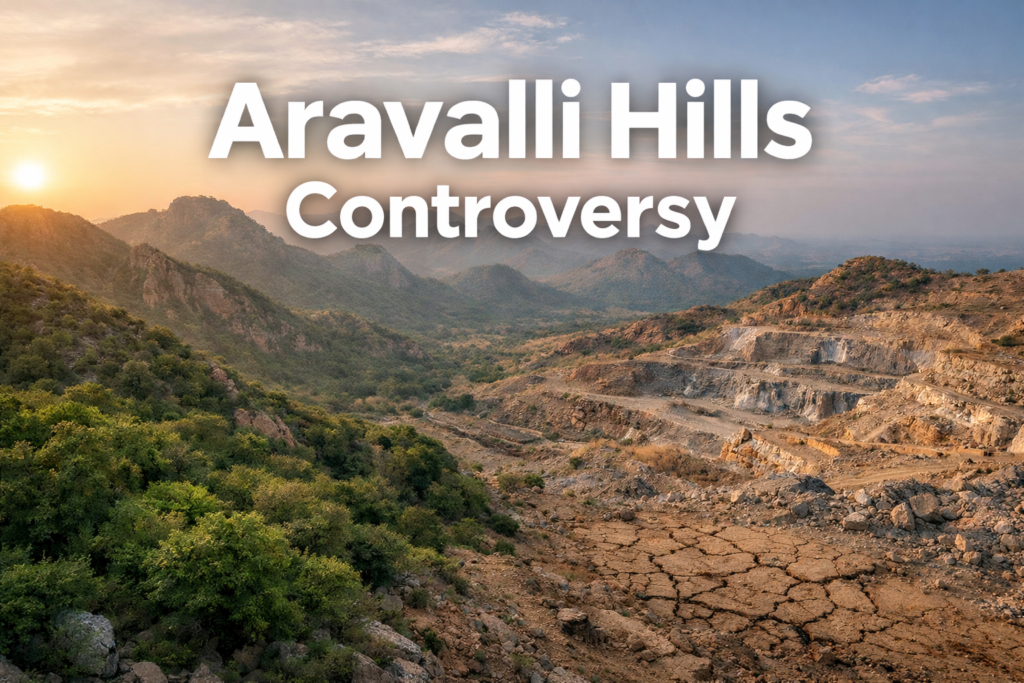
The Aravalli Range, one of the oldest mountain systems on Earth, are back in the national spotlight. But this time, it is not for their history or beauty. It is because of a growing legal, environmental, and political controversy that could decide the future of these ancient hills.
At the heart of the issue lies a new definition, mining permissions, and fears that large parts of the Aravalis may slowly disappear under the name of development.
Why Are the Aravalli Hills in the News?
The Aravali Hills came into focus after recent court observations and government clarifications regarding how the Aravalli range should be officially defined and protected.

A key point of controversy is the benchmark-based definition of the Aravallis, where only landforms rising 100 meters or more above surrounding areas are being officially recognized as part of the range in certain records.
Environmentalists argue this could exclude vast stretches of the Aravalis that are low-lying but ecologically critical.
Supreme Court and Legal Angle
The Supreme Court of India has intervened multiple times over the years to protect the Aravali ecosystem, especially in Rajasthan, Haryana, and Delhi-NCR.
Recent legal discussions have:
- Reopened debates on what legally qualifies as Aravalli land
- Triggered fears of dilution in environmental protection
- Raised questions about how scientific definitions are being used in policy decisions
Activists warn that redefining the hills on height alone ignores geology, age, and ecological value.
Mining: The Core of the Controversy
Mining has always been the most sensitive issue in the Aravalis.
Key concerns include:
- Illegal stone and sand mining
- Forest destruction
- Groundwater depletion
- Increased desertification risk
The central government has stated that no new mining leases will be allowed until a sustainable mining framework is finalized. Officials also claim that more than 90% of the Aravali region remains protected.
However, critics argue that even limited mining in such an ancient and fragile ecosystem can cause irreversible damage.
#SaveAravalli Movement Gains Momentum
The controversy has sparked widespread protests and digital campaigns under the #SaveAravalli movement.
Environmental groups, local residents, and climate activists are demanding:
- A geology-based definition of the Aravalis
- Complete ban on mining in sensitive zones
- Stronger enforcement against illegal activities
- Recognition of the Aravalis as a climate shield for North India
For cities like Delhi, Gurugram, Jaipur, and Faridabad, the Aravalis are not optional greenery—they are survival infrastructure.
Why the Aravalis Matter More Than Ever
The Aravali Hills play a crucial role in:
- Blocking desert expansion from the Thar
- Recharging groundwater
- Reducing air pollution
- Supporting wildlife corridors
- Regulating local climate
Experts warn that weakening Aravali protection will directly worsen heatwaves, water scarcity, and air quality across North India.
In simple terms: damage the Aravalis, and cities will pay the price.
Political Reactions and Public Debate
The issue has also taken a political turn, with opposition leaders accusing the Centre of:
- Undermining environmental safeguards
- Using technical definitions to bypass protections
- Favoring commercial interests over ecology
The government, on the other hand, insists that the new approach brings clarity, not dilution, and helps curb illegal mining more effectively.
This clash of narratives has turned the Aravalis into a national talking point.
What Happens Next?
The future of the Aravali Hills depends on:
- Final legal interpretations
- Implementation of sustainable mining policies
- Stronger environmental monitoring
- Public pressure and awareness
Once destroyed, these hills cannot be restored. They are billions of years old, and human decisions today will decide whether they survive the next century.
Final Words
The Aravali Hills are not just rocks and ridges. They are India’s natural defense system against climate disaster. The current debate is a clear reminder that environmental protection is no longer a choice—it is a necessity.
The question is simple:
Will India protect its oldest mountains, or redefine them out of existence?
The answer will shape the country’s environmental future.