|
Getting your Trinity Audio player ready...
|
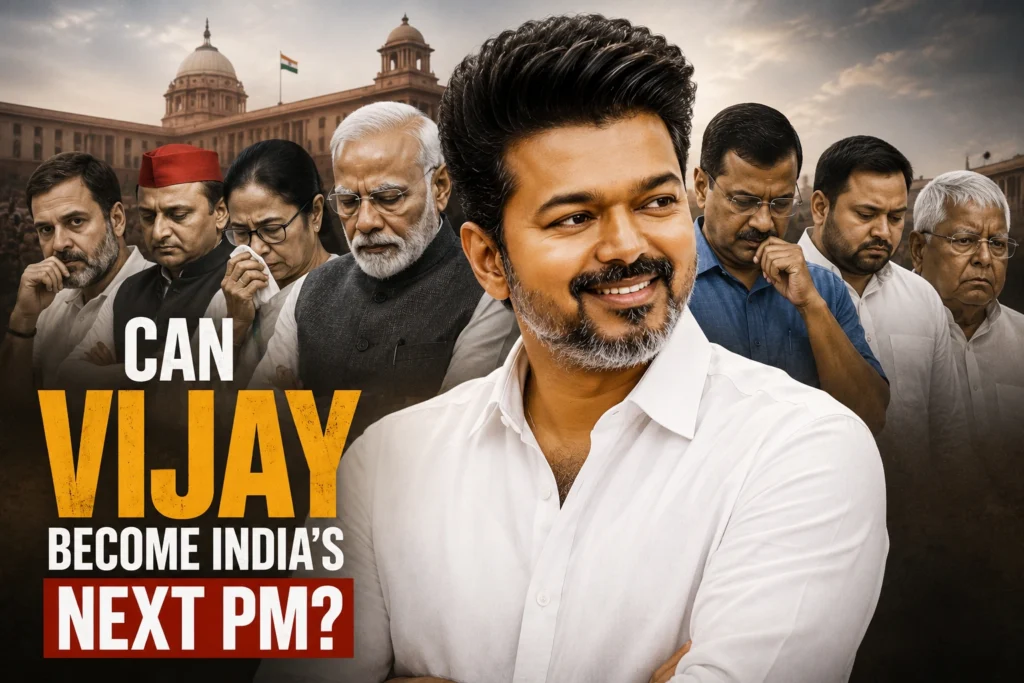
Ever since Vijay entered active politics and later rose to become Chief Minister of Tamil Nadu, one question has repeatedly surfaced among supporters, political observers, and social media users: Can Vijay become the next Prime Minister of India?
It is a question driven by curiosity, popularity, and political imagination. Throughout Indian political history, several leaders who initially built their influence at the state level eventually emerged as major national figures. This has naturally led many people to wonder whether Vijay could follow a similar path in the future.
The discussion has become even more intense because of Vijay’s massive fan following, strong public image, and unique journey from cinema superstar to elected leader. Unlike many politicians who spend decades climbing the political ladder, Vijay entered politics with a level of public recognition that most leaders can only dream of achieving.
However, becoming the Prime Minister of India is one of the most difficult political achievements in the world. It requires far more than popularity in a single state. It demands national acceptance, political alliances, governance experience, economic credibility, and the ability to connect with people across diverse regions and cultures.
While nobody can accurately predict the future of politics, examining the possibility provides an interesting insight into both Vijay’s potential and the realities of Indian democracy.
Why People Are Asking This Question
The idea of Vijay becoming Prime Minister is not emerging from nowhere. It is largely driven by the remarkable scale of his popularity.
For decades, Vijay built one of the most loyal fan bases in Indian cinema. His films consistently attracted massive audiences, and his influence extended far beyond entertainment. Many fans viewed him as more than an actor; they saw him as a role model, a public figure, and eventually a political leader.
After entering politics and becoming Chief Minister, the conversation naturally evolved. Supporters began asking what his ultimate political destination might be. Since the Prime Minister’s office represents the highest executive position in the country, speculation about his future ambitions became inevitable.
Social media has amplified these discussions significantly. Every successful initiative, public appearance, or governance decision often leads to conversations about whether Vijay’s influence could eventually extend beyond Tamil Nadu.
The Strength of Vijay’s Popularity
One factor that makes the discussion interesting is the extraordinary scale of Vijay’s popularity.
Few political leaders begin their careers with millions of dedicated supporters already familiar with their public image. Years of cinema success helped Vijay establish emotional connections with audiences across multiple generations.
This popularity provides several advantages. Public recognition reduces the need to introduce oneself to voters. Media attention is easier to attract. Political messages often spread more rapidly. Supporters are generally more enthusiastic about volunteering and campaigning.
However, popularity alone is not enough to win national elections. History has shown that fame can create opportunities, but governance and political strategy ultimately determine long-term success.
The challenge is transforming popularity into broad political trust across different regions of India.
The Importance of Performance as Chief Minister
Before any discussion about becoming Prime Minister can be taken seriously, Vijay’s performance as Chief Minister will remain the most important factor.
Indian voters often judge national leaders based on their administrative track record. Successful governance at the state level can become a powerful foundation for national ambitions.
If Vijay’s administration delivers measurable improvements in infrastructure, employment, healthcare, education, investment, public safety, and economic growth, his reputation could expand significantly beyond Tamil Nadu. Effective governance creates credibility, and credibility is essential for any leader seeking national influence.
On the other hand, if major challenges remain unresolved, it becomes much more difficult to convince voters across the country that a leader is ready for a larger role.
For this reason, many political analysts believe that the next several years of governance will be more important than any political speculation.
Can Vijay Appeal Beyond Tamil Nadu?
One of the biggest challenges facing any regional leader is expanding support beyond their home state.
Tamil Nadu has a unique political culture, strong regional identity, and distinct electoral priorities. Success within the state does not automatically translate into national popularity.
To become Prime Minister, Vijay would need to build support among voters in northern India, western India, eastern India, and the northeast. He would need to address issues that affect farmers in Punjab, entrepreneurs in Gujarat, professionals in Bengaluru, industrial workers in Maharashtra, and countless other communities.
This requires a national vision that resonates across linguistic, cultural, and regional boundaries.
The ability to connect with a diverse electorate is often what separates successful regional leaders from successful national leaders.
Lessons From Other Leaders
Indian politics offers several examples of leaders who started as state-level figures before gaining national influence.
Many Prime Ministers and national leaders first established strong reputations through governance within their respective states. Their rise was not based solely on popularity but on administrative achievements, political organisation, and the ability to communicate a broader vision for the country.
These examples demonstrate that the path from regional leadership to national leadership is possible. However, it is also extremely demanding and requires years of sustained political effort.
Vijay would need to demonstrate not only popularity but also policy expertise, coalition-building ability, and strategic leadership at a national scale.
The Challenge of National Politics
National politics operates very differently from state politics.
A Prime Minister must address foreign policy, defence, international trade, economic strategy, national security, energy policy, climate challenges, technological development, and relations with multiple states.
These responsibilities require extensive administrative experience and a strong team of advisors. Leaders must make decisions that affect more than a billion citizens across highly diverse circumstances.
For Vijay, transitioning from state leadership to national leadership would involve developing expertise across a much broader range of policy areas.
This is not impossible, but it represents one of the largest challenges on the path toward becoming Prime Minister.
The Role of Political Alliances
India’s political system often rewards leaders who can build strong alliances.
Even highly popular leaders frequently rely on coalitions, partnerships, and strategic relationships to achieve national success. Political influence is rarely built by one individual alone.
If Vijay were ever to pursue national leadership, his ability to work with regional parties, national organisations, and political allies would become increasingly important.
Building alliances requires negotiation, compromise, and long-term relationship management. These skills are often just as important as public popularity.
The future of any national ambition would therefore depend not only on Vijay’s personal appeal but also on the strength of his political network.
Why Supporters Believe It Is Possible
Supporters point to several factors that make the idea attractive.
They highlight his enormous popularity, strong communication skills, public image, and ability to connect emotionally with ordinary citizens. Many believe that his transition from cinema to politics demonstrates leadership qualities that could eventually resonate at a national level.
Supporters also argue that Indian politics has repeatedly shown that unconventional leaders can achieve extraordinary success when they successfully connect with public aspirations.
From their perspective, it is too early to place limits on what Vijay may achieve in the future.
Why Critics Remain Skeptical
Critics argue that becoming Prime Minister requires much more than popularity and public goodwill.
They point out that national leadership demands extensive experience in governance, economics, diplomacy, and coalition politics. They also note that India is an incredibly diverse country with complex political dynamics.
According to this perspective, Vijay must first demonstrate long-term success as Chief Minister before any serious discussion about national leadership can occur.
Critics believe that performance, rather than popularity, should remain the primary measure of political potential.
What Would Need to Happen First?
Before Vijay could realistically emerge as a Prime Ministerial contender, several developments would likely need to occur.
His administration would need to establish a strong governance record. Economic indicators would need to show progress. Public services would need to improve. National recognition would need to grow beyond his existing fan base. Political alliances would need to expand. Most importantly, he would need to develop a compelling national vision that appeals to voters across India.
These steps would not happen overnight. They would likely require years of consistent political work and administrative success.
The journey from Chief Minister to Prime Minister is possible, but it is rarely quick.
Who Could Become India’s Next Prime Minister If Not Vijay?
You can add a heading near the end of the article:
Narendra Modi
As the current Prime Minister and one of the most influential political leaders in modern Indian history, Narendra Modi would naturally remain a major contender if he chooses to continue in national politics. His leadership experience, nationwide recognition, and strong political network make him one of the most significant figures in any discussion about India’s future leadership.
Yogi Adityanath
The Chief Minister of Uttar Pradesh is frequently mentioned by political analysts and supporters as a potential future national leader. His administrative experience in India’s most populous state and his strong support base have made him one of the most discussed names in succession debates.
Rahul Gandhi
As one of the most prominent opposition leaders, Rahul Gandhi remains a key figure in national politics. While his supporters see him as a potential future Prime Minister, critics continue to debate his leadership style and electoral performance. Regardless of opinion, his name is almost always part of discussions about future Prime Ministerial candidates.
Other Emerging Leaders
India’s political landscape is constantly evolving. Several regional leaders and Chief Ministers across different states may emerge as national contenders in the coming years. Political history has shown that unexpected leaders can rise rapidly based on governance performance and public support.
Where Does Vijay Fit Into This Discussion?
Vijay’s name enters this conversation because of his enormous popularity, growing political influence, and the attention generated by his governance style. However, unlike the leaders mentioned above, his national political journey is only beginning. The coming years as Chief Minister will likely determine whether he remains a powerful regional leader or develops into a figure with broader national appeal.
Conclusion
Can Vijay become the next Prime Minister of India? The honest answer is that nobody knows.
Politics is constantly evolving, and history has repeatedly shown that unexpected leaders can rise to extraordinary positions. Vijay already possesses qualities that many politicians would envy, including widespread recognition, public support, and a strong personal brand.
At the same time, becoming Prime Minister requires far more than popularity. It demands proven governance, national appeal, political alliances, policy expertise, and the ability to unite diverse communities behind a shared vision.
For now, Vijay’s immediate focus remains his role as Chief Minister and the responsibilities that come with governing Tamil Nadu. The success or failure of that leadership journey will likely determine whether future discussions about national leadership become realistic possibilities or remain political speculation.
One thing is certain: as long as Vijay continues to attract public attention and political interest, the question of whether he could one day become Prime Minister will remain one of the most fascinating topics in Indian politics.
FAQs
Can a Chief Minister become Prime Minister of India?
Yes. Several national leaders have previously served as Chief Ministers before taking on larger roles in national politics.
Does Vijay have national-level popularity?
Vijay enjoys significant recognition across India because of his successful film career, although political popularity can differ from entertainment popularity.
What is the biggest challenge Vijay would face in becoming Prime Minister?
Building support beyond Tamil Nadu and establishing strong national political influence would be among the biggest challenges.
Is there any indication that Vijay plans to become Prime Minister?
There is currently no confirmed indication. Most discussions on the subject are based on public speculation and political analysis.
What will determine Vijay’s future political growth?
His performance as Chief Minister, governance achievements, public trust, political alliances, and ability to develop a national vision will all play important roles.