|
Getting your Trinity Audio player ready...
|
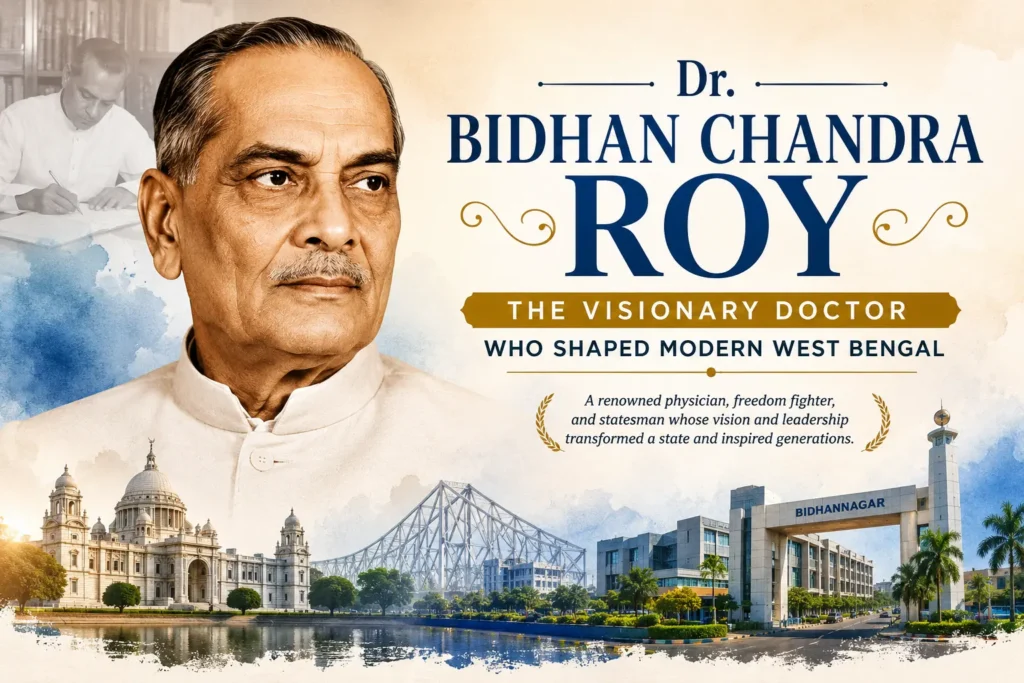
Every year on July 1, India remembers one of its most respected physicians, freedom fighters, and political leaders—Bidhan Chandra Roy. His contributions to medicine, public health, education, and governance continue to inspire generations of Indians.
Interestingly, Dr. Roy was born on July 1, 1882, and passed away on the same date in 1962. In recognition of his extraordinary contributions to the medical profession, India celebrates National Doctors’ Day on July 1 every year in his honour.
More than six decades after his passing, Dr. Bidhan Chandra Roy remains a symbol of service, dedication, and nation-building.
Early Life and Education
Bidhan Chandra Roy was born on July 1, 1882, in Patna, which was then part of British India. He belonged to a family that deeply valued education and public service. From an early age, he demonstrated exceptional academic abilities and a strong commitment to helping others.
After completing his schooling, he pursued higher education in medicine. His determination and talent eventually led him to the United Kingdom, where he studied at the prestigious St Bartholomew’s Hospital in London.
Despite facing numerous challenges, including financial difficulties and institutional barriers, he successfully earned qualifications from both the Royal College of Physicians and the Royal College of Surgeons, a remarkable achievement for an Indian student during that era.
A Distinguished Medical Career
After returning to India, Dr. Roy quickly established himself as one of the country’s most respected physicians. His medical expertise, compassionate approach, and dedication to patient care earned him widespread admiration.
He believed that healthcare should be accessible to all sections of society, regardless of economic status. Throughout his career, he worked tirelessly to improve medical facilities and healthcare standards.
Dr. Roy was also associated with several educational and healthcare institutions. He played an important role in developing medical education and encouraging young doctors to combine professional excellence with social responsibility.
Participation in India’s Freedom Movement
Like many prominent leaders of his time, Dr. Roy actively supported India’s struggle for independence. He worked closely with leaders of the Indian National Congress and participated in various national movements.
His association with Mahatma Gandhi significantly influenced his philosophy of public service. Gandhi valued Dr. Roy’s medical expertise and often sought his advice on health-related matters.
Although medicine remained his primary profession, Dr. Roy strongly believed that nation-building required active participation in public affairs.
Becoming the Chief Minister of West Bengal
One of the most significant chapters of Dr. Roy’s life began when he entered active politics. In 1948, he became the Chief Minister of West Bengal, a position he held until his death in 1962.
His tenure came at a particularly challenging time. India had recently gained independence, and the country was dealing with the social and economic consequences of Partition. West Bengal faced enormous challenges, including refugee rehabilitation, housing shortages, unemployment, and infrastructure development.
Dr. Roy approached these issues with vision and determination, focusing on long-term development rather than short-term solutions.
Transforming West Bengal Through Development
During his leadership, several major development initiatives were launched that helped shape modern West Bengal.
He played a key role in the development of important urban centres and industrial regions, including:
- Durgapur
- Bidhannagar (popularly known as Salt Lake City)
- Kalyani
- Ashoknagar
These projects contributed significantly to industrial growth, planned urban development, and employment generation.
His vision extended beyond city planning. He also focused on improving healthcare facilities, educational institutions, transportation infrastructure, and public services.
Contributions to Healthcare and Medical Education
Dr. Roy’s influence on healthcare extended far beyond his own medical practice.
He was instrumental in promoting:
- Better medical education
- Expansion of hospitals and healthcare services
- Professional standards in medicine
- Public health awareness
- Training of future healthcare professionals
Many hospitals, medical colleges, and institutions across India continue to honour his legacy and principles.
His belief that healthcare should serve society remains highly relevant even today as India continues to strengthen its healthcare infrastructure.
Bharat Ratna Award
In recognition of his exceptional service to the nation, Dr. Bidhan Chandra Roy was awarded the prestigious Bharat Ratna in 1961.
The award acknowledged his extraordinary achievements in medicine, public administration, education, and social service.
Receiving the Bharat Ratna placed him among the most distinguished personalities in Indian history.
Why National Doctors’ Day Is Celebrated on July 1
National Doctors’ Day in India is celebrated every year on July 1 to honour Dr. Bidhan Chandra Roy’s contributions to medicine and public service.
The occasion serves as a reminder of the dedication shown by doctors who work tirelessly to protect public health and save lives.
Hospitals, medical colleges, healthcare organisations, and government institutions across the country observe the day through events, awareness programmes, and tributes to medical professionals.
Dr. Roy’s Enduring Legacy
More than sixty years after his passing, Dr. Bidhan Chandra Roy’s legacy remains visible in many aspects of Indian society.
His life demonstrated that professional excellence and public service can go hand in hand. Whether as a physician, educator, freedom fighter, or Chief Minister, he consistently prioritised the welfare of people.
His contributions continue to inspire doctors, administrators, students, and leaders who aspire to create meaningful change in society.
As India celebrates National Doctors’ Day each year, the nation not only honours its medical community but also remembers a remarkable individual whose vision helped shape modern India.
Conclusion
Dr. Bidhan Chandra Roy was much more than a renowned doctor. He was a nation-builder, a visionary administrator, and a compassionate leader who dedicated his life to serving others. His achievements in healthcare, education, urban development, and public administration continue to influence India today.
On his birth anniversary and National Doctors’ Day, remembering Dr. Roy is an opportunity to reflect on the values of service, integrity, and commitment that defined his extraordinary life.
FAQs
Who was Dr. Bidhan Chandra Roy?
Dr. Bidhan Chandra Roy was a renowned physician, freedom fighter, and former Chief Minister of West Bengal.
Why is National Doctors’ Day celebrated on July 1?
India celebrates National Doctors’ Day on July 1 to honour the birth and legacy of Dr. Bidhan Chandra Roy.
When was Dr. Bidhan Chandra Roy born?
He was born on July 1, 1882, in Patna, British India.
What award did Dr. Roy receive?
He was awarded the Bharat Ratna in 1961 for his outstanding contributions to the nation.
What are Dr. Roy’s major contributions?
His major contributions include advancements in healthcare, medical education, urban development, and governance in West Bengal.