|
Getting your Trinity Audio player ready...
|

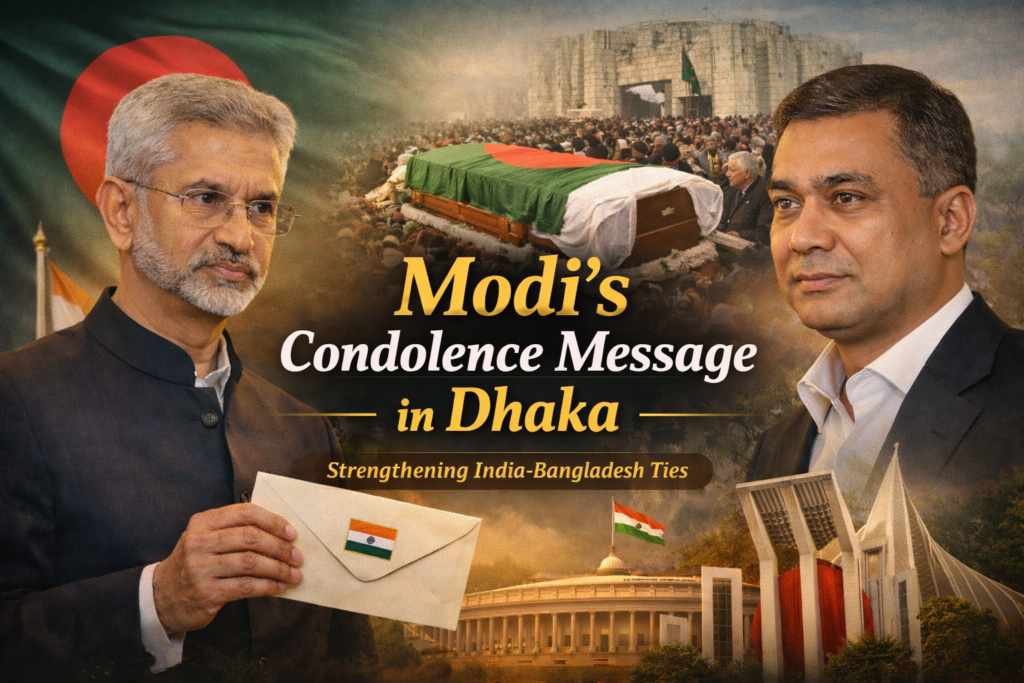
India’s diplomatic engagement in South Asia often unfolds quietly, yet its impact is long-lasting. One such moment was witnessed in Dhaka when India’s External Affairs Minister S. Jaishankar attended the funeral of former Bangladesh Prime Minister Khaleda Zia and delivered a condolence message from Prime Minister Narendra Modi.
At first glance, the visit appeared ceremonial. However, when examined closely, it revealed a carefully calibrated diplomatic signal that extended well beyond condolences. It reflected India’s intent to remain engaged with Bangladesh across political lines while reinforcing mutual respect during a sensitive transition.
The End of a Political Era in Bangladesh
Khaleda Zia’s passing marked the conclusion of one of the most influential chapters in Bangladesh’s political history. As the country’s first woman prime minister, she shaped national politics for decades and remained a defining force even during periods of political turbulence. Her leadership style, mass appeal, and political resilience made her a central figure in Bangladesh’s democratic evolution.

Over the years, Khaleda Zia symbolised opposition politics and democratic assertion. While her tenure faced criticism and controversy, her contribution to Bangladesh’s political identity cannot be ignored. Therefore, her funeral was not merely a family event—it became a national moment of reflection. Thousands gathered in Dhaka, cutting across political affiliations, to pay their last respects.
Consequently, the presence of Indian leadership at such a moment carried symbolic and strategic weight.
India’s Diplomatic Presence at the Funeral
India’s decision to send External Affairs Minister S. Jaishankar to Dhaka demonstrated seriousness and respect. Rather than opting for a routine diplomatic representative, New Delhi chose a senior minister, underlining the importance it attached to the moment.
During the visit, Jaishankar personally handed over Prime Minister Modi’s condolence letter to Tarique Rahman, Khaleda Zia’s son and the acting leader of the Bangladesh Nationalist Party. The message conveyed sympathy to the bereaved family and acknowledged Khaleda Zia’s role in shaping Bangladesh’s political journey.
Importantly, the interaction was dignified and restrained. There were no political statements, no joint briefings, and no overt messaging. Yet, the gesture spoke clearly: India recognises the legacy of Khaleda Zia and respects the sentiments of the Bangladeshi people.
Why the Meeting with BNP Leadership Matters
Diplomacy often communicates more through actions than words. By meeting the BNP leadership at such a sensitive time, India sent a subtle but unmistakable signal of political balance.
Traditionally, India’s relationship with Bangladesh has been viewed through the lens of engagement with the ruling establishment. However, Bangladesh’s political landscape is dynamic, and future leadership configurations remain open. In this context, India’s willingness to engage respectfully with opposition leadership enhances its credibility as a regional partner.
Moreover, this outreach reinforces India’s image as a country that supports democratic continuity rather than political convenience. It shows that New Delhi does not limit its engagement to power corridors alone but also values institutional and people-centric relationships.
The Strategic Timing of Modi’s Condolence Message
Timing, in diplomacy, is everything. The condolence message from Prime Minister Modi arrived at a moment when Bangladesh is preparing for significant political developments. Emotions were high, public attention was intense, and political narratives were being shaped.
By choosing empathy over politics, India avoided the risk of appearing opportunistic. Instead, it demonstrated maturity and restraint. This approach strengthens long-term trust and ensures that future dialogue rests on mutual respect rather than transactional diplomacy.
Furthermore, Modi’s message acknowledged Khaleda Zia’s role without entering ideological debates. This balance ensured that the message resonated widely without alienating any section of Bangladeshi society.
India–Bangladesh Relations Beyond Governments
India and Bangladesh share more than formal diplomatic ties. History, culture, language, and people-to-people connections bind the two nations deeply. Therefore, moments of transition in either country often have emotional and political resonance across borders.
By participating in a national moment of mourning, India reaffirmed that its relationship with Bangladesh goes beyond administrations and electoral cycles. It reinforced the idea that India values continuity, stability, and mutual respect.
This approach becomes especially important in South Asia, where political shifts can rapidly alter diplomatic equations. India’s measured response positions it as a steady and dependable neighbour.
A Message to the Region
Beyond Bangladesh, the visit sent a broader regional message. South Asian countries closely observe how India navigates political transitions in neighbouring nations. By engaging respectfully during a moment of loss, India projected itself as a mature regional power that prioritises stability over short-term gains.
This matters because regional diplomacy today demands emotional intelligence as much as strategic calculation. India’s conduct in Dhaka showcased both.
What This Means for the Future
Looking ahead, this diplomatic gesture may not lead to immediate policy changes or announcements. However, its value lies in relationship-building. Trust accumulated during moments of sincerity often pays dividends during negotiations and cooperation in the future.
Whether Bangladesh’s political trajectory shifts or remains steady, India has positioned itself as a partner willing to engage constructively with all stakeholders. This flexibility strengthens India’s long-term strategic interests while maintaining goodwill among the Bangladeshi public.
Conclusion
Modi’s condolence message in Dhaka was not a routine diplomatic exercise. It was a carefully considered act of respect, empathy, and foresight.
Through S. Jaishankar’s presence and the delivery of the condolence letter, India honoured a towering political figure, acknowledged Bangladesh’s moment of grief, and quietly reinforced its commitment to balanced regional engagement. In a region where diplomacy often makes headlines through confrontation, this gesture stood out for its calm precision.
Ultimately, this episode reaffirmed a simple truth of diplomacy: when respect leads the way, influence follows naturally.