|
Getting your Trinity Audio player ready...
|

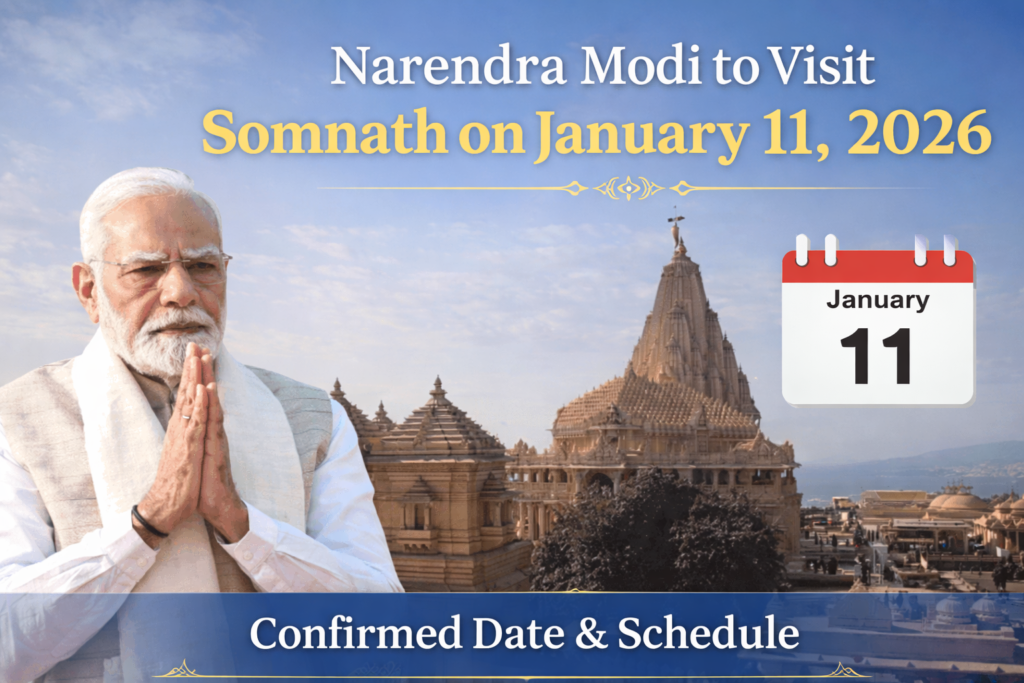
India’s spiritual focus will turn toward Somnath as Narendra Modi is scheduled to visit the iconic temple on January 11, 2026. This visit forms the concluding highlight of the Somnath Swabhiman Parv, a multi-day event celebrating the temple’s thousand-year legacy of resilience, faith, and cultural pride.
More than a ceremonial appearance, the visit reflects a deeper connection between leadership, heritage, and national identity.
📅 Confirmed Visit Date
- Date: January 11, 2026
- Location: Somnath Temple, Prabhas Patan, Gujarat
The visit has been officially confirmed and is expected to draw a large gathering of devotees, dignitaries, and local residents.

🕉️ Narendra Modi’s Visit Schedule (Reported)
While exact timings are finalized closer to the visit, the broad schedule is as follows:
- January 10, 2026 (Evening):
Arrival in Somnath region and administrative briefing - January 11, 2026 (Early Morning):
Darshan and traditional rituals at Somnath Temple, including special पूजा and ध्वज पूजा - January 11, 2026 (Morning):
Participation in Somnath Swabhiman Parv ceremonies
Interaction with temple trust members and local officials - January 11, 2026 (Late Morning):
Address to devotees and attendees highlighting Somnath’s historical and cultural importance - January 11, 2026 (Afternoon):
Departure for other official engagements in Gujarat
This schedule highlights a balanced focus on spirituality, public interaction, and governance.
Why the Somnath Visit Matters
Somnath is not just a religious destination. It represents India’s civilizational continuity. As the first of the twelve Jyotirlingas of Lord Shiva, the temple has been destroyed and rebuilt multiple times across centuries. Each reconstruction symbolized renewal and collective resolve.
By visiting Somnath, Modi reinforces a narrative of cultural confidence—where heritage and modern leadership coexist. The visit sends a clear message that development does not replace tradition; instead, it draws strength from it.
Cultural and Political Context
Modi’s association with Gujarat runs deep. His years as Chief Minister shaped the state’s infrastructure, tourism, and cultural branding. Somnath, in particular, became a focal point for spiritual tourism and heritage-led development.
This visit continues that legacy. It also aligns with a broader national approach that places cultural revival at the center of India’s growth story.
Security and Preparations
Authorities have intensified security arrangements in and around Somnath. Local administration and security agencies are jointly managing crowd movement, regulating traffic, and coordinating activities across the temple परिसर.
At the same time, authorities are preparing the temple area to smoothly handle the expected increase in devotee footfall. Cleanliness drives, facility checks, and logistical planning are already underway.
Impact on Spiritual Tourism
High-profile visits to Somnath traditionally lead to a surge in pilgrim arrivals. This benefits local businesses, hospitality services, and transport providers. In the longer term, it strengthens Gujarat’s position as a major spiritual tourism hub.
Such visits also reinforce India’s image globally as a nation deeply rooted in living traditions.
Public Sentiment
Public response to the announcement has been largely positive. Devotees view the visit as a moment of pride, while supporters see it as reaffirmation of cultural values. Anticipation around January 11 continues to build across Gujarat and beyond.
Conclusion
Narendra Modi’s visit to Somnath on January 11, 2026, stands at the intersection of faith, history, and leadership. Anchored in spirituality yet framed by governance, the visit reflects a vision where India’s past informs its future.
As Somnath prepares to welcome the Prime Minister, the temple once again becomes a symbol—not only of devotion, but of a nation confident in its civilizational identity.