|
Getting your Trinity Audio player ready...
|
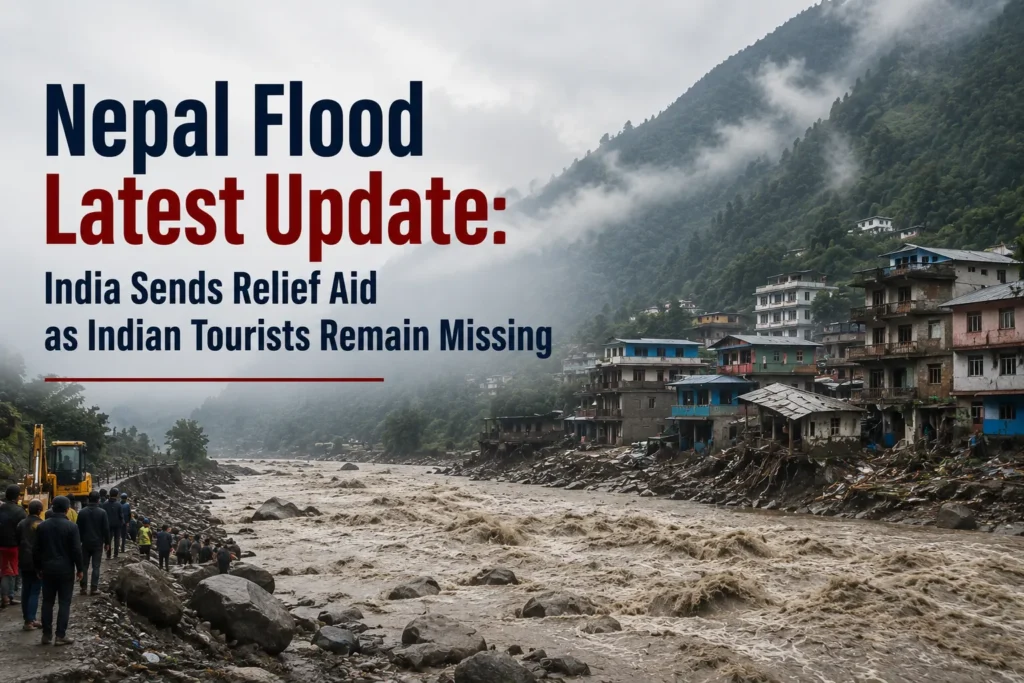
Nepal Flood Latest Update: A devastating flash flood along the Nepal-China border has left a trail of destruction across Nepal’s Himalayan region, with the death toll rising sharply and hundreds of people still unaccounted for.
The disaster struck the Rasuwa district near the Tibet border on August 26 after a sudden surge of water swept through villages, roads, bridges and infrastructure projects along the Bhote Koshi river system.
Among those missing are Indian nationals, including people travelling towards Tibet for the Kailash Mansarovar pilgrimage. India has also stepped up its humanitarian response, sending relief material to Nepal while coordinating with authorities regarding missing and stranded Indian citizens.
Nepal Flood Latest Update: What Happened?
A massive flash flood hit Nepal’s Rasuwa region near the China border on Wednesday, August 26.
The floodwaters surged through the Bhote Koshi river, devastating areas including Timure and Syafrubesi. Vehicles, buildings, roads and project sites were swept away or badly damaged.
The initial reports described the event simply as a flash flood, but later assessments pointed towards a possible glacial or ice-rock avalanche as a major trigger. A magnitude 4.4 earthquake was also recorded in the region, and experts said it may have contributed to the instability that led to the disaster. The precise sequence of events continues to be assessed.
The disaster was particularly destructive because the mountainous terrain funnelled a huge volume of water, mud, rocks and debris through narrow valleys.
Nepal Flood Death Toll Rises
The death toll has increased significantly as rescue teams have reached more affected areas.
The latest reports available on August 27 put the combined death toll at around 160 people, including deaths reported in Nepal and Tibet. Hundreds of others remain missing.
Authorities have warned that the toll could change as search-and-rescue operations continue and previously inaccessible areas are reached.
The disaster has also damaged important infrastructure, including roads, bridges, hydropower facilities and communications networks, making rescue operations more difficult.
Indian Tourists and Pilgrims Missing in Nepal
One of the biggest concerns for India is the number of Indian citizens who remain unaccounted for.
NDTV’s latest update on August 27 reported that 133 Indians were among those missing after the floods. Many of the affected Indians are believed to be travelling as part of the Kailash Mansarovar pilgrimage route towards Tibet.
However, the numbers remain fluid.
Nepal’s Foreign Minister Shishir Khanal was separately quoted by NDTV as saying that nearly 300 Indian nationals, mostly Mansarovar pilgrims, were reported missing. This difference highlights that authorities are still trying to reconcile passenger lists, pilgrimage groups and people who have lost communication because of the disaster.
Therefore, the exact number of missing Indian citizens should be treated as provisional until authorities complete verification.
Why Were So Many Kailash Mansarovar Pilgrims in the Area?
The affected region is an important route for people travelling towards Tibet, including pilgrims heading for Mount Kailash and Mansarovar.
Several groups were travelling through Nepal before continuing towards Tibet. When the sudden flood destroyed roads and disrupted communications, authorities and families lost contact with a number of these groups.
Reports have identified several Indian groups among those affected, including travellers from different states.
The lack of roads, electricity and communication networks has made it difficult for authorities to immediately determine whether missing people are dead, stranded or simply unable to communicate.
India Sends Relief Aid to Flood-Hit Nepal
India has responded to the disaster by sending emergency relief supplies to Nepal.
According to reports, India dispatched 10 metric tonnes of disaster-relief material, including:
- Emergency shelters
- Blankets
- Hygiene supplies
- Solar lamps
- Medicines and medical supplies
The relief effort is intended to support Nepal’s immediate rescue and recovery operations following the devastating floods.
India has also been closely monitoring the situation involving its citizens in Nepal.
Indian Air Force and NDRF on Standby
India has also prepared additional resources in case Nepal requests further assistance.
Reports said the Indian Air Force is prepared for relief and rescue operations, while the National Disaster Response Force has been kept on standby.
This could allow India to provide additional logistical, medical or evacuation support if requested by Nepalese authorities.
The immediate priority remains locating missing people and providing assistance to those stranded in remote areas.
Rescue Operations Continue in Nepal
Nepal has deployed its security and disaster-response forces to the affected areas.
The Nepal Army, Armed Police Force and Nepal Police have been involved in rescue and relief operations. Helicopters are being used where roads have been destroyed or blocked.
Rescue work remains extremely challenging because of:
- Destroyed roads and bridges
- Landslides
- Heavy debris
- Damaged communication networks
- Difficult Himalayan terrain
- Continuing risks near rivers and unstable slopes
Earlier reports said more than 100 people had already been rescued by helicopter from some affected areas.
What Caused the Nepal Flash Flood?
The exact cause is still being investigated.
Early reports linked the disaster to an earthquake and landslide. However, subsequent expert assessments have pointed towards a possible ice or glacier-related avalanche that may have blocked a river before releasing a massive surge of water.
CNN’s reporting cited a Nepalese environmental expert who said an ice avalanche may have blocked the river and caused a sudden release of water. The expert also noted that warmer temperatures and glacier instability could have contributed to the event.
The US Geological Survey later identified the seismic event as a 4.4-magnitude earthquake, while other assessments continued to examine whether the earthquake triggered the avalanche or whether the two events were connected.
Therefore, it is safer to describe the disaster as a glacial/ice-rock avalanche-related flash flood under investigation, rather than stating that an earthquake alone caused it.
Areas Worst Hit by the Flood
The Rasuwa district has suffered severe damage, particularly around Timure and Syapru Besi.
The flood also affected other parts of Nepal’s central region, with reports of destruction and casualties in areas including Nuwakot and Dhading.
The Bhote Koshi river system was at the centre of the disaster, while the river eventually connects to the wider Trishuli-Gandak river system flowing towards India.
Roads and Transport Severely Affected
Several roads and highways have been damaged or closed following the disaster.
This has created major difficulties for rescue teams attempting to reach remote communities.
The destruction of bridges and roads is also affecting cross-border movement and trade routes between Nepal and China.
Authorities are working to restore access wherever possible while continuing search-and-rescue operations.
Nepal Flood Latest Update: What We Know So Far
Here are the key developments as of August 27, 2026:
| Category | Latest Information |
| Disaster | Massive flash floods in Nepal’s Himalayan border region |
| Main affected area | Rasuwa and surrounding districts |
| Border | Nepal-China/Tibet border |
| River system | Bhote Koshi |
| Death toll | Around 160 reported across Nepal and Tibet |
| People missing | Hundreds |
| Indian nationals missing | At least 133 in the latest NDTV update; other Nepalese estimates are higher |
| Many affected Indians | Kailash Mansarovar pilgrims |
| India’s relief aid | 10 metric tonnes of emergency supplies |
| Indian rescue support | IAF prepared; NDRF on standby |
| Nepal rescue forces | Nepal Army, Armed Police Force and Nepal Police |
| Major damage | Roads, bridges, villages, hydropower and communications |
| Possible cause | Ice/glacier-rock avalanche and river surge; earthquake connection under investigation |
Are Indian Tourists Safe in Nepal?
Not all Indian tourists in Nepal are affected by the disaster.
The missing-person reports are concentrated around the flood-affected border region, particularly among travellers and pilgrims whose routes passed through the affected areas.
Authorities are still working to identify and locate people who have lost communication.
Families of missing travellers should rely on updates from the Indian Embassy in Kathmandu, Nepalese authorities and official state government channels, rather than unverified social-media posts.
India-Nepal Relief and Rescue Efforts
India and Nepal are coordinating on the humanitarian response.
India’s immediate assistance includes emergency relief material, while its defence and disaster-response agencies are prepared to provide additional support if required.
The international response is also growing, with China, the United States, the European Union, the Red Cross and United Nations agencies among those offering or mobilising assistance.
What Happens Next?
The immediate priorities for Nepal are:
- Finding people who remain missing.
- Rescuing stranded residents and tourists.
- Providing food, water, shelter and medical assistance.
- Restoring roads and communication networks.
- Assessing damage to bridges and hydropower infrastructure.
- Identifying victims and informing their families.
Because many affected locations are difficult to access, authorities are expected to continue aerial and ground search operations.
Nepal Flood Latest Update: Conclusion
The Nepal flash flood disaster has become one of the region’s most serious recent natural emergencies, with around 160 deaths reported and hundreds of people still missing.
Indian citizens are among those affected, including a significant number of Kailash Mansarovar pilgrims. The exact number of missing Indians remains under verification, with different official and media estimates currently being reported.
India has already sent 10 metric tonnes of emergency relief supplies to Nepal and has prepared additional rescue capabilities through the Indian Air Force and NDRF.
Rescue teams in Nepal are continuing their search despite damaged roads, difficult terrain and disrupted communications.
As the situation remains fluid, casualty and missing-person figures may change as authorities gain access to more affected areas.
FAQs
1. What happened in Nepal on August 26, 2026?
A massive flash flood swept through Nepal’s Rasuwa region near the Tibet border, destroying villages, roads, bridges and infrastructure.
2. How many people died in the Nepal floods?
The latest reports available on August 27 put the combined death toll at around 160, although figures may change as rescue teams reach more areas.
3. How many Indians are missing in Nepal?
The latest NDTV update reported 133 missing Indian nationals, while Nepal’s Foreign Minister gave a separate estimate of nearly 300 Indians. Authorities are still verifying the numbers.
4. Are Kailash Mansarovar pilgrims among the missing?
Yes. Several reports indicate that many of the missing Indian nationals were travelling as Kailash Mansarovar pilgrims towards Tibet.
5. Has India sent help to Nepal?
Yes. India has dispatched 10 metric tonnes of disaster-relief supplies, including shelters, blankets, hygiene items, solar lamps and medicines.