|
Getting your Trinity Audio player ready...
|
A new Merchant Discount Rate (MDR) framework will apply to certain UPI merchant transactions above ₹2,000. However, ordinary UPI users will not have to pay a transaction fee for making payments.
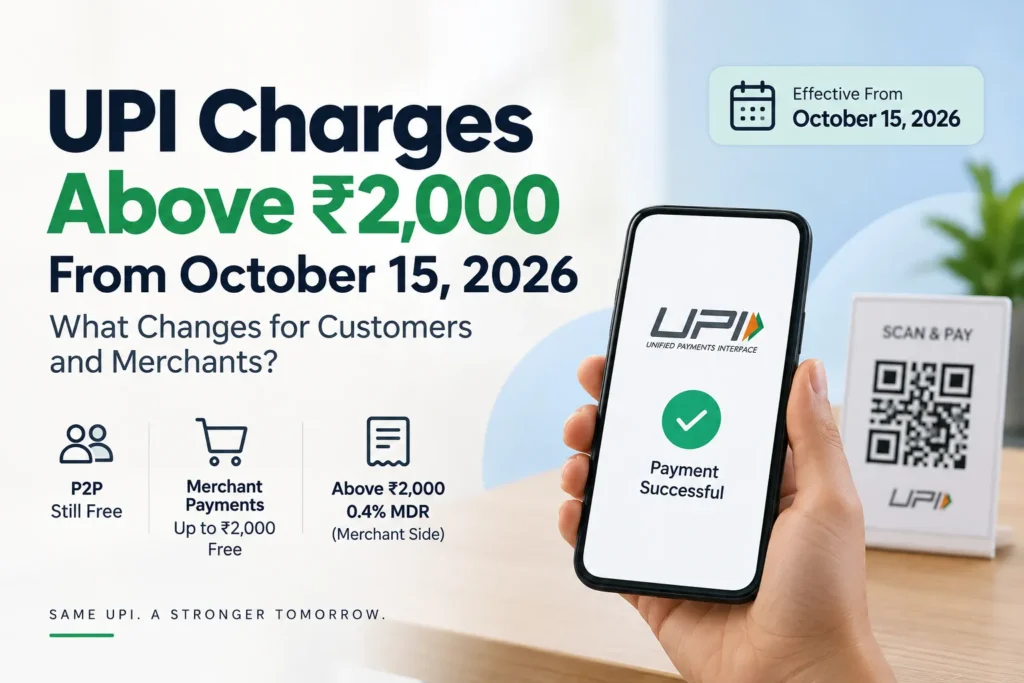
The Government of India clarified on September 15 that UPI will remain free for person-to-person (P2P) transactions, while payments to merchants up to ₹2,000 will also remain free. The new MDR will apply only to specified merchant transactions above the ₹2,000 threshold.
So, does this mean customers will now pay extra when they use UPI for purchases above ₹2,000? No. The MDR applies within the merchant payment ecosystem and is not a customer transaction charge.
UPI Charges From October 15: What Is Changing?
From October 15, 2026, a 0.4% MDR will apply to specified Person-to-Merchant (P2M) UPI transactions above ₹2,000.
For transactions of ₹75,000 or more, the MDR will have a maximum cap of ₹300 per transaction.
The new framework does not introduce a blanket UPI charge for all users.
According to the official clarification, around 96% of merchant UPI transactions will remain unaffected because they either fall below the ₹2,000 threshold or qualify under the zero-MDR framework for small merchants.
Will Customers Have to Pay UPI Charges?
No.
Customers will continue to make UPI payments without a transaction charge. The MDR is a merchant-side charge within the UPI payment ecosystem.
The Government has also advised banks to ensure that merchants do not pass the MDR cost on to customers. UPI application providers cannot impose platform fees or hidden charges on individuals under this framework.
This means that if you scan a QR code and pay a shopkeeper ₹10,000, you will still pay ₹10,000, not ₹10,040 because of the new MDR.
What Happens to UPI Payments Up to ₹2,000?
UPI payments to merchants of up to ₹2,000 will remain free of MDR.
This covers everyday digital payments and keeps the existing zero-MDR structure for small-value merchant transactions.
There is also no change to Person-to-Person payments. You can continue sending money to family members, friends or your own bank account through UPI without a transaction fee, regardless of the amount.
What Is the New 0.4% UPI MDR?
MDR stands for Merchant Discount Rate. It is a charge within the payment ecosystem that gets distributed among participating entities such as banks, payment service providers and UPI application providers.
For eligible merchant transactions above ₹2,000, the standard MDR will be 0.4%.
Here are some simple examples:
| UPI Payment | Applicable MDR |
| ₹2,000 | ₹0 |
| ₹3,000 | ₹12 |
| ₹10,000 | ₹40 |
| ₹50,000 | ₹200 |
| ₹75,000 | ₹300 |
| ₹1,00,000 | ₹300* |
*The MDR is capped at ₹300 for transactions of ₹75,000 and above.
The key point is that these MDR amounts are not additional UPI charges for customers.
Will Small Shops and Street Vendors Pay MDR?
Not necessarily.
The official framework keeps zero MDR for eligible small merchants under the P2PM category.
Small merchants receiving up to ₹1 lakh per month through UPI QR codes under this category can continue to receive payments without MDR. This provision covers eligible street vendors, neighbourhood shops and other small businesses.
This means the new UPI MDR framework does not automatically impose a charge on every small shop accepting a payment above ₹2,000.
Are There Special UPI Charges for Certain Sectors?
Yes.
Certain essential and thin-margin sectors will follow a separate flat MDR structure.
For specified transactions above ₹2,000, including categories such as railways, telecommunications, insurance, fuel and agricultural inputs, the MDR will be ₹5 per transaction.
Capital-market payments will have a separate MDR structure. Payments related to mutual funds, securities, stockbrokers and dealers will attract an MDR of 0.02%, subject to a maximum cap of ₹300 per transaction.
What About UPI Transfers Between Friends and Family?
There is no change.
Person-to-Person UPI transactions will remain completely free, irrespective of the amount transferred.
For example, if you send ₹5,000 to a friend or transfer ₹50,000 between your own linked bank accounts, the new merchant MDR does not apply.
The Government has confirmed that P2P transactions remain outside the MDR framework.
Is ₹2,000 the New UPI Payment Limit?
No.
₹2,000 is not a new UPI payment limit.
It is the threshold used for determining the applicability of the new MDR framework for specified merchant transactions.
The official clarification also states that daily UPI transaction limits set by banks and NPCI are separate security and risk-management measures. They should not be confused with the MDR threshold.
Why Is UPI MDR Being Introduced?
The new MDR framework aims to support the long-term sustainability of the UPI ecosystem.
According to the Government, the MDR revenue will support payment ecosystem participants and help fund areas such as payment infrastructure, cybersecurity, innovation and customer service.
The framework also includes a dedicated fund for promoting UPI adoption among small merchants. An amount equivalent to 5% of total MDR collections will go toward this fund.
UPI Charges From October 15, 2026: What Users Need to Know
For most people, the change will have little or no impact on everyday UPI payments.
Here is the simple breakdown:
- P2P UPI payments: Free
- Merchant payments up to ₹2,000: Free
- Eligible small merchants under the zero-MDR framework: Free
- Specified merchant payments above ₹2,000: 0.4% MDR
- Transactions of ₹75,000 or more: MDR capped at ₹300
- Specified essential sectors above ₹2,000: ₹5 flat MDR
- Capital-market transactions: 0.02% MDR, capped at ₹300
- Customer transaction fee: No charge
Conclusion
The new UPI rules from October 15, 2026, do not mean that customers will start paying a UPI fee whenever they make a payment above ₹2,000.
The change mainly introduces an MDR for specified merchant transactions above ₹2,000. Person-to-person UPI payments will remain free, merchant payments up to ₹2,000 will remain free, and eligible small merchants will continue under the zero-MDR framework.
The Government says approximately 96% of P2M transactions will remain unaffected.
So, if you regularly use UPI to send money to friends, family or make everyday purchases, there is no new customer-side UPI transaction charge under this framework.