|
Getting your Trinity Audio player ready...
|
Cancer remains one of the most formidable health challenges of our time. With millions of new cases diagnosed each year worldwide, innovations in treatment are eagerly sought. One of the most eye-catching developments lately comes from Russia: the announcement of a personalized, mRNA-based cancer vaccine called Enteromix, with reported early “100% efficacy” in trials. Let’s dive into what this vaccine claims, how it reportedly works, what remains uncertain, and what it could mean globally — including for India.
What is Enteromix and how did it come about?
According to Russian governmental and research sources:
- Enteromix is described as an mRNA-based vaccine designed to treat (not necessarily prevent) cancer.
- It is reportedly personalized: tailored to each patient’s tumour RNA/mutation profile in order to teach the immune system to recognise and attack those specific cancer cells.
- In December 2024, Russia announced the development of this vaccine and the intention to provide it free of charge to Russian patients starting in early 2025.
- The early trials reportedly involved about 48 volunteers (for a colorectal-cancer target initially) and statements suggest “100% efficacy and safety” in early human trials.
- It was developed by the National Medical Research Radiological Centre (NMRRC) of the Russian Ministry of Health in collaboration with the Engelhardt Institute of Molecular Biology and the Russian Academy of Sciences.
How does it work? The science behind it
Here are some of the claimed mechanisms and features:
- mRNA-platform: Much like mRNA vaccines for viruses (e.g., some COVID-19 vaccines), the idea is to deliver messenger RNA that encodes a protein (or proteins) associated with the patient’s cancer cells. The immune system recognises the protein as “foreign” and mounts a response.
- Personalisation: Each dose is reportedly customised based on the tumour’s molecular profile—so the vaccine is unique to the patient’s tumour. That means it’s less “one-size-fits-all” and more “tailored therapy”.
- Target cancers: The initial version reportedly targets colorectal cancer, with development underway for glioblastoma (brain cancer) and certain melanomas (skin cancers).
- Speed via AI: Russian scientists say they are using artificial intelligence/neural networks to speed up the vaccine design process, possibly reducing the time from tumour profiling to vaccine formulation drastically.
Why is this noteworthy?
- If real and robustly validated, such a vaccine would mark a major shift in oncology: moving from traditional treatments like surgery, chemotherapy and radiation (with heavy side-effects) to more precise immunotherapy approaches.
- The claim of “100% efficacy” in early trials is attention-grabbing and generates hope. Reports say tumour shrinkage and even elimination in some early tests.
- Free distribution in Russia could mean broader access (at least within Russian healthcare) if regulatory approval comes through.
- For countries like India and others with large cancer burdens and limited access to very high-cost therapies, breakthroughs of this nature could, in principle, offer new options in the future.
Key caveats & questions (because science isn’t done yet)
Despite the excitement, there are several important warnings:
- Early data only
- The “100% efficacy” claim is based on early human trials (or perhaps preclinical + small human sample). Early results are often not replicated in larger trials.
- It’s unclear whether results have been peer-reviewed and published in full detail in scientific journals.
- As one commentary on Reddit notes: “There are dozens of clinical trials ongoing testing different modalities of mRNA-based cancer vaccines… Nothing too special here … A big open clinical trial.”
- “Cancer” is not a single disease
- The term “cancer” comprises hundreds of different diseases with different biology. A vaccine effective for colorectal cancer in one setting may not work for lung cancer, pancreatic cancer, etc.
- Claims might be more limited (e.g., colorectal cancer only, specific patient subgroups). Indeed, the Russia reports say the first version is for colorectal cancer.
- Personalised vaccine == complex logistics & cost
- Creating individualized vaccines (one per patient) requires tumour profiling, custom manufacturing, logistics, and regulatory oversight.
- While Russia claims free distribution domestically, scalability globally, especially in low-resource settings, may be challenging.
- Regulatory & transparency issues
- For any medical therapy, independent validation, publication of trial protocols, safety data (including long-term), and regulatory approvals matter. Some commentators caution that the claims may involve state-led optimism/propaganda.
- It will be crucial to see Phase II/III clinical trial data, with larger patient numbers and longer follow-up.
- Not necessarily a “preventive” vaccine
- The reports say this is a therapeutic vaccine (to treat already-existing cancer), not a preventive vaccine like those for HPV or hepatitis B.
What does this mean for India (and the world)?
- In India, where cancer incidence is rising and access to advanced therapies remains uneven, a validated, effective immunotherapy could be transformative.
- However, until data are peer-reviewed and approved, this remains a promise rather than a ready-to-use solution.
- Indian researchers, policymakers, and oncologists will likely watch this development closely; if robust, collaborations or technology transfer could eventually occur.
- Patients & clinicians must maintain realistic expectations: while hopeful, breakthroughs often take years from announcement to broad implementation.
- Regulatory frameworks in India (e.g., by the Drugs Controller General of India) will scrutinize safety, efficacy, cost, manufacturing, and distribution before adoption.
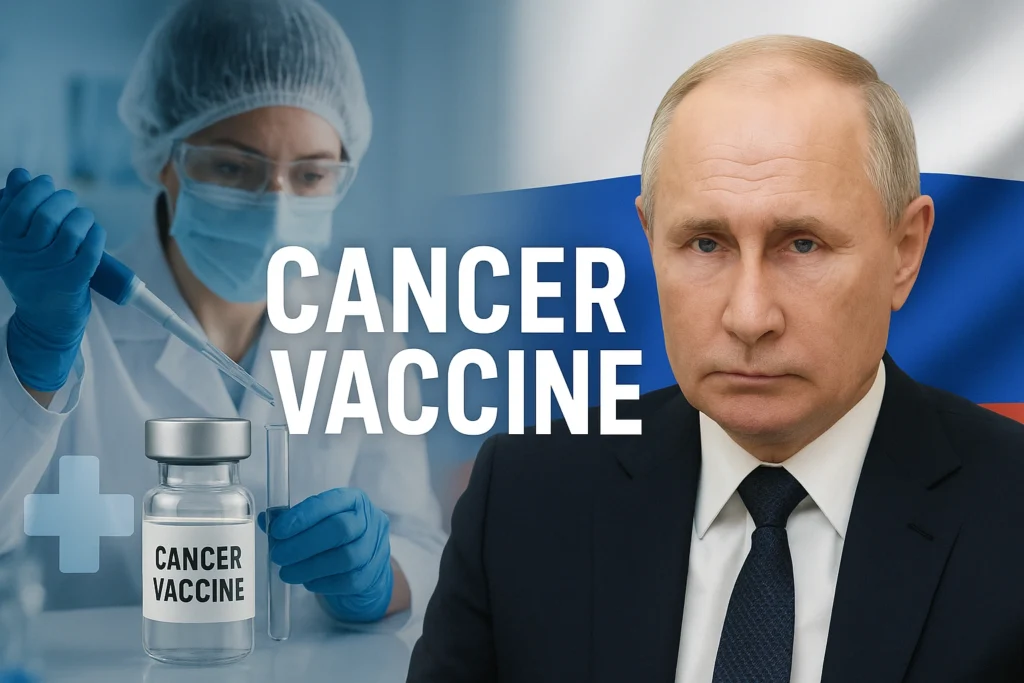
President of Russia: Vladimir Putin’s Reaction
Vladimir Putin has publicly expressed optimism about Russia’s progress toward a cancer vaccine, stating that “we have come very close to the creation of so-called cancer vaccines and immunomodulatory drugs of a new generation.”
He emphasized that the goal is for such therapies to be used “as methods of individual therapy” in the near future, underscoring Russian ambition in personalised medicine.
Final thoughts
The announcement of Russia’s Enteromix cancer vaccine is undeniably exciting. It encapsulates a vision: using cutting-edge mRNA technology + personalised immunotherapy to tackle one of medicine’s toughest problems. If the early results hold up, we could be witnessing the beginning of a new chapter in oncology.
That said — until larger trials, independent validation and real-world data arrive — we should view this as a hopeful signal rather than a done deal. For patients, families and health systems, the promise is meaningful, but the journey from laboratory to routine treatment is frequently winding.