|
Getting your Trinity Audio player ready...
|
India has taken a decisive step toward privacy-centric digital governance with the launch of the new Aadhaar App. Designed to give citizens full control over their personal identity data, the app represents a major shift from traditional document-based verification to a secure, consent-driven, digital-first identity system.
This is not just a redesign of Aadhaar services. It is a structural upgrade in how identity verification works in India — putting choice, transparency, and data protection directly into the hands of users.
Why the New Aadhaar App Is a Game Changer
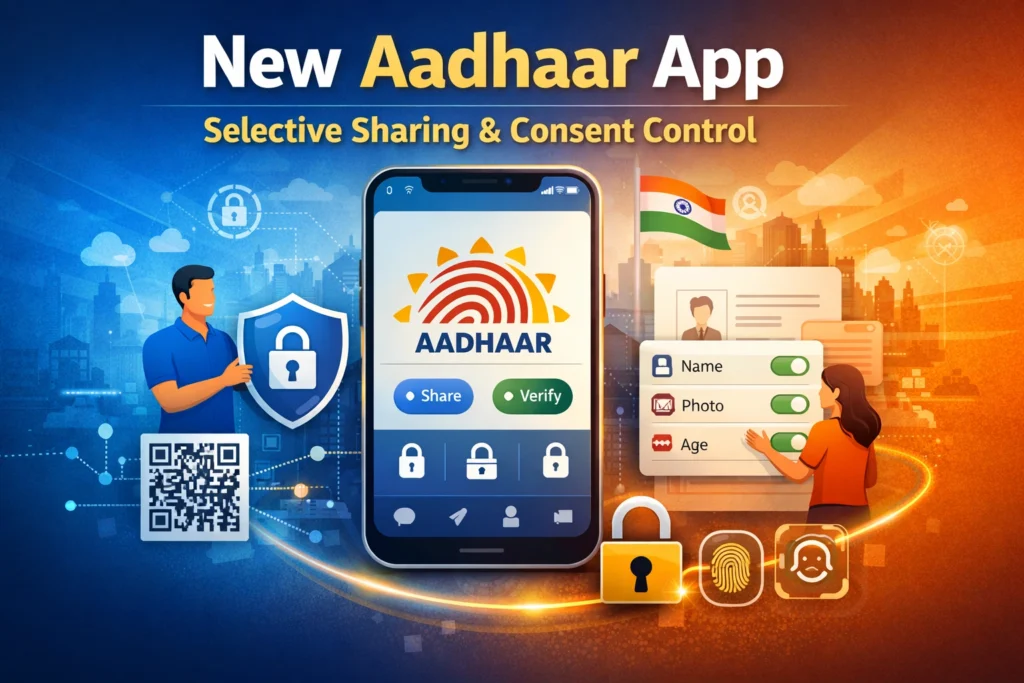
For years, Aadhaar verification often required sharing full Aadhaar numbers or photocopies, increasing the risk of misuse and unnecessary exposure of sensitive personal data. The new Aadhaar App fundamentally changes this model by introducing selective sharing and explicit consent.
Instead of oversharing identity details, users now disclose only what is required, only when required, and only after approval.
This marks a clear shift from system-controlled identity to citizen-controlled identity.
Core Objective: Citizen Control and Trust
The guiding philosophy of the new Aadhaar App is simple and powerful:
- Citizens own their data
- Consent is mandatory
- Privacy is built into the system
- Identity verification must be minimal, secure, and transparent
The app aligns with India’s broader digital public infrastructure vision, where technology enhances trust rather than eroding it.
Key Features of the New Aadhaar App
1. Selective Sharing of Aadhaar Details
Users can now choose exactly which details to share, such as:
- Name
- Photograph
- Age or year of birth
- Address
The full Aadhaar number is never shared with the verifying entity. This drastically reduces the risk of identity fraud and data leakage.
2. Real-Time Consent Control
Every identity request requires explicit user consent. Before sharing any information, the app clearly displays:
- Who is requesting the data
- What information will be shared
- The purpose of sharing
Nothing is shared automatically. The user remains in full control at all times.
3. Show, Share, and Verify Digitally
The app allows instant digital verification using QR-based credentials. This eliminates the need for physical Aadhaar cards in situations such as:
- Hotel check-ins
- Airport identity verification
- Banking and financial services
- Telecom verification
- Hospital registrations
Both online and offline verification are supported, ensuring usability even without internet access.
4. Family Aadhaar Management
A single device can securely manage up to five Aadhaar profiles, making it convenient for families to handle identity needs for children, elderly parents, or dependents.
5. Advanced Security Features
The app includes multiple security layers, such as:
- One-tap biometric lock and unlock
- Face authentication options
- Authentication history tracking
- Secure QR-based Aadhaar sharing
These features ensure that identity access is both traceable and protected.
6. In-App Updates for Aadhaar Details
Users can update important Aadhaar information directly through the app, including:
- Mobile number
- Address
This significantly reduces dependency on physical Aadhaar centers and paperwork.
Privacy by Design: Data Minimisation at the Core
One of the most important aspects of the new Aadhaar App is its strict adherence to data minimisation principles.
- Only essential information is shared
- Aadhaar numbers are never stored by verifiers
- Each verification uses a unique, digitally signed QR credential
- Data sharing complies with India’s digital data protection framework
This approach ensures privacy without compromising usability.
Impact on Daily Life
The new Aadhaar App simplifies identity verification across everyday activities:
- No need to carry physical Aadhaar copies
- Faster verification and reduced waiting time
- Lower risk of identity misuse
- Better user awareness and transparency
- Seamless integration with digital services
For citizens, this means less friction, more safety, and greater confidence in digital identity systems.
Strengthening India’s Digital Infrastructure
The app fits seamlessly into India’s broader digital ecosystem, complementing platforms such as digital payments, document storage, and online governance services.
Together, these systems form a robust foundation where identity, services, and security work in harmony — reinforcing India’s leadership in scalable digital public infrastructure.
Conclusion
The new Aadhaar App is not just an upgrade — it is a redefinition of digital identity in India. By placing consent, privacy, and user control at the center, the government has set a strong precedent for responsible identity management.
As digital interactions become more frequent and essential, this app ensures that citizens remain empowered, protected, and in control of their most important personal data.
India’s digital identity ecosystem has officially entered a smarter, safer, and more citizen-first era.