|
Getting your Trinity Audio player ready...
|
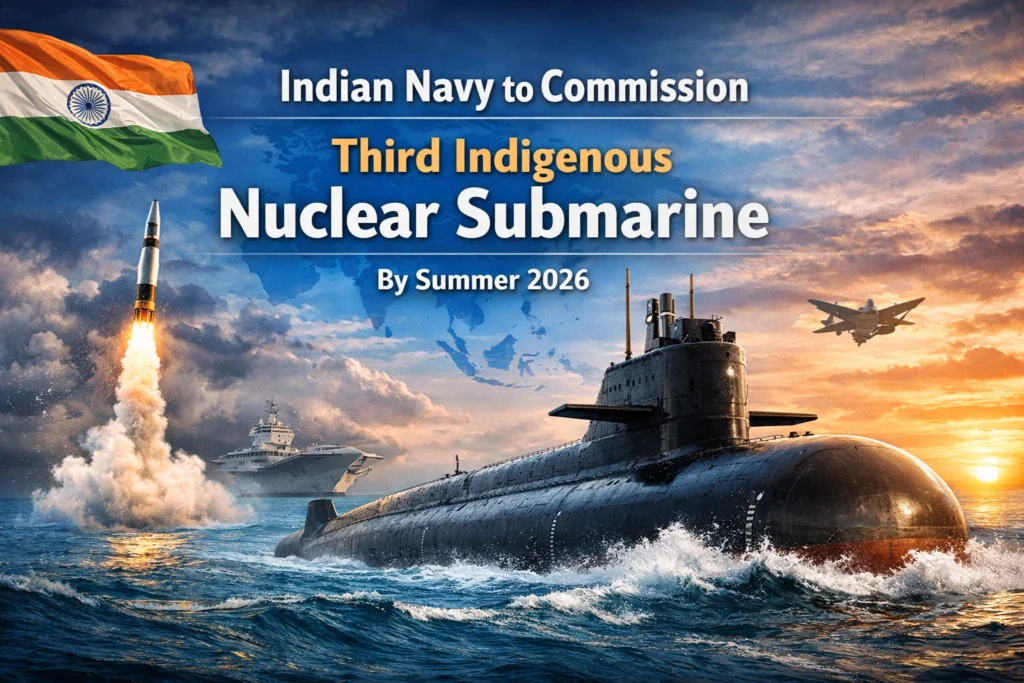
India is preparing to commission its third indigenous nuclear-powered ballistic missile submarine, INS Aridhaman (S4), by the summer of 2026. The Indian Navy has already completed extensive sea trials and is now moving toward operational induction. This step will significantly strengthen India’s sea-based nuclear deterrence and enhance its strategic maritime dominance in the Indo-Pacific region.
India continues to accelerate its naval modernization, and the induction of INS Aridhaman marks a decisive phase in this journey. Not only does the submarine showcase indigenous defense capabilities, but it also reinforces India’s long-term strategic deterrence framework. As global naval competition intensifies, India is steadily building a stronger and more resilient underwater force.
What is INS Aridhaman
INS Aridhaman is an indigenous nuclear-powered ballistic missile submarine developed under the Advanced Technology Vessel programme. Engineers and defence scientists built this submarine at the Ship Building Centre in Visakhapatnam using largely domestic technology and expertise. As a result, the platform reflects India’s growing technological independence in high-end defence manufacturing.
Unlike conventional submarines, INS Aridhaman uses nuclear propulsion, which allows it to remain submerged for months without surfacing. Consequently, the submarine can operate undetected for extended durations, making it ideal for strategic deterrence missions where stealth is critical.
Key Specifications and Capabilities
INS Aridhaman will displace around 7,000 tonnes and operate with nuclear propulsion that ensures long underwater endurance. Moreover, the submarine will carry advanced submarine-launched ballistic missiles such as the K-15 Sagarika and the longer-range K-4 missile. These missiles provide India with the ability to strike strategic targets while staying hidden deep underwater.
In addition, the submarine incorporates improved stealth features, advanced sonar systems, and enhanced survivability mechanisms. Therefore, it can effectively operate in high-threat maritime environments while reducing the risk of detection by adversaries.
Strengthening India’s Nuclear Triad
India follows a nuclear doctrine based on a triad that includes land-based missiles, air-delivered weapons, and sea-based deterrence systems. Among these, the sea-based leg offers the highest survivability because submarines remain concealed in deep ocean waters. Consequently, they ensure a credible second-strike capability even after a potential nuclear attack.
With the commissioning of INS Aridhaman, India will operate three ballistic missile submarines. As a result, the Navy will move closer to achieving continuous at-sea deterrence, where at least one submarine remains on patrol at all times. This capability strengthens deterrence credibility and reinforces India’s strategic stability.
Indigenous Defense Manufacturing Milestone
INS Aridhaman represents a major milestone in India’s defence self-reliance mission. Designers, engineers, and defence agencies collaborated to develop this complex nuclear platform domestically. Therefore, the submarine demonstrates India’s ability to produce advanced naval systems without heavy reliance on foreign technology.
Furthermore, the Advanced Technology Vessel programme has created a strong ecosystem for nuclear propulsion systems, underwater weapons, and submarine design expertise. As a result, India is steadily building a sustainable indigenous defence manufacturing base capable of delivering future-generation naval platforms.
Strategic Importance in the Indo-Pacific Region
The Indo-Pacific region is witnessing rapid naval expansion and growing maritime competition. Consequently, underwater dominance has become a critical factor in maintaining strategic balance. Nuclear-powered submarines like INS Aridhaman allow India to conduct long-duration stealth patrols and maintain a constant deterrent presence across vast oceanic areas.
Additionally, the submarine enhances India’s capability to monitor key maritime zones, protect sea lines of communication, and respond effectively to emerging regional threats. Therefore, the induction of this platform significantly strengthens India’s influence in the Indo-Pacific security architecture.
Arihant-Class Fleet Overview
The Arihant-class submarines form the backbone of India’s sea-based nuclear deterrence force. INS Arihant, the first indigenous SSBN, marked India’s entry into the elite group of nations operating nuclear-powered ballistic missile submarines. Subsequently, INS Arighaat expanded this capability and improved operational readiness.
Now, INS Aridhaman will become the third addition to this fleet. As a result, India will establish a more robust and survivable underwater nuclear deterrent that ensures long-term strategic security.
Future Implications for India’s Naval Strategy
The induction of INS Aridhaman signals a broader shift in India’s future naval strategy. With three SSBNs, the Navy can rotate patrol cycles more effectively and maintain continuous deployment of strategic assets. Consequently, adversaries will find it far more difficult to predict or neutralise India’s sea-based nuclear deterrent.
Moreover, the success of the Arihant-class programme will encourage the development of next-generation nuclear submarines with greater range, improved stealth, and larger missile payload capacity. Therefore, India is laying the foundation for a powerful and technologically Forward: correct phrasing below.
Moreover, the success of the Arihant-class programme will encourage the development of next-generation nuclear submarines with greater range, improved stealth, and larger missile payload capacity. Therefore, India is laying the foundation for a powerful and technologically advanced underwater fleet.
Conclusion
The commissioning of INS Aridhaman by summer 2026 will mark a defining moment in India’s defence evolution. It will strengthen the sea-based leg of the nuclear triad, accelerate indigenous defence manufacturing, and enhance India’s strategic reach across the Indo-Pacific.
Ultimately, this development will transform India into a more resilient and technologically advanced naval power capable of maintaining credible deterrence beneath the oceans. As maritime competition intensifies, platforms like INS Aridhaman will play a decisive role in securing India’s national interests and ensuring long-term strategic stability.