|
Getting your Trinity Audio player ready...
|
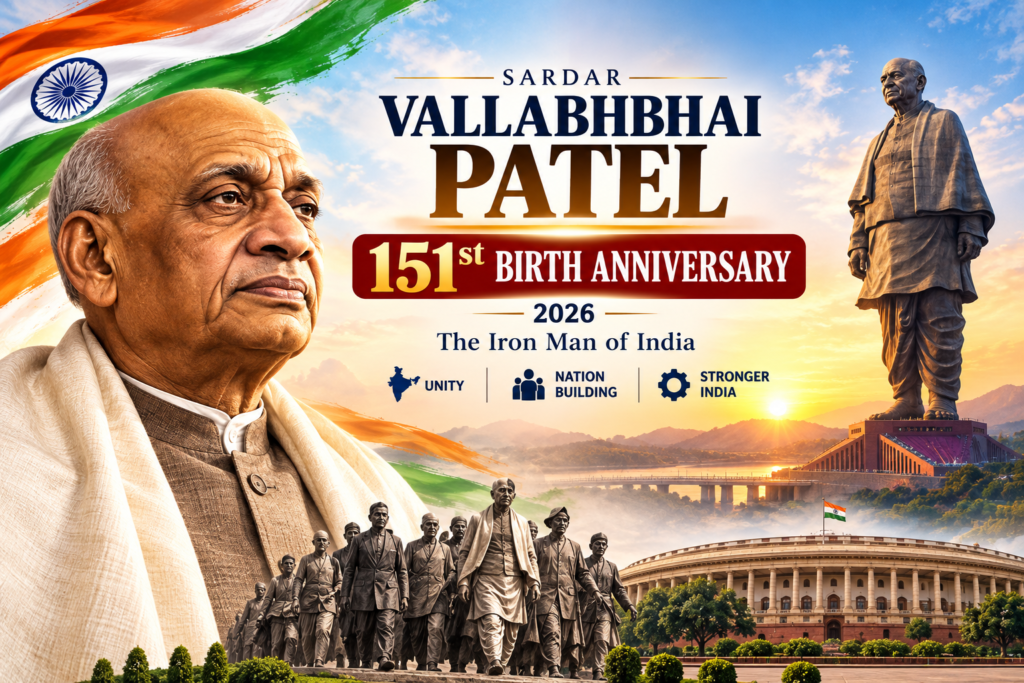
India celebrates the 151st birth anniversary of Sardar Vallabhbhai Patel on 31 October 2026, remembering one of the most influential leaders in the country’s freedom struggle and the making of modern India. Popularly known as the Iron Man of India, Sardar Patel played a historic role in bringing hundreds of princely states together to form a united nation after Independence.
His leadership, determination, administrative skills and commitment to national integration made him an important figure in Indian history. From organising farmers against unfair British policies to becoming India’s first Deputy Prime Minister and Home Minister, his journey reflects a life dedicated to public service and nation-building.
Sardar Vallabhbhai Patel’s birth anniversary is also observed as Rashtriya Ekta Diwas, or National Unity Day. The occasion reminds citizens of the importance of national unity, integrity, cooperation and respect for India’s diversity.
As India marks his 151st birth anniversary, it is an opportunity to revisit his life, achievements, contribution to independence and the legacy that continues to shape the country.
Who Was Sardar Vallabhbhai Patel?
Sardar Vallabhbhai Patel was an Indian freedom fighter, senior political leader and statesman who played a major role in India’s independence movement and the integration of princely states after 1947.
He was born on 31 October 1875 in Nadiad, Gujarat. He later became a successful lawyer before joining the national movement under the influence of Mahatma Gandhi. His organisational abilities and leadership became particularly visible during farmers’ movements in Gujarat, including the Kheda Satyagraha and Bardoli Satyagraha.
After India became independent in 1947, Patel became the country’s first Deputy Prime Minister and Home Minister. He was given the responsibility of handling the integration of princely states into the Indian Union, a complicated task that required diplomacy, negotiation and firm administrative decisions.
His contribution to national integration earned him the title of the Iron Man of India. He passed away on 15 December 1950, but his role in shaping independent India remains an important part of the country’s history.
Early Life and Education of Sardar Vallabhbhai Patel
Vallabhbhai Jhaverbhai Patel was born into an agricultural family in Gujarat. His early life was connected with the villages of the Kheda region, where he experienced the challenges faced by ordinary farming families.
He completed his early education in Gujarat and later pursued a career in law. Despite financial and personal challenges, he remained determined to build a professional career. He initially practised law in Gujarat before travelling to England to study further.
Patel qualified as a barrister and returned to India, where he established a successful legal practice. His career as a lawyer helped him develop skills in reasoning, negotiation and understanding complex disputes.
Although he had built a promising professional life, his priorities gradually changed as India’s freedom movement gained momentum. Inspired by Mahatma Gandhi and the growing national struggle, Patel moved away from his legal career and devoted himself to public service and the fight against British rule.
Sardar Patel’s Role in India’s Freedom Struggle
Sardar Vallabhbhai Patel became one of the important organisers of India’s freedom movement. Rather than limiting his work to political speeches, he focused on bringing people together, organising local movements and building public participation.
His ability to communicate with farmers and understand their difficulties made him an effective leader of mass movements. He believed that people could challenge unfair policies through collective action, discipline and organised non-violent resistance.
Patel worked closely with Mahatma Gandhi and other national leaders. He participated in important phases of the independence movement, including the wider campaigns against British rule. His organisational contribution became particularly significant in Gujarat, where he helped mobilise farmers and local communities.
His work during the Kheda and Bardoli movements established his reputation as a determined leader who could organise people around a common cause.
Kheda Satyagraha: A Major Turning Point in His Life
The Kheda Satyagraha of 1918 was one of the important events that brought Vallabhbhai Patel closer to the national freedom movement.
Farmers in the Kheda district of Gujarat were facing difficult conditions because of crop failure and financial hardship. Despite the agricultural crisis, the British administration continued to demand land revenue from farmers.
Under Mahatma Gandhi’s leadership, a movement developed demanding relief from revenue collection. Vallabhbhai Patel played a major organisational role in mobilising farmers and coordinating the campaign.
The movement encouraged farmers to remain united and peacefully resist the demand for revenue under the difficult circumstances. It became an important example of collective action against an unfair policy.
The Kheda Satyagraha helped establish Patel as a capable organiser and strengthened his connection with rural communities. It also marked an important stage in his transformation from a successful lawyer into a full-time public leader.
Bardoli Satyagraha and How Patel Earned the Title Sardar
The Bardoli Satyagraha of 1928 became one of the most significant chapters in Sardar Vallabhbhai Patel’s political journey.
Farmers in Bardoli taluka of Gujarat opposed an increase in land revenue assessment announced by the British government. Many cultivators believed the increase was unjustified, particularly given the economic difficulties they were experiencing.
Patel took charge of organising the movement. He helped farmers coordinate their response, maintain discipline and remain united during the protest. The campaign relied on collective non-payment of the increased revenue and peaceful resistance.
The movement attracted attention across India. After sustained pressure and negotiations, the British administration agreed to an inquiry into the revenue assessment and postponed collection of the increased amount.
Patel’s leadership during the campaign earned him the title “Sardar”, meaning leader or chief. The title became closely associated with his identity and is how millions of Indians remember him today.
The Bardoli movement also demonstrated that organised public participation could challenge administrative decisions and bring attention to the difficulties faced by ordinary citizens.
Sardar Vallabhbhai Patel’s Contribution to India’s Independence
Patel continued to play an important role in the national movement as the struggle for independence progressed. He worked within the Indian National Congress and contributed to the organisation and coordination of political activities.
He participated in the wider struggle against British rule, including the Civil Disobedience Movement and the Quit India Movement. His leadership and organisational experience made him an important member of the national leadership.
The freedom movement involved leaders with different responsibilities and approaches. While some focused on political negotiations and public mobilisation, Patel was particularly known for his administrative abilities, organisational discipline and capacity to bring people together.
When India achieved independence on 15 August 1947, Patel took on an even greater responsibility: helping the newly independent country remain united.
Integration of More Than 560 Princely States: Patel’s Historic Contribution
One of Sardar Vallabhbhai Patel’s most important contributions came immediately after India’s independence.
At the time of Independence, the Indian subcontinent included British-administered territories and hundreds of princely states. These princely states were ruled by different kings, nawabs and other rulers. Under the arrangements accompanying the end of British rule, their political future had to be settled.
This created a serious challenge for the new Indian government. If the princely states remained separate or chose different political arrangements, the country could face fragmentation and administrative difficulties.
As India’s first Home Minister, Patel took responsibility for the integration of these states. Working closely with V. P. Menon and the States Department, he used negotiations, persuasion and administrative measures to encourage rulers to join the Indian Union.
More than 560 princely states eventually became part of the Indian Union through this process. The integration was not a simple administrative exercise. It involved complicated political negotiations, regional concerns and difficult decisions.
Several states required particular attention. Junagadh, for example, became a major issue because its ruler announced accession to Pakistan despite the geographical and demographic circumstances. The matter was eventually resolved through political and administrative developments, including a referendum.
Hyderabad also presented a major challenge. Its ruler initially resisted joining India, and the situation was resolved in September 1948 through the Indian government’s military-police operation known as Operation Polo.
Patel’s role in bringing the princely states into the Indian Union helped establish the territorial and administrative foundations of modern India. This achievement is one of the main reasons he is remembered as the Iron Man of India and the Unifier of India.
Why Is Sardar Vallabhbhai Patel Called the Iron Man of India?
Sardar Vallabhbhai Patel earned the title Iron Man of India because of his firm leadership, determination and role in national integration.
His approach to difficult political situations was marked by practical decision-making and strong organisational abilities. He could negotiate with different groups while remaining focused on the larger objective of building a united country.
The integration of princely states required patience, diplomacy and the ability to make difficult decisions. Patel’s leadership during this period became a defining part of his legacy.
His title does not refer simply to personal toughness. It reflects his reputation for determination and his contribution to maintaining India’s unity during a challenging period immediately after Independence.
Today, the title continues to be associated with national unity, administrative strength and commitment to public service.
Sardar Patel as India’s First Deputy Prime Minister and Home Minister
After Independence in 1947, Sardar Vallabhbhai Patel became India’s first Deputy Prime Minister and first Home Minister.
The responsibilities of the Home Ministry were especially important because the country was dealing with the consequences of Partition, communal violence, refugee movements and the integration of princely states.
Patel played a major role in restoring administrative order and addressing the challenges faced by the new government. He also contributed to strengthening India’s administrative structure during the early years of independence.
He supported the development and continuation of an organised civil services system that could help maintain administrative stability across the country. His contribution to strengthening the All India Services remains an important part of his administrative legacy.
His years in government were relatively short, but they came during one of the most challenging periods in India’s history.
Sardar Vallabhbhai Patel and His Connection With Gujarat
Gujarat holds a special place in the life and legacy of Sardar Vallabhbhai Patel.
Born in Nadiad, he grew up in the region and built much of his early public life around the people of Gujarat. His leadership during the Kheda and Bardoli movements connected him closely with farmers and rural communities.
His contribution is remembered across Gujarat through educational institutions, public programmes, memorials and historical locations associated with his life.
The most prominent monument dedicated to him is the Statue of Unity, located near Ekta Nagar in Gujarat’s Narmada district. Standing approximately 182 metres tall, it is recognised as the world’s tallest statue.
The monument was inaugurated on 31 October 2018, marking Patel’s birth anniversary. It has become a major attraction for visitors and a prominent symbol associated with his contribution to India’s unity.
For Gujarat, Sardar Patel remains an important historical figure whose journey from the region to national leadership continues to inspire people.
Statue of Unity: A Monument Dedicated to Sardar Patel
The Statue of Unity is one of India’s most recognised landmarks and a major tribute to Sardar Vallabhbhai Patel.
Located near the Sardar Sarovar Dam in Gujarat, the statue stands on the banks of the Narmada River. At approximately 182 metres, it is the tallest statue in the world.
The monument was inaugurated on 31 October 2018. Its height and location make it visible from a considerable distance, while the surrounding area has been developed as a major tourism destination.
Visitors can explore the statue complex, exhibition spaces and viewing facilities, along with other attractions in Ekta Nagar. The location also offers opportunities to learn about Patel’s life and the integration of India.
The Statue of Unity is more than a tourist attraction. It represents the contribution of a leader whose work helped bring hundreds of princely states together into one country.
What Is Rashtriya Ekta Diwas and Why Is It Celebrated on 31 October?
Rashtriya Ekta Diwas, also known as National Unity Day, is observed every year on 31 October to commemorate the birth anniversary of Sardar Vallabhbhai Patel.
The Government of India introduced the observance in 2014 to recognise Patel’s contribution to national integration and remind citizens of the importance of unity and national integrity.
The day carries particular importance because India is a country of different languages, religions, cultures, traditions and regional identities. National unity does not require people to give up their differences. Instead, it encourages citizens to respect diversity while sharing a commitment to the country.
Rashtriya Ekta Diwas highlights the values of cooperation, harmony, solidarity and collective responsibility. It also encourages people to remember the historical efforts that helped establish a united India after Independence.
How Is National Unity Day Celebrated Across India?
National Unity Day is observed through events organised by government departments, educational institutions, police forces, community organisations and other groups.
One of the most recognised activities is the Run for Unity. People participate in organised runs and walks to promote the message of national unity and public participation.
Schools and colleges conduct speeches, essay competitions, debates, cultural programmes and activities focused on Sardar Patel’s life. These programmes help younger generations understand his contribution to India’s freedom movement and national integration.
Government institutions also organise the Rashtriya Ekta Diwas pledge, encouraging citizens to uphold the unity, integrity and security of the country.
At Ekta Nagar in Gujarat, national-level celebrations have included ceremonial parades, cultural performances and tributes to Sardar Patel.
The purpose of these activities is to make national unity a shared responsibility rather than limiting the occasion to a formal anniversary celebration.
Sardar Vallabhbhai Patel’s Legacy for Today’s Generation
Sardar Patel’s life offers several lessons that remain relevant for modern India.
His first important lesson is the value of unity. The integration of princely states demonstrated the importance of working towards a shared national objective even when political interests and regional differences create challenges.
His second lesson is leadership through action. Patel was not only a political speaker but also an organiser who worked directly with farmers, communities and public institutions.
His third lesson is the importance of administrative responsibility. As Home Minister, he dealt with some of the most difficult challenges faced by the newly independent country. His contribution highlights how strong institutions and effective administration are important for national development.
His fourth lesson is determination. From his early legal career to the Bardoli Satyagraha and the integration of princely states, Patel’s journey shows the importance of staying focused on long-term objectives.
For young Indians, his life is a reminder that nation-building requires more than individual achievement. It also requires cooperation, responsibility and respect for the country’s diverse communities.
Sardar Vallabhbhai Patel: Death and Recognition
Sardar Vallabhbhai Patel passed away on 15 December 1950 in Bombay, now Mumbai. His death came only a few years after India achieved independence.
His contribution to the freedom movement, national integration and administrative development continued to be remembered after his death.
In 1991, he was posthumously awarded the Bharat Ratna, India’s highest civilian honour. The recognition reflected his significant contribution to the country’s history.
The Statue of Unity, inaugurated in 2018, is another major tribute to his legacy. His birth anniversary is observed as Rashtriya Ekta Diwas every year, ensuring that his contribution remains part of the country’s public memory.
Conclusion
Sardar Vallabhbhai Patel’s 151st birth anniversary is an occasion to remember a leader whose contribution helped shape modern India. From organising farmers during the freedom struggle to integrating more than 560 princely states after Independence, his journey reflects determination, leadership and commitment to national unity.
Known as the Iron Man of India, Patel played a major role in building the foundations of a united and independent nation. His work as the first Deputy Prime Minister and Home Minister also helped strengthen India’s early administrative structure.
As the country observes Rashtriya Ekta Diwas on 31 October 2026, his legacy reminds every citizen that India’s strength lies in unity, cooperation and respect for diversity.
Remembering Sardar Vallabhbhai Patel is not only about celebrating his achievements. It is also about carrying forward the values of national integrity, public service and collective responsibility that shaped his life.
FAQs
When is Sardar Vallabhbhai Patel’s 151st birth anniversary?
Sardar Vallabhbhai Patel’s 151st birth anniversary will be observed on 31 October 2026. He was born on 31 October 1875.
Why is Sardar Vallabhbhai Patel called the Iron Man of India?
He is known as the Iron Man of India because of his firm leadership, determination and major role in integrating more than 560 princely states into the Indian Union after Independence.
What is Rashtriya Ekta Diwas?
Rashtriya Ekta Diwas, or National Unity Day, is observed on 31 October every year to mark Sardar Vallabhbhai Patel’s birth anniversary and recognise his contribution to India’s unity and integrity.
What was Sardar Patel’s role in the integration of princely states?
As India’s first Home Minister, Patel led the process of bringing more than 560 princely states into the Indian Union through negotiations, persuasion and administrative measures. V. P. Menon was a key collaborator in this process.
Where was Sardar Vallabhbhai Patel born?
Sardar Vallabhbhai Patel was born in Nadiad, Gujarat, on 31 October 1875.
Where is the Statue of Unity located?
The Statue of Unity is located near Ekta Nagar in Gujarat’s Narmada district, close to the Sardar Sarovar Dam. It is approximately 182 metres tall.
When did Sardar Vallabhbhai Patel die?
Sardar Vallabhbhai Patel passed away on 15 December 1950 in Bombay, now known as Mumbai.
Which award was given to Sardar Vallabhbhai Patel after his death?
He was posthumously awarded the Bharat Ratna in 1991 in recognition of his contribution to India’s freedom struggle and nation-building.