|
Getting your Trinity Audio player ready...
|
Electronic Voting Machines, commonly known as EVMs, play an important role in India’s election process. They are used in Lok Sabha elections, state assembly elections and other elections conducted under the supervision of the Election Commission of India.
However, EVMs have also become a subject of public discussion and political debate. Questions about electronic voting, possible hacking, vote manipulation, transparency and the reliability of election results regularly appear in news reports and online searches.
One of the most common questions is: Can EVMs be hacked in India?
Another important question is whether India should continue using electronic voting machines or return to the traditional ballot-paper voting system.
To understand this debate, it is necessary to examine how Indian EVMs work, what security measures are used, what VVPAT does, how ballot-paper elections were conducted and what the Supreme Court has said about EVM-related concerns.
This article explains the differences between EVMs and ballot papers, the possibility of hacking, the security procedures followed during elections and the arguments for and against both voting methods.
What Is an EVM in India?
An Electronic Voting Machine is an electronic device used to record votes during elections. Instead of marking a paper ballot and placing it inside a ballot box, voters use a button on the machine to select their preferred candidate.
The Election Commission of India uses a system consisting of three main components:
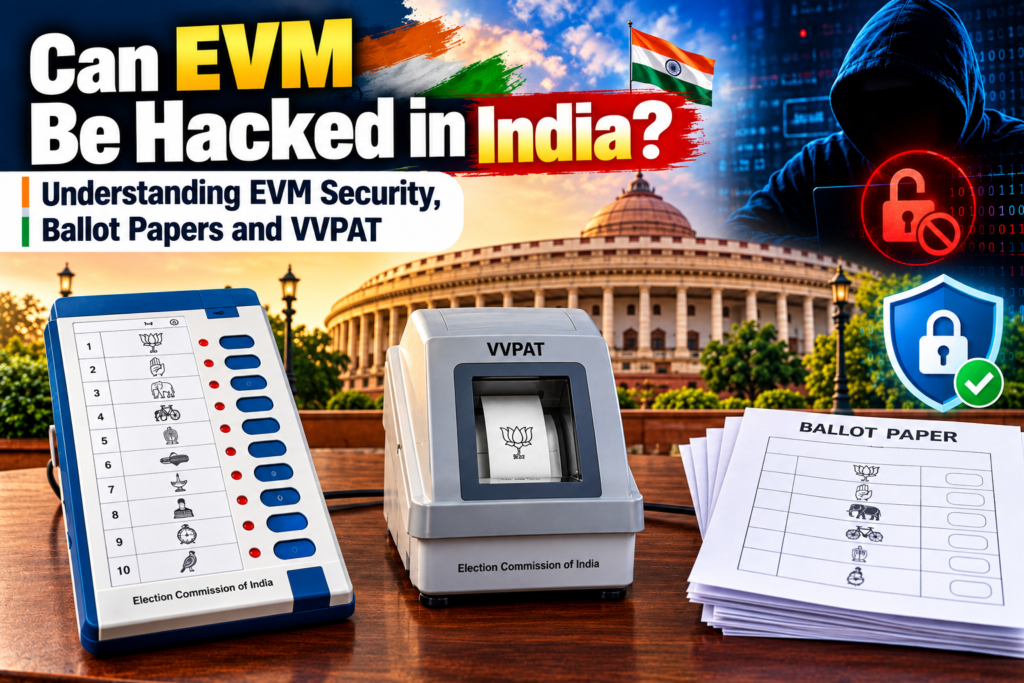
Ballot Unit (BU): This is the unit placed inside the voting compartment. It displays the candidates’ names and election symbols. Voters press the button beside their preferred candidate.
Control Unit (CU): This unit is operated by the polling officer. It controls the voting process and stores the electronic votes recorded through the Ballot Unit.
Voter Verifiable Paper Audit Trail (VVPAT): This unit prints a paper slip showing the candidate’s serial number, name and symbol. The voter can briefly see the slip through a transparent window before it drops into a sealed collection compartment.
The purpose of this arrangement is to record votes electronically while providing a paper-based verification mechanism.
Can EVM Be Hacked in India?
The question of whether Indian EVMs can be hacked requires a careful explanation.
According to the Election Commission of India, its EVMs are standalone machines and are not connected to the internet, Wi-Fi or Bluetooth networks. The Commission also describes technical and administrative safeguards designed to prevent unauthorised access and manipulation.
The Election Commission states that the Control Unit, Ballot Unit and VVPAT authenticate one another and that the machines are designed to reject unauthorised connections. It also describes one-time-programmed microcontrollers and procedures intended to prevent unauthorised changes to the machine’s firmware.
These safeguards are important because they make Indian EVMs different from ordinary computers, smartphones or internet-connected devices.
However, it is equally important to understand that no serious security discussion should rely only on the statement that a machine has never been hacked. Security depends on the design of the device, manufacturing controls, physical custody, testing, election procedures, independent scrutiny and the ability to investigate complaints.
In its April 2024 judgment concerning EVMs and VVPATs, the Supreme Court discussed a report that had identified potential vulnerabilities but had also stated that no hacking of an EVM had been detected. The Court noted that the arguments before it were based on apprehension and suspicion rather than demonstrated evidence sufficient to establish that election results had been manipulated.
Therefore, the accurate conclusion is that the Election Commission maintains that Indian EVMs are protected against remote hacking and unauthorised manipulation, while concerns about election technology should be examined through evidence, technical scrutiny and established legal procedures.
A viral video or an unverified social media post is not, by itself, proof that an EVM used in an Indian election has been hacked.
How Does EVM Voting Work in India?
The EVM voting process involves several steps designed to control access to the machine and record each vote.
When a voter enters the polling station, election officials verify the voter’s identity and eligibility. After the verification process, the polling officer enables the Control Unit for voting.
The voter then enters the voting compartment and checks the candidates displayed on the Ballot Unit. Each candidate is identified by a name and election symbol.
The voter presses the button next to the preferred candidate. A beep from the Control Unit confirms that the vote has been registered.
Where a VVPAT unit is attached, a printed slip showing the selected candidate’s details appears behind a transparent window for a few seconds. The slip then drops into a sealed compartment.
Once the vote is recorded, the machine does not allow the same voter to cast another vote. The polling officer must enable the next vote through the Control Unit.
This process helps maintain a controlled voting sequence and reduces the possibility of multiple votes being recorded by the same voter during a single authorised voting turn.
What Is VVPAT and Why Is It Important?
VVPAT stands for Voter Verifiable Paper Audit Trail. It was introduced to provide voters with a paper-based confirmation of their electronic vote.
When a voter presses a candidate’s button on the EVM, the VVPAT machine prints a slip containing the candidate’s serial number, name and symbol. The voter can see this slip through a transparent window for a short period before it falls into a sealed box.
VVPAT is important because it adds a paper record to an electronic voting system.
Without a paper trail, voters would have to rely entirely on the electronic record stored by the machine. VVPAT provides a way to verify whether the printed candidate details match the voter’s selection and allows election authorities to conduct paper-slip counting under prescribed procedures.
The Supreme Court’s April 2024 judgment did not order a return to traditional ballot papers. It also declined to introduce a blanket requirement for counting every VVPAT slip. The Court maintained the existing verification framework and directed additional safeguards concerning the storage and verification of certain electronic components.
VVPAT therefore plays an important role in the discussion about transparency and public confidence in electronic voting.
What Is the Traditional Ballot-Paper Voting System?
Before the widespread use of EVMs, Indian elections were conducted using paper ballots.
In the traditional system, voters received a ballot paper containing the names and symbols of contesting candidates. They marked their preferred candidate using the prescribed method, folded the ballot paper and placed it inside a ballot box.
After voting ended, the ballot boxes were transported to counting centres. Election officials opened the boxes and manually counted the valid ballot papers.
The candidate who received the highest number of valid votes was declared the winner, subject to the applicable election rules.
Ballot-paper voting has an important advantage: it creates a physical paper record of every vote. The voter can see and mark the paper directly, and the counting process can be observed by authorised representatives.
However, traditional ballot-paper elections also faced practical challenges. Incorrect markings could make votes invalid, ballot papers could be damaged, and manual counting required significant time and administrative effort.
The Election Commission has identified problems such as invalid votes, ballot-box stuffing, pre-marked ballot papers and the possibility of booth capturing as concerns associated with the traditional system.
These historical concerns form part of the reason India moved towards electronic voting.
EVM vs Ballot Paper: What Is the Difference?
EVMs and ballot papers are two different methods of recording and counting votes. Both are designed to identify the choice of eligible voters, but their procedures and practical challenges differ.
| Feature | EVM Voting | Ballot-Paper Voting |
|---|---|---|
| Voting method | Voter presses a candidate’s button | Voter marks a paper ballot |
| Vote recording | Electronic record | Physical paper record |
| Counting | Electronic counting through the Control Unit | Manual counting of valid ballot papers |
| VVPAT | Available as a paper audit trail | The ballot paper itself is the record |
| Invalid votes | Avoids invalid markings caused by voters | Incorrect markings may make a ballot invalid |
| Counting time | Generally faster | Usually takes longer |
| Storage | Electronic units and VVPAT slips are secured | Ballot papers and ballot boxes are secured |
| Main concerns | Machine security, custody and verification | Ballot-box security, invalid votes and counting errors |
The comparison shows that neither system is free from practical challenges. EVMs reduce some problems associated with paper ballots, while traditional ballot papers provide a direct physical record of each vote.
Why Did India Replace Ballot Papers With EVMs?
India adopted EVMs to make the voting and counting process more efficient and to address certain problems associated with paper-ballot elections.
Large elections in India involve millions of voters and thousands of polling stations. Manually counting paper ballots across such a large electoral system can require considerable time and manpower.
EVMs help speed up counting and reduce the number of invalid votes caused by incorrect markings.
They also make it more difficult to cast large numbers of votes rapidly through booth capturing because the machine controls the rate at which votes can be registered.
The Election Commission has stated that EVMs were first used in a limited manner in 1982 and that their use expanded across Indian elections in subsequent years.
The transition was not simply about replacing paper with technology. It was also intended to improve the administration of large elections and reduce certain forms of electoral malpractice.
However, faster counting does not automatically mean greater public trust. Transparency, independent scrutiny and effective grievance procedures remain essential.
Can EVMs Be Connected to the Internet or Hacked Remotely?
One of the most common claims about EVM hacking involves the possibility of remotely changing votes through the internet, mobile networks, Wi-Fi or Bluetooth.
The Election Commission states that its EVMs are standalone devices and do not have external wired or wireless network connectivity for receiving voting instructions. This is an important distinction from computers and other devices that communicate through the internet.
According to the Commission, the machines use dedicated microcontrollers and authentication mechanisms to ensure that authorised EVM components communicate with one another.
This means that claims about remotely hacking an Indian EVM through an ordinary internet connection should not be treated as established facts.
At the same time, security discussions should not confuse remote hacking with every possible form of physical or procedural risk. The security of an election system also depends on who can access the machines, how they are transported and stored, how they are tested and how complaints are investigated.
The Election Commission describes several administrative procedures designed to control these risks.
What Security Measures Does the Election Commission Follow?
The Election Commission has outlined technical and administrative safeguards for EVMs. These procedures cover different stages of the election process.
First Level Checking: EVMs and VVPATs undergo technical inspection before being used in elections. Machines that do not meet functional requirements are rejected.
Randomisation: Machines are allocated to constituencies and polling stations through a randomisation process. This is intended to prevent advance knowledge of the exact machines that will be used at a particular polling station.
Candidate and symbol setting: Candidate details and symbols are loaded through the prescribed process after the final list of contesting candidates is available.
Mock polls: Before actual voting begins, mock polls are conducted to check whether the EVMs and VVPATs are functioning correctly. The recorded electronic votes and corresponding paper slips are checked according to election procedures.
Sealing and security: EVMs are sealed and handled under prescribed procedures. Candidates and their representatives can participate in or observe various stages as permitted by election rules.
Counting-day procedures: On counting day, the Control Units are opened and their stored results are displayed under the supervision of election officials and in the presence of authorised representatives.
These measures are intended to protect the voting process from unauthorised access and to make the handling of machines more transparent.
What Happens If an EVM Stops Working During Voting?
Like other electronic equipment, EVMs can sometimes develop technical problems.
A machine may stop responding, its display may fail or the VVPAT printer may experience a mechanical issue. Such a failure does not automatically mean that votes have been changed or manipulated.
Election officials follow prescribed procedures when an EVM or VVPAT becomes non-functional. The affected unit can be replaced with a functioning machine as authorised under election instructions.
The Election Commission states that non-functional machines are identified during checking and that defective units are not supposed to be used for polling.
The important distinction is between a technical malfunction and deliberate tampering. A machine stopping during voting is a technical issue; proving that someone intentionally changed votes requires evidence.
EVM Hacking Allegations and the Supreme Court’s 2024 Decision
EVM security has been challenged through public campaigns and legal proceedings over the years. Some petitioners have argued that electronic voting systems should have additional safeguards or that all VVPAT slips should be counted.
In April 2024, the Supreme Court of India delivered a judgment on petitions seeking changes to the EVM and VVPAT verification process.
The Court declined to return to the ballot-paper system and did not direct a universal count of all VVPAT slips. It retained the existing process under which VVPAT slips from five randomly selected polling stations in each Assembly constituency or Assembly segment are counted and matched with the electronic results.
The judgment also introduced additional safeguards concerning the storage of symbol-loading units and allowed candidates to request verification of the burnt memory or microcontroller of EVMs after the declaration of results, subject to the conditions and procedure specified by the Court.
The decision is important because it recognises the need to maintain confidence in the election process while considering the existing safeguards and available legal remedies.
It should not be misrepresented as proof that hacking is theoretically impossible. Equally, it should not be described as evidence that Indian EVMs have been hacked.
Should India Return to Ballot-Paper Voting?
The debate over returning to ballot papers is not only about technology. It is also about trust, transparency, cost, speed and election management.
Supporters of ballot-paper voting argue that a physical paper record is easier for voters to understand. They believe that manual counting can provide an additional level of public visibility and reduce dependence on electronic systems.
Supporters of EVMs argue that electronic voting makes counting faster, reduces invalid votes and helps address certain problems associated with traditional ballot-paper elections.
A return to ballot papers would also require India to manage the large-scale printing, distribution, storage, transportation and manual counting of ballot papers. These processes would need strong safeguards to prevent fraud and errors.
On the other hand, continuing with EVMs requires regular technical checks, secure custody procedures, transparent verification and effective public communication.
There is no simple answer that applies to every country or election system. The choice should be based on evidence, administrative capacity, security standards and public confidence.
The discussion should also recognise that EVMs and ballot papers are not necessarily mutually exclusive ideas. VVPAT itself combines electronic vote recording with a paper-based audit trail.
EVM vs Ballot Paper: Which Is Better for Indian Elections?
EVMs offer practical advantages in a country with India’s large electorate. They allow faster counting and reduce the problem of invalid votes caused by incorrect ballot-paper markings.
Traditional ballot papers offer a direct physical record that can be manually examined and counted. However, they also require careful control of ballot boxes and extensive manual counting procedures.
The choice between the two systems should therefore be based on measurable factors rather than political preferences alone.
These factors include the accuracy of vote recording, security of the voting process, transparency of counting, reliability of verification, cost of election administration and the ability to investigate complaints.
For public confidence, the most important requirement is that voters, candidates and political parties have access to transparent procedures and credible ways to challenge genuine irregularities.
How Can Voters Verify Their Votes and Report Election Concerns?
Voters should understand the basic role of the VVPAT slip. After pressing the selected candidate’s button, they can check the slip displayed through the transparent window to confirm that the candidate details match their choice.
If a voter believes that the VVPAT slip does not show the selected candidate, the voter should immediately inform the polling official and follow the complaint procedure explained by election authorities. Election rules provide a prescribed process for handling such claims.
Candidates and their representatives also have access to specific procedures for requesting VVPAT slip verification and, where applicable, additional technical verification after results are declared.
The important point is to use official complaint and legal procedures rather than relying only on social media posts or unverified claims.
Conclusion
The question of whether EVMs can be hacked in India requires a fact-based answer. The Election Commission states that Indian EVMs are standalone devices with technical and administrative safeguards against unauthorised access and manipulation. The Supreme Court’s 2024 judgment discussed concerns about possible vulnerabilities but noted that no hacking of an EVM had been detected in the report considered by the Court.
Traditional ballot-paper voting also has advantages and disadvantages. It provides a direct paper record, but it involves manual counting and historical concerns such as invalid votes and ballot-box security. EVMs make counting faster, while VVPAT adds a paper-based verification mechanism.
The larger issue is not simply whether India should use EVMs or ballot papers. It is whether the entire election process remains secure, transparent, independently scrutinised and open to legitimate challenges.
A strong democracy depends on voters having confidence that every valid vote is recorded accurately and counted according to the law.
FAQs
Can EVMs be hacked in India?
The Election Commission states that Indian EVMs are standalone devices without internet, Wi-Fi or Bluetooth connectivity and have technical and administrative safeguards. No detected hacking of an Indian EVM was identified in the report discussed in the Supreme Court’s April 2024 judgment. Claims of hacking should be assessed using verifiable evidence.
Are Indian EVMs connected to the internet?
According to the Election Commission of India, its EVMs are standalone machines and are not connected to the internet or external wireless networks for voting operations.
What is the difference between EVM and ballot-paper voting?
EVM voting records a voter’s choice electronically through a button, while ballot-paper voting requires the voter to mark a printed paper and place it in a ballot box. EVMs generally allow faster counting, whereas ballot papers provide a direct physical record of each vote.
What is VVPAT in Indian elections?
VVPAT stands for Voter Verifiable Paper Audit Trail. It prints a slip showing the candidate’s serial number, name and symbol after a voter presses a button on the EVM. The slip is briefly visible before dropping into a sealed compartment.
Has the Supreme Court ordered India to return to ballot-paper voting?
No. In its April 2024 judgment, the Supreme Court declined to order a return to traditional ballot-paper voting. It retained the existing EVM and VVPAT framework while directing additional verification-related safeguards.
Are ballot papers more secure than EVMs?
Both systems have different security requirements. Ballot papers require protection against invalid markings, ballot-box stuffing and counting errors. EVMs require technical safeguards, secure handling and verification procedures. Their security should be assessed through evidence and the effectiveness of the complete election process.